
Pulp Fiction, 1923 · page 157 of 178
Argosy All-Story Weekly — page 157: what you’re looking at
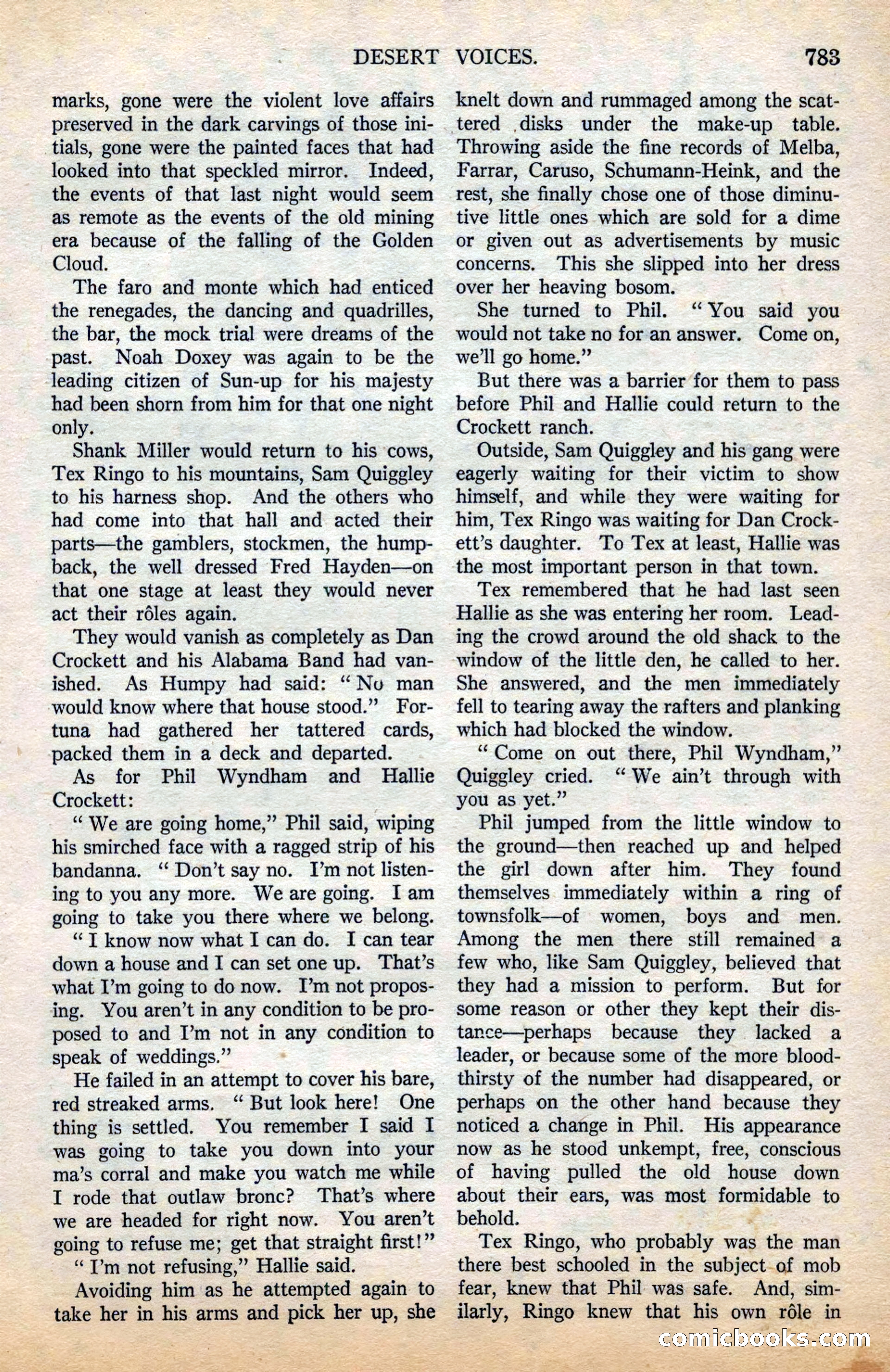
A restored page from Pulp Fiction, 1923. Page through the whole issue in the reader above.
📄 Transcribed text from this page (OCR, searchable)
Machine-transcribed from the original scan — historical spelling and the odd misread are preserved.
DESERT marks, gone were the violent love affairs preserved in the dark carvings of those ini- tials, gone were the painted faces that had looked into that speckled mirror. Indeed, the events of that last night would seem as remote as the events of the old mining era because of the falling of the Golden Cloud. The faro and monte which had enticed the renegades, the dancing and quadrilles, the bar, the mock trial were dreams of the past. Noah Doxey was again to be the leading citizen of Sun-up for his majesty had been shorn from him for that one night only. Shank Miller would return to his ‘cows, Tex Ringo to his mountains, Sam Quiggley to his harness shop. And the others who had come into that hall and acted their parts—the gamblers, stockmen, the hump- back, the well dressed Fred Hayden—on that one stage at least they would never act their roles again. They would vanish as completely as Dan Crockett and his Alabama Band had van- ished. As Humpy had said: “ Nu man would know where that house stood.” For- tuna had gathered her tattered cards, packed them in a deck and departed. As for Phil Wyndham and Hallie Crockett: “We are going home,” Phil said, wiping his smirched face with a ragged strip of his bandanna. ‘‘ Don’t say no. I’m not listen- ing to you any more. Weare going. I am going to take you there where we belong. “ TI know now what I can do. I can tear down a house and I can set one up. That’s what I’m going to do now. I’m not propos- ing. You aren’t in any condition to be pro- posed to and I’m not in any condition to speak of weddings.” He failed in an attempt to cover his bare, red streaked arms. “ But look here! One thing is settled. You remember I said I was going to take you down into your ma’s corral and make you watch me while I rode that outlaw bronc? That’s where we are headed for right now. You aren’t going to refuse me; get that straight first!” “Tm not refusing,” Hallie said. Avoiding him as he attempted again to take her in his arms and pick her up, she VOICES. 183 knelt down and rummaged among the scat- tered disks under the make-up table. Throwing aside the fine records of Melba, Farrar, Caruso, Schumann-Heink, and the rest, she finally chose one of those diminu- tive little ones which are sold for a dime or given out as advertisements by music concerns. ‘This she slipped into her dress over her heaving bosom. She turned to Phil. ‘You said you would not take no for an answer. Come on, we'll go home.” But there was a barrier for them to pass before Phil and Hallie could return to the Crockett ranch. Outside, Sam Quiggley and his gang were eagerly waiting for their victim to show himself, and while they were waiting for him, Tex Ringo was waiting for Dan Crock- ett’s daughter. To Tex at least, Hallie was the most important person in that town. Tex remembered that he had last seen Hallie as she was entering her room. Lead- ing the crowd around the old shack to the window of the little den, he called to her. She answered, and the men immediately fell to tearing away the rafters and planking which had blocked the window. ‘“‘Come on out there, Phil Wyndham,” Quiggley cried. “ We ain’t through with you as yet.” Phil jumped from the little window to the ground—then reached up and helped the girl down after him. They found themselves immediately within a ring of townsfolk—of women, boys and men. Among the men there still remained a few who, like Sam Quiggley, believed that they had a mission to perform. But for some reason or other they kept their dis- tance—perhaps because they lacked a leader, or because some of the more blood- thirsty of the number had disappeared, or perhaps on the other hand because they noticed a change in Phil. His appearance now as he stood unkempt, free, conscious of having pulled the old house down about their ears, was most a to behold. Tex Ringo, who probably was the man there best schooled in the subject.of mob fear, knew that Phil was safe. And, sim- ilarly, ae knew that his own réle in Ecomircek goo! SHO!