
Pulp Fiction, 1923 · page 143 of 178
Argosy All-Story Weekly — page 143: what you’re looking at
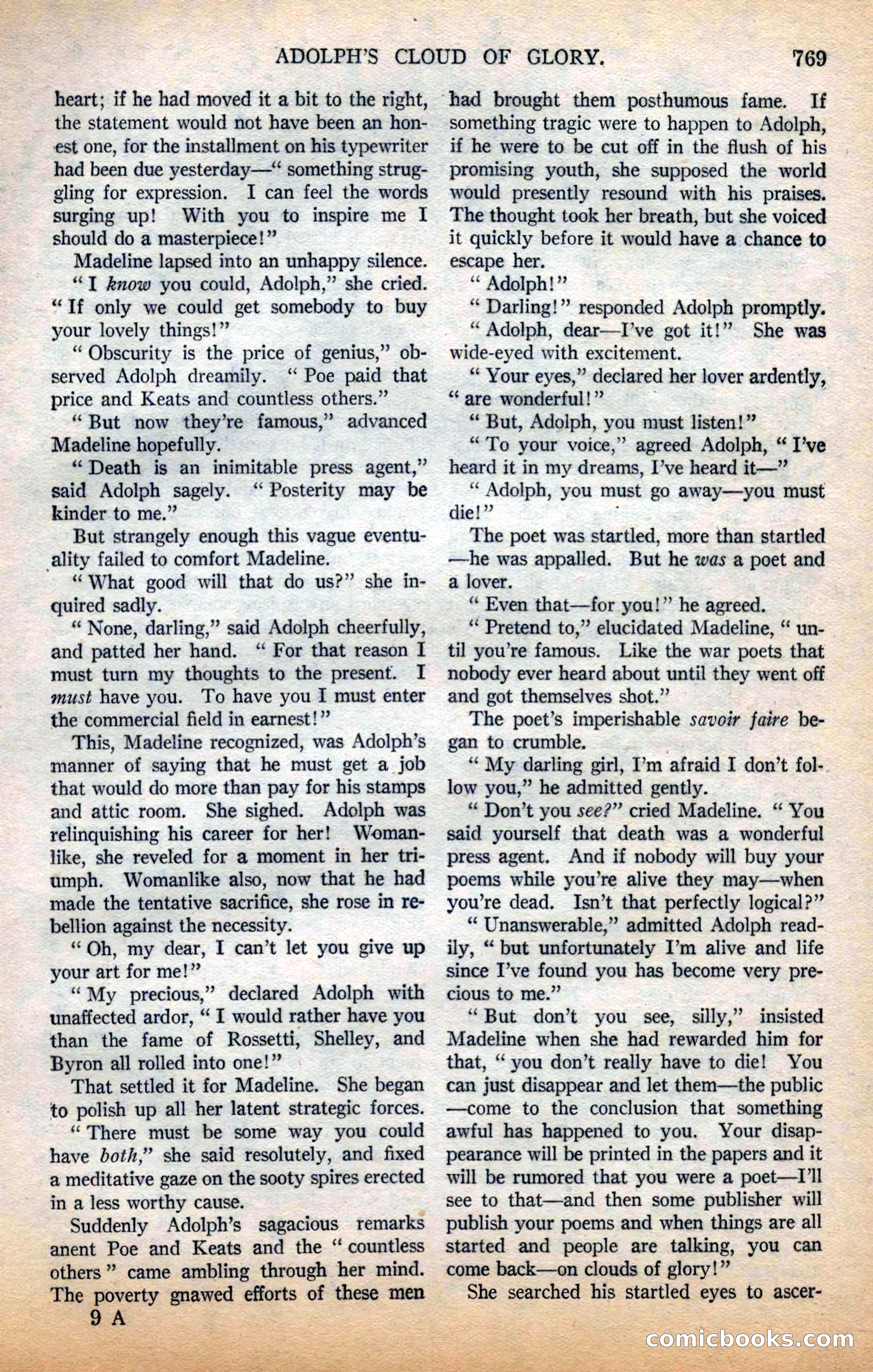
A restored page from Pulp Fiction, 1923. Page through the whole issue in the reader above.
📄 Transcribed text from this page (OCR, searchable)
Machine-transcribed from the original scan — historical spelling and the odd misread are preserved.
Se — me eS - = —, = Ea ADOLPH’S CLOUD OF GLORY. heart; if he had moved it a bit to the right, the statement would not have been an hon- est one, for the installment on his typewriter had been due yesterday—* something strug- gling for expression. I can feel the words surging up! With you to inspire me I should do a masterpiece!” Madeline lapsed into an unhappy silence. “T know you could, Adolph,” she cried. “Tf only we could get somebody to buy your lovely things!” “Obscurity is the price of genius,” ob- served Adolph dreamily. ‘ Poe paid that price and Keats and countless others.” “ But now they’re famous,” advanced Madeline hopefully. “Death is an inimitable press agent,” said Adolph sagely. ‘‘ Posterity may be kinder to me.” But strangely enough this vague eventu- ality failed to comfort Madeline. “What good will that do us?” she in- quired sadly. “ None, darling,” said Adolph cheerfully, and patted her hand. “ For that reason I must turn my thoughts to the present. I must have you. To have you I must enter the commercial field in earnest!” This, Madeline recognized, was Adolph’s manner of saying that he must get a job that would do more than pay for his stamps and attic room. She sighed. Adolph was relinquishing his career for her! Woman- like, she reveled for a moment in her tri- umph. Womanlike also, now that he had made the tentative sacrifice, she rose in re- bellion against the necessity. “Oh, my dear, I can’t let you give up your art for me!”’ “My precious,” declared Adolph with unaffected ardor, “ I would rather have you than the fame of Rossetti, Shelley, and Byron all rolled into one!” That settled it for Madeline. She began to polish up all her latent strategic forces. “ There must be some way you could have both,” she said resolutely, and fixed a meditative gaze on the sooty spires erected in a less worthy cause. Suddenly Adolph’s sagacious remarks anent Poe and Keats and the “ countless others” came ambling through her mind. _ The poverty es a des of these men = : nd —< * ” Wal — am we = , = eae oe ba _ =e A =e OS 5 a ne’ SE nw ve nS ee on ea - = ng ‘had brought them posthumous fame. 769 If something tragic were to happen to Adolph, if he were to be cut off in the flush of his promising youth, she supposed the world would presently resound with his praises. The thought took her breath, but she voiced it quickly before it would have a chance to escape her. ** Adolph!” “ Darling!” responded Adolph promptly. “ Adolph, dear—I’ve got it!” She was wide-eyed with excitement. “ Your eyes,” declared her lover ardently, “ are wonderful!” “ But, Adolph, you must listen!” “To your voice,” agreed Adolph, “ I’ve heard it in my dreams, I’ve heard it—” “* Adolph, you must go away—you must die!” The poet was startled, more than startled —he was appalled. But he was a poet and a lover. “ Even that—for you!” he agreed. ‘ Pretend to,” elucidated Madeline, “ un- | til you’re famous. Like the war poets that nobody ever heard about until they went off and got themselves shot.”’ The poet’s imperishable savoir faire be- gan to crumble. “ My darling girl, I’m afraid I don’t fol- low you,” he admitted gently. “ Don’t you see?” cried Madeline. “ You said yourself that death was a wonderful press agent. And if nobody will buy your poems while you’re alive they may—when you’re dead. Isn’t that perfectly logical?” “* Unanswerable,” admitted Adolph read- ily, “ but unfortunately I’m alive and life since I’ve found you has become very pre- cious to me.” | “But don’t you see, silly,” insisted Madeline when she had rewarded him for that, “ you don’t really have to die! You can just disappear and let them—the public —come to the conclusion that something awful has happened to you. Your disap- pearance will be printed in the papers and it will be rumored that you were a poet—I’ll see to that—and then some publisher will publish your poems and when things are all started and people are talking, you can come back—on clouds of glory!” She searched his startled aS to ascer- es