
Pulp Fiction, 1923 · page 141 of 178
Argosy All-Story Weekly — page 141: what you’re looking at
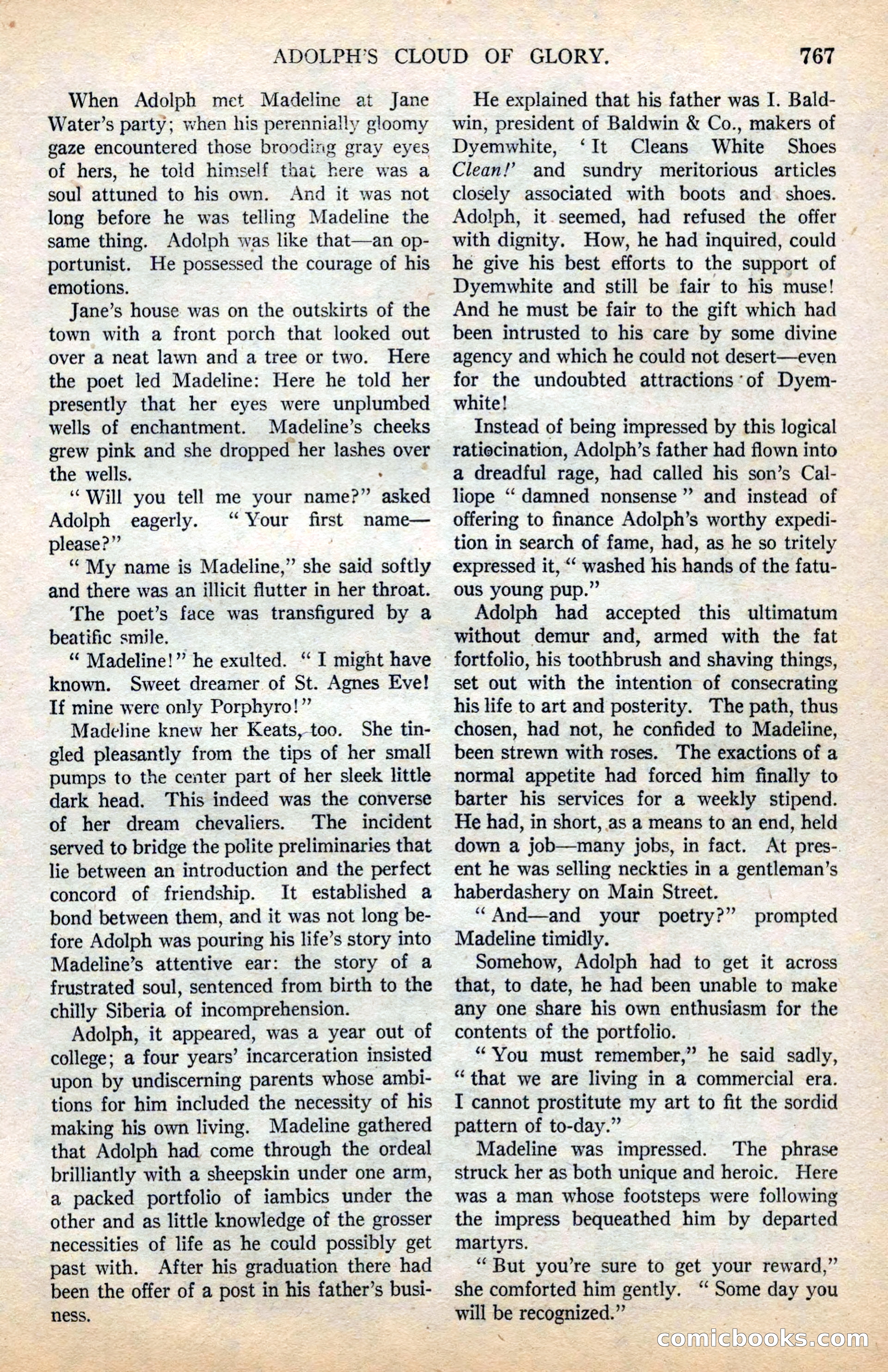
A restored page from Pulp Fiction, 1923. Page through the whole issue in the reader above.
📄 Transcribed text from this page (OCR, searchable)
Machine-transcribed from the original scan — historical spelling and the odd misread are preserved.
ADOLPH’S CLOUD OF GLORY. When Adolph met Madeline at Jane Water’s party; when his perennially gloomy gaze encountered those brooding gray eyes of hers, he told himself that here was a soul attuned to his own. And it was not long before he was telling Madeline the same thing. Adolph was like that—an op- portunist. He possessed the courage of his emotions. Jane’s house was on the outskirts of the town with a front porch that looked out over a neat lawn and a tree or two. Here the poet led Madeline: Here he told her presently that her eyes were unplumbed wells of enchantment. Madeline’s cheeks grew pink and she dropped her lashes over the wells. “Will you tell me your name?” ‘aled Adolph eagerly. “ Your first name— please?” ‘My name is Madeline,” she said softly and there was an illicit flutter in her throat. ‘The poet’s face was transfigured by a beatific smile. “ Madeline!” he exulted. “ I might have known. Sweet dreamer of St. Agnes Eve! If mine were only Porphyro!” Madeline knew her Keats, too. She tin- gled pleasantly from the tips of her small pumps to the center part of her sleek little dark head. This indeed was the converse of her dream chevaliers. The incident served to bridge the polite preliminaries that lie between an introduction and the perfect concord of friendship. It established a bond between them, and it was not long be- fore Adolph was pouring his life’s story into Madeline’s attentive ear: the story of a frustrated soul, sentenced from birth to the chilly Siberia of incomprehension. Adolph, it appeared, was a year out of college; a four years’ incarceration insisted upon by undiscerning parents whose ambi- tions for him included the necessity of his making his own living. Madeline gathered that Adolph had come through the ordeal brilliantly with a sheepskin under one arm, a packed portfolio of iambics under the other and as little knowledge of the grosser necessities of life as he could possibly get past with. After his graduation there had been the offer of a post in his father’s busi- ness. 767 He explained that his father was I. Bald- win, president of Baldwin & Co., makers of Dyemwhite, ‘It Cleans White Shoes Clean!’ and sundry meritorious articles closely associated with boots and. shoes. Adolph, it.seemed, had refused the offer with dignity. How, he had inquired, could — he give his best efforts to the support of Dyemwhite and still be fair to his muse! And he must be fair to the gift which had been intrusted to his care by some divine agency and which he could not desert—even for the undoubted attractions of Dyem- white! Instead of being impressed by this logical ratiecination, Adolph’s father had flown into a dreadful rage, had called his son’s Cal- liope “‘ damned nonsense” and instead of offering to finance Adolph’s worthy expedi- tion in search of fame, had, as he so tritely expressed it, “‘ washed his hands of the fatu- ous young pup.” Adolph had accepted this ultimatum without demur and, armed with the fat fortfolio, his toothbrush and shaving things, set out with the intention of consecrating his life to art and posterity. The path, thus chosen, had not, he confided to Madeline, been strewn with roses. The exactions of a normal appetite had forced him finally to barter his services for a weekly stipend. He had, in short, as a means to an end, held down a job—many jobs, in fact. At pres- ent he was selling neckties in a gentleman’s haberdashery on Main Street. ‘“And—and your poetry?” prompted Madeline timidly. Somehow, Adolph had to get it across that, to date, he had been unable to make any one share his own enthusiasm for the contents of the portfolio. “You must remember,” he said sadly, “that we are living in a commercial era. I cannot prostitute my art to fit the sordid pattern of to-day.” Madeline was impressed. The ‘ess struck her as both unique and heroic. Here was a man whose footsteps were following the impress bequeathed him by departed martyrs. “But you're sure to get your reward,” she comforted him gently. ‘“‘ Some day you will be recognized.” | | <e Eomichbooks;€o