
Pulp Fiction, 1923 · page 72 of 196
Argosy All-Story Weekly — page 72: what you’re looking at
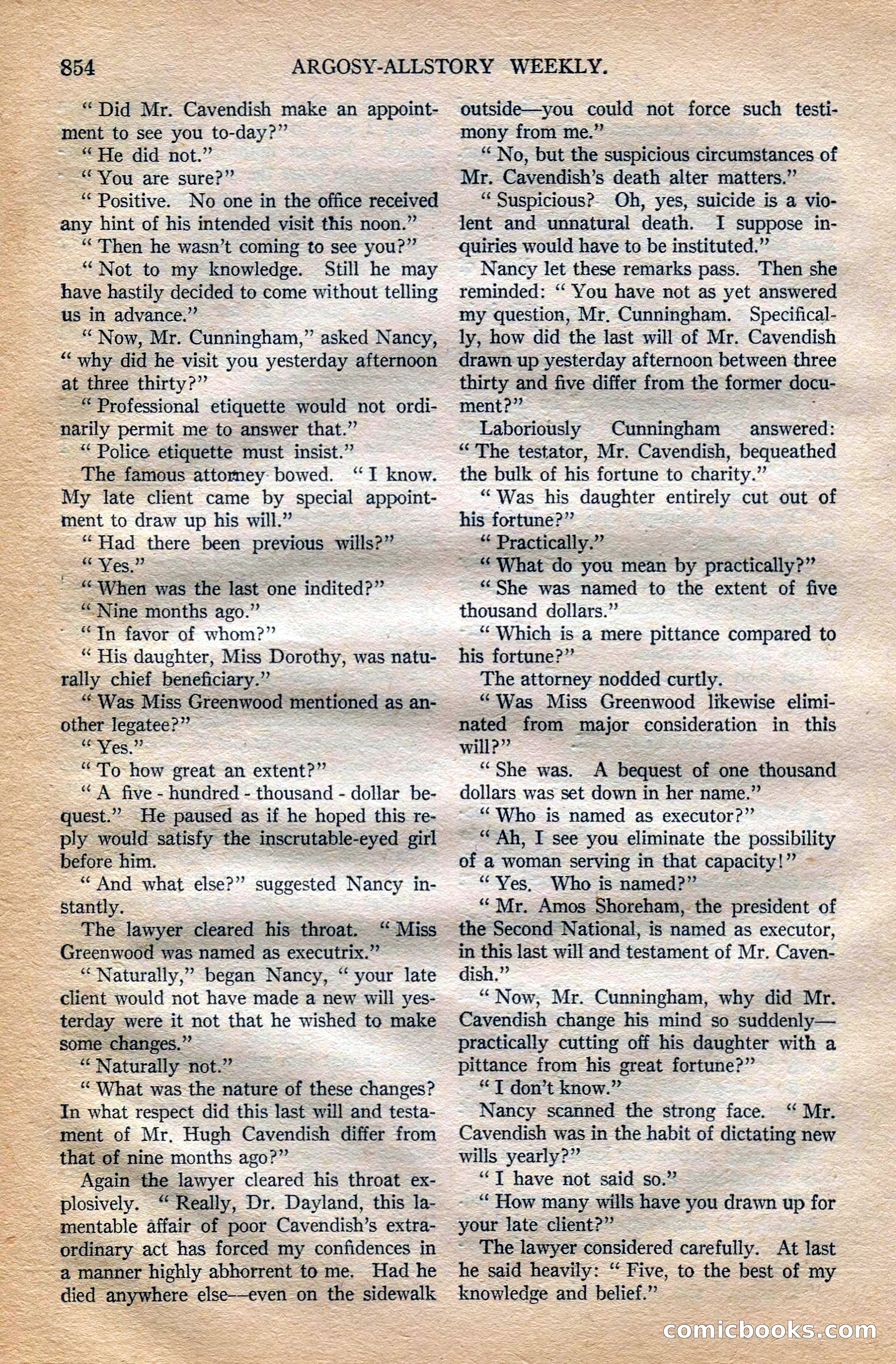
A restored page from Pulp Fiction, 1923. Page through the whole issue in the reader above.
📄 Transcribed text from this page (OCR, searchable)
Machine-transcribed from the original scan — historical spelling and the odd misread are preserved.
= ss | Pe Did Mr. Cavendish make an appoint- == “ment to see you to-day?” = He did not.” = « You are sure?” _ * Positive. No one in the office received any hint of his intended visit this noon.” “Then he wasn’t coming to see you?” “Not to my knowledge. Still he may have hastily decided to come without telling us in advance.” “Now, Mr. Cunningham,” asked Nancy, ““why did he visit you yesterday afternoon at three thirty?” ~~ Professional etiquette would not ordi- “wie has 23 ---~-narily permit me to answer that.” ~ “ Police etiquette must insist.” The famous attorney bowed. “I know. My late client came by special appoint- - ment to draw up his will.” ““Had there been previous wills?” “a = a4 Yes. b>] : = “When was the last one indited?” ~ “Nine months ago.” “Tn favor of whom?” “ His daughter, Miss Dorothy, was natu- rally chief beneficiary.” “Was Miss Greenwood mentioned as an- other legatee?” —— a tt Yes. 33 ~ “To how great an extent?” ‘A five - hundred - thousand - dollar be- : quest. ”. He paused as if he hoped this re- oa would satisfy the inscrutable- -eyed girl | ~ before ‘him. _“ And what else?” suggested Nancy in- Sian ~The lawyer cleared his throat. ‘Greenwood was named as executrix.” =a Naturally,” began Nancy, ‘“‘ your late client would not have made a new will yes- _ terday 1 were it not that he wished to make some changes.” — Naturally not.” “What was the nature of these changes? - In what respect did this last will and testa- ment. of Mr. Hugh Cavendish differ from t of nine months ago?” ~ Again” the lawyer cleared his throat ex- ~_plosively “Really, Dr. Dayland, this la- _ mentable affair of poor Cavendish’s extra- _ord inary act has forced my confidences in nee ae oe — ees ‘highly abhorrent to me. Had he ARGOSY-ALLSTORY WEEKLY. outside—you could not force such testi- mony from me.” “No, but the suspicious circumstances of Mr. Cavendish’s death alter matters.” “‘ Suspicious?- Oh, yes, suicide is a vio- lent and unnatural death. I suppose in- quiries would have to be instituted.” Nancy let these remarks pass. Then she reminded: “ You have not as yet answered my question, Mr. Cunningham. Specifical- ly, how did the last will of Mr. Cavendish drawn up yesterday afternoon between three thirty and five differ from the former docu- ment?” Laboriously Cunningham answered: “The testator, Mr. Cavendish, bequeathed the bulk of his fortune to charity.” “Was his daughter entirely cut out of his fortune?” “ Practically.” ~ “What do you mean oS practically?” “She was named to the extent of five thousand dollars.” “Which is a mere pittance compared to his fortune?” The attorney nodded curtly. “Was Miss Greenwood likewise elimi- nated from major consideration in this will??? = == “She was. A bequest of one thousand dollars was set down in her name.” “Who is named as executor?” ~ “Ah, I see you eliminate the possibility of a woman serving in that capacity!” ~ “Yes. Who is named?” ‘“‘Mr. Amos Shoreham, the president of the Second National, is named as executor, in this last will and testament of Mr. Caven- dish.” “Now; Mr. Cunningham, why did Mr. Cavendish change his mind so suddenly— practically cutting off his daughter with a pittance from his great fortune?” “T don’t know.” Nancy scanned the strong face. ‘ Mr. Cavendish was in the habit of dictating new wills yearly?” “T have not said so.” “How many wills have you drawn up for your late client?” The lawyer considered carefully. At last he said heavily: “ Five, a the best of pay knowledge =e belief. ze CO .)