
Pulp Fiction, 1923 · page 20 of 196
Argosy All-Story Weekly — page 20: what you’re looking at
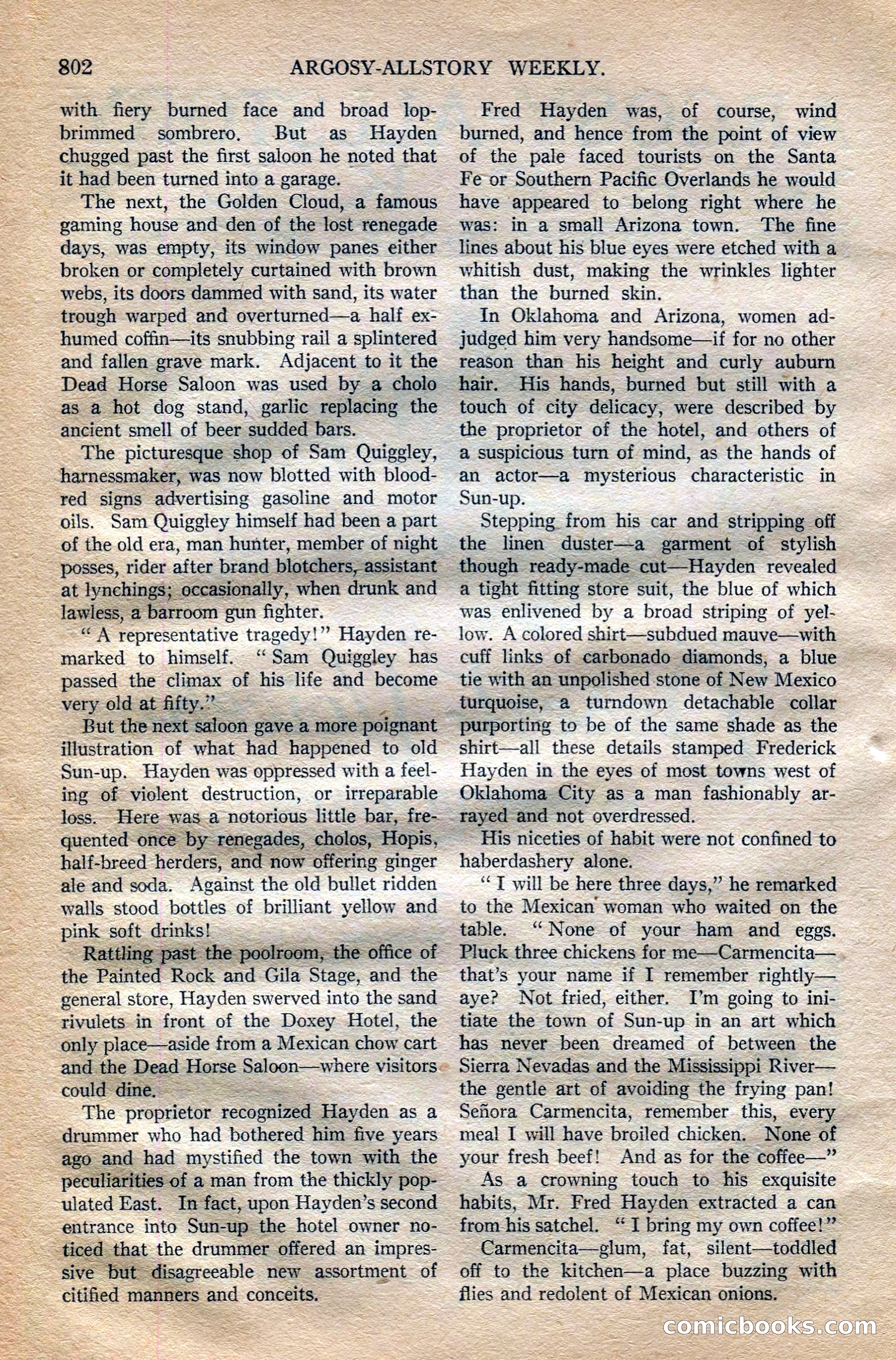
A restored page from Pulp Fiction, 1923. Page through the whole issue in the reader above.
📄 Transcribed text from this page (OCR, searchable)
Machine-transcribed from the original scan — historical spelling and the odd misread are preserved.
= 32 with fiery burned face and broad fons brimmed sombrero. But as Hayden __ chugged past the first saloon he noted that it had been turned into a garage. The next, the Golden Cloud, a famous - gaming house and den of the lost renegade _ days, was empty, its window panes either _ broken or completely curtained with brown ~ webs, its doors dammed with sand, its water trough warped and overturned—a half ex- humed coffin—its snubbing rail a splintered and fallen grave mark. Adjacent to it the Dead Horse Saloon was used by a cholo as a hot dog stand, garlic replacing the ~ ancient smell of beer ‘sudded bars. The picturesque shop of Sam Quiggley, -harnessmaker, was now blotted with blood- red signs advertising gasoline and motor oils. Sam Quiggley himself had been a part _of the old era, man hunter, member of night ~ posses, rider after brand blotchers, assistant at lynchings; occasionally, when drunk and lawless, a barroom gun fighter. ~ © X& representative franetse ”” Hayden re- marked to himself. “Sam Quiggley has passed the climax of his life and become very old at fifty.” But the next saloon gave a more ieoai illustration of what had happened to old Sun-up. Hayden was oppressed with a feel- ing of violent destruction, or irreparable ~~ Joss. Here was_a notorious little bar, fre- quented-once by- renegades, cholos, Hopis, - half-breed herders, and now offering ginger = ale and soda. _-_. walls stood bottles of brilliant yellow and ees pink soft drinks! _ see ast the poolroom,- the office of = the Painted Rock and Gila Stage, and the Apainst the old bullet ridden | Rattling { pas — general store, Hayden swerved into the sand ~~-yivulets.in front of the Doxey Hotel, the = only place—aside from a Mexican chow cart and the Dead Horse Saloon—where visitors « could dine. = The proprietor recognized: Hayden as a = Z — drummer who had bothered him five years = ago” and had mystified the town with the peculiarities of a man from the thickly pop- culated East. In fact, upon Hayden’s second = ‘entrance into Sun-up_ the hotel owner no- fe — ticed- that the drummer offered an impres- — sive but disagreeable new assortment of —— = citified manners and conceits. — —_ ARGOSY-ALLSTORY WEEKLY. Fred Haden was, of course, burned, and hence from the point of view of the pale faced tourists on the Santa Fe or Southern Pacific Overlands he would have appeared to belong right where he was: in a small Arizona town. ‘The fine lines about his blue eyes were etched with a — whitish dust, making the wrinkles lighter than the burned skin. In Oklahoma and Arizona, women ad- judged him very handsome—if for no other reason than his height and curly auburn hair. His hands, burned but still with a touch of city delicacy, were described by the proprietor of the hotel, and others of a Suspicious turn of mind, as the hands of an actor—a mysterious characteristic in Sun-up. Stepping from his car and stripping off the linen duster—a garment of stylish though ready-made cut—Hayden revealed a tight fitting store suit, the blue of which was enlivened by a broad striping of yel- low. A colored shirt—subdued mauve—with cuff links of carbonado diamonds, a blue tie with an unpolished stone of New Mexico _turquoise, a turndown detachable collar purporting to be of the same shade as the shirt—all these details stamped Frederick Hayden in the eyes of most towns west of Oklahoma City as a man fashionably ar- _Tayed and not overdressed. ~ His niceties of habit were not confined to haberdashery alone. ‘“T will be here three days,” he remarked to the Mexican woman who waited on the table. “ None of your ham and eggs. Pluck three chickens for me—Carmencita— that’s your name if I remember rightly— aye? Not fried, either. I’m going to ini- tiate the town of Sun-up in an art which has never been dreamed of between the Sierra Nevadas and the Mississippi River— the gentle art of avoiding the frying pan! Sefiora Carmencita, remember this, every meal I will have broiled chicken. None of your fresh beef! And as for the coffee—” As a crowning touch to his exquisite habits, Mr. Fred. Hayden extracted a can from-his satchel. “ Carmencita—glum, fat, silent—toddled off to the kitchen—a place buzzing with flies and redolent of Mexican onions. = wind “T bring my own coffee!” co -¢ om ck boo SG