
Pulp Fiction, 1923 · page 60 of 176
Argosy All-Story Weekly — page 60: what you’re looking at
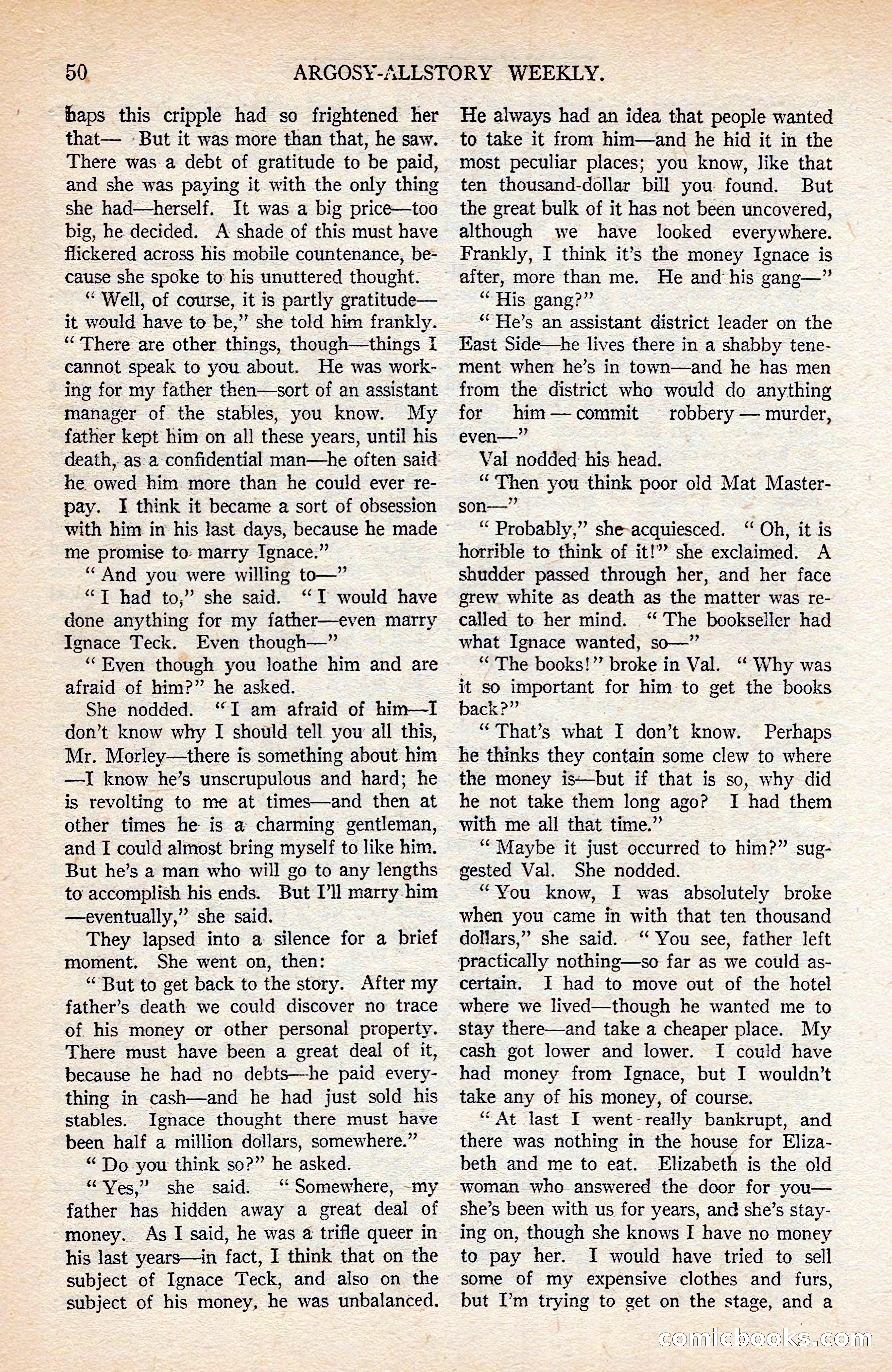
A restored page from Pulp Fiction, 1923. Page through the whole issue in the reader above.
📄 Transcribed text from this page (OCR, searchable)
Machine-transcribed from the original scan — historical spelling and the odd misread are preserved.
50. haps this cripple had so frightened her that— But it was more than that, he saw. There was a debt of gratitude to be paid, and she was paying it with the only thing she had—herself. It was a big price—too big, he decided. A: shade of this must have flickered across his mobile countenance, be- cause she spoke to his unuttered thought. “Well, of course, it is partly gratitude— it would have to be,” she told him frankly. “There are other things, though—things I cannot speak to you about. He was work-. ing for my father then—sort of an assistant manager of the stables, you know. My father kept him on all these years, until his death,. as. a confidential man—he often said: he owed him more than he could ever re- pay. I think it became a sort of obsession ‘with him in his last days, because he made © me promise to: marry Ignace.” “And you were willing to—” “{ had to,” she said. “TI would have done anything for my father—even marry Tenace Teck. Even though—” ‘Even though you loathe him and are afraid of him?” he asked. She nodded. “I am afraid of him—I don’t know why I should tell you all this, Mr. Morley—there is something about him —I know he’s unscrupulous and hard; he is revolting to me at times—and then at other times he is a charming gentleman, and I could almost bring myself to like him. But he’s a man who will go to any lengths to accomplish his ends. But Ill marry him —eventually,” she said. They lapsed into a silence for a brief moment. She went on, then: “But to get back to the story. After my father’s death we could discover no trace of his money or other personal property. There must have been a great deal of it, because he had no debts—he paid every- thing in cash—and he had just sold his stables. Ignace thought there must have been half a million dollars, somewhere.” * Do you think so?” he asked. “Ves,” she said. ‘Somewhere, -my father has hidden away a great deal of ‘money. As I said, he was a trifle queer in his last years—in fact, I think that on the subject of Ignace Teck, and also on the subject of his money, he was unbalanced. ) ARGOSY-ALLSTORY WEEKLY. He always had an idea that people wanted to take it from him—and he hid it in the most peculiar places; you know, like that ten thousand-dollar bill you found. But the great bulk of it has not been uncovered, although we have looked everywhere. Frankly, I think it’s the money Ignace is alter, more than me. He and his gang—’’ “His gang?” ‘*'He’s an assistant district leader on the East Side—he lives there in a shabby tene- ment when he’s in town—and he has men from the district who would do anything for him—commit robbery — murder, even—” Val nodded his head. “Then you think poor old Mat Master- son—” “‘ Probably,” she-acquiesced. ‘‘ Oh, it is horrible to think of it!” she exclaimed. A shudder passed through her, and her face grew white as death as the matter was re- called to her mind. ‘ The bookseller had what Ignace wanted, so—”’ _ “ The books!” broke in Val. ‘‘ Why was it so important for him to get the books back?” “That’s what I don’t know. Perhaps he thinks they contain some clew to where the money is—but if that is so, why did he not take them long ago? I had them with me all that time.” “Maybe it just occurred to him?” sug- gested Val. She nodded. “You know, I was absolutely broke when you came in with that ten thousand dollars,” she said. ‘‘ You see, father left practically nothing—so far as we could as- certain. I had to move out of the hotel where we lived—though he wanted me to stay there—and take a cheaper place. My cash got lower and lower. I could have had money from Ignace, but I wouldn’t take any of his money, of course. ““At last I went-really bankrupt, and there was nothing in the house for Eliza- beth and me to eat. Elizabeth is the old woman who answered the door for you— she’s been with us for years, and she’s stay- ing on, though she knows I have no money to pay her. I would have tried to sell some of my expensive clothes and furs, but I’m trying to get on the stage, and a CORNICLOO@ (C@