
Pulp Fiction, 1923 · page 22 of 176
Argosy All-Story Weekly — page 22: what you’re looking at
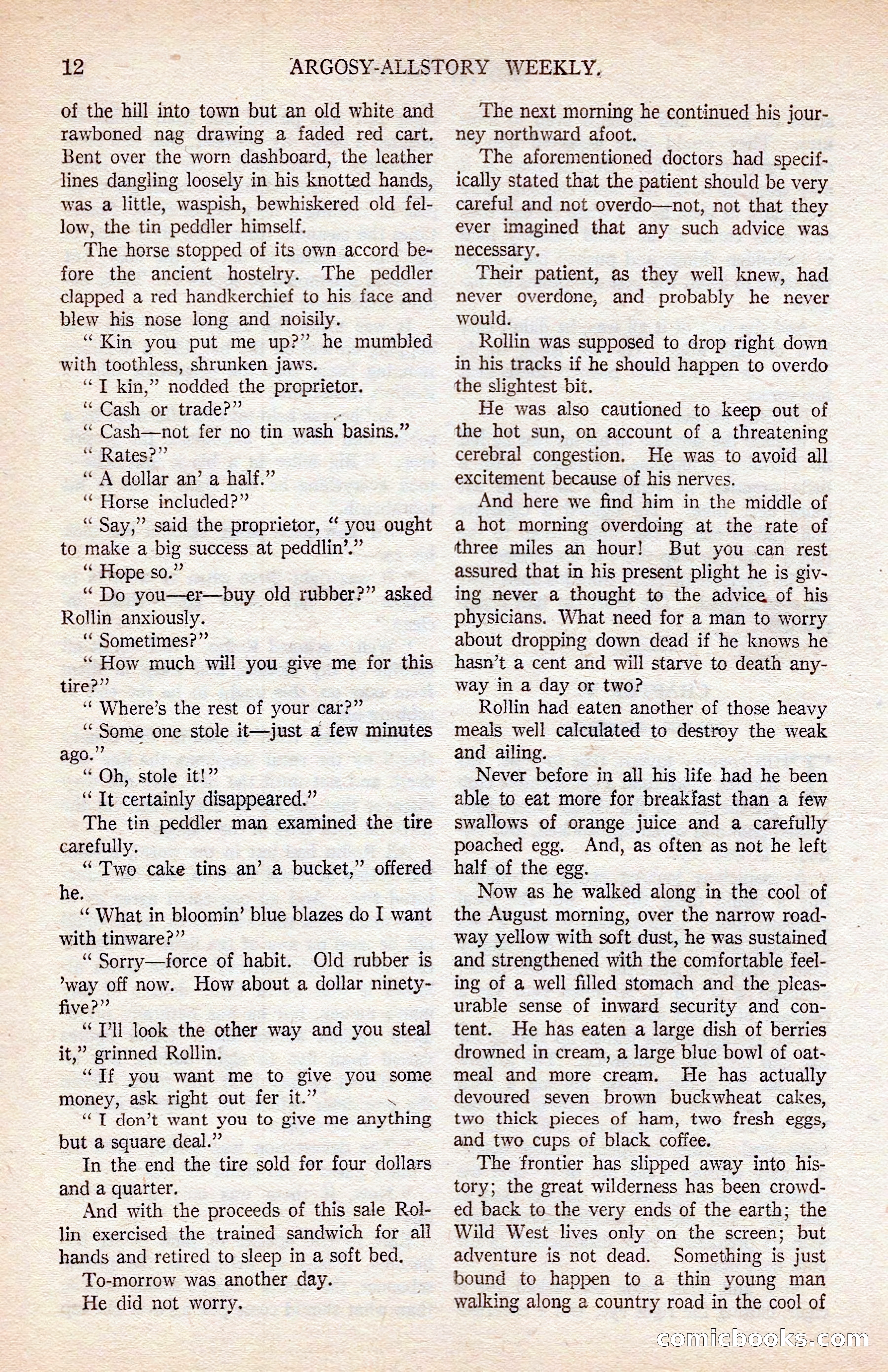
A restored page from Pulp Fiction, 1923. Page through the whole issue in the reader above.
📄 Transcribed text from this page (OCR, searchable)
Machine-transcribed from the original scan — historical spelling and the odd misread are preserved.
12 of the hill into town but an old white and rawboned nag drawing a faded red cart. Bent over the worn dashboard, the leather lines dangling loosely in his knotted hands, was a little, waspish, bewhiskered old fel- low, the tin peddler himself. The horse stopped of its own accord be~ fore the ancient hostelry. The peddler clapped a red handkerchief to his face and blew his nose long and noisily. “Kin you put me up?” he mumbied with toothless, shrunken jaws. ‘““T kin,” nodded the proprietor. ‘“Cash or trade?” = ‘“ Cash—not fer no tin wash basins.” ‘“ Rates?” “A dollar an’ a half.” ‘Horse included?” “ Say,” said the proprietor, “ you ought to make a big success at peddlin’.” ‘ Hope so.” “ Do you—er—buy old rubber?” asked Rollin anxiously. ‘ Sometimes?” ‘How much will you give me for this tire?” ‘‘ Where’s the rest of your car?” “Some one stole it—just a few minutes ago.” “Oh, stole it!” “Tt certainly disappeared.” The tin peddler man examined the tire carefully. “Two cake tins an’ a bucket,” offered he. ‘“‘ What in bloomin’ blue blazes do I want with tinware?”’ ‘“ Sorry—force of habit. Old rubber is ’way off now. How about a dollar ninety- five?” “T’ll look the other way and you steal it,” grinned Rollin. “Tf you want me to give you some money, ask right out fer it.’ = “T don’t want you to give me anything but a square deal.” In the end the tire sold for four dollars and a quarter. And with the proceeds of this sale Rol- lin exercised the trained sandwich for all hands and retired to sleep in a soft bed. To-morrow was another day. He did not worry. ARGOSY-ALLSTORY WEEKLY, The next morning he continued his jour- ney northward afoot. The aforementioned doctors had specif- ically stated that the patient should be very careful and not overdo—not, not that they ever imagined that any such advice was necessary. : Their patient, as they well knew, had never overdone, and probably he never would. Rollin was supposed to drop right down in his tracks if he should happen to overdo the slightest bit. He was also cautioned to keep out of the hot sun, on account of a threatening cerebral congestion. He was to avoid all excitement because of his nerves. And here we find him in the middle of a hot morning overdoing at the rate of three miles an hour! But you can rest assured that in his present plight he is giv- ing never a thought to the advice of his physicians. What need for a man to worry about dropping down dead if he knows he hasn’t a cent and will starve to death any- way in a day or two? Rollin had eaten another of those heavy meals well calculated to destroy the weak and ailing. Never before in all his life had he been able to eat more for breakfast than a few swallows of orange juice and a carefully poached egg. And, as often as not he left half of the egg. Now as he walked along in the cool of the August morning, over the narrow road- way yellow with soft dust, he was sustained and strengthened with the comfortable feel- ing of a well filled stomach and the pleas- urable sense of inward security and con- tent. He has eaten a large dish of berries drowned in cream, a large blue bowl of oat- meal and more cream. He has actually devoured seven brown buckwheat cakes, two thick pieces of ham, two fresh eggs, and two cups of black coffee. The frontier has slipped away into his- tory; the great wilderness has been crowd- ed back to the very ends of the earth; the Wild West lives only on the screen; but adventure is not dead. Something is just bound to happen to a thin young man walking along a country road in the cool of Comicoooks (S@)