
Pulp Fiction, 1923 · page 142 of 176
Argosy All-Story Weekly — page 142: what you’re looking at
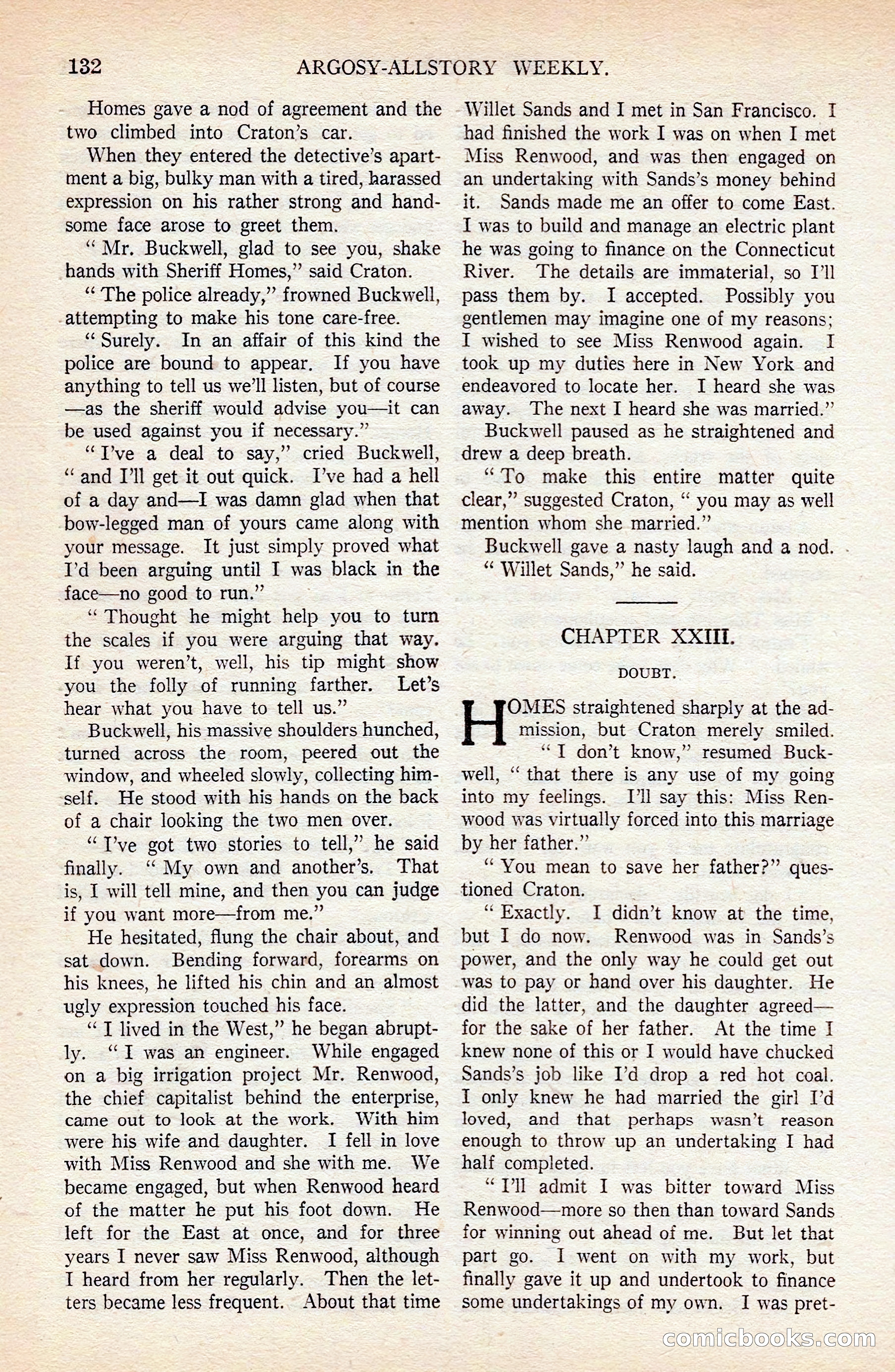
A restored page from Pulp Fiction, 1923. Page through the whole issue in the reader above.
📄 Transcribed text from this page (OCR, searchable)
Machine-transcribed from the original scan — historical spelling and the odd misread are preserved.
132 Homes gave a nod of agreement and the two climbed into Craton’s car. When they entered the detective’s apart- ment a big, bulky man with a tired, harassed expression on his rather strong and hand- some face arose to greet them. ‘Mr. Buckwell, glad to see you, shake hands with Sheriff Homes,” said Craton. “The police already,” frowned Buckwell, -attempting to make his tone care-free. ‘Surely. In an affair of this kind the police are bound to appear. If you have anything to tell us we'll listen, but of course —as the sheriff would advise you—it can be used against you if necessary.” “T’ve a deal to say,” cried Buckwell, “and I'll get it out quick. I’ve had a hell of a day and—I was damn glad when that bow-legged man of yours came along with your message. It just simply proved what I’d been arguing until I was black in the face—no good to run.” “Thought he might help you to turn the scales if you were arguing that way. If you weren’t, well, his tip might show you the folly of running farther. Let’s hear what you have to tell us.” Buckwell, his massive shoulders hunched, turned across the room, peered out the window, and wheeled slowly, collecting him- ‘self. He stood with his hands on the back of a chair looking the two men over. “T’ve got two stories to tell,” he said finally. ‘“‘ My own and another’s. That is, I will tell mine, and then you can judge if you want more—from me.” He hesitated, flung the chair about, and sat down. Bending forward, forearms on his knees, he lifted his chin and an almost ugly expression touched his face. ‘“ T lived in the West,” he began abrupt- ly. ‘I was an engineer. While engaged on a big irrigation project Mr. Renwood, the chief capitalist behind the enterprise, came out to look at the work. With him were his wife and daughter. I fell in love with Miss Renwood and she with me. We became engaged, but when Renwood heard of the matter he put his foot down. He left for the East at once, and for three years I never saw Miss Renwood, although I heard from her regularly. Then the let- ters became less frequent. About that time ARGOSY-ALLSTORY WEEKLY. Willet Sands and I met in San Francisco. I had finished the work I was on when I met Miss Renwood, and was then engaged on an undertaking with Sands’s money behind it. Sands made me an offer to come East. I was to build and manage an electric plant he was going to finance on the Connecticut River. The details are immaterial, so Ill pass them by. I accepted. Possibly you gentlemen may imagine one of my reasons; I wished to see Miss Renwood again. I took up my duties here in New York and endeavored to locate her. I heard she was away. ‘The next I heard she was married.”’ Buckwell paused as he straightened and drew a deep breath. “To make this entire matter quite clear,” suggested Craton, “ you may as well mention whom she married.” Buckwell gave a nasty laugh and a nod. . “ Willet Sands,”’ he said. CHAPTER XXII. DOUBT. OMES straightened sharply at the ad- mission, but Craton merely smiled. ““T don’t know,” resumed Buck- well, “ that there is any use of my going into my feelings. IJ’ll say this: Miss Ren- wood was virtually forced into this marriage by her father.” “You mean to save her father?” ques- tioned Craton. | “Exactly. I didn’t know at the time, but I do now. Renwood was in Sands’s power, and the only way he could get out was to pay or hand over his daughter. He did the latter, and the daughter agreed— for the sake of her father. At the time I knew none of this or I would have chucked Sands’s job like I’d drop a red hot coal. I only knew he had married the girl I’d loved, and that perhaps wasn’t reason enough to throw up an undertaking I had half completed. “Vl admit I was bitter toward Miss Renwood—more so then than toward Sands for winning out ahead of me. But let that part go. I went on with my work, but finally gave it up and undertook to finance some undertakings of my own. I was pret- Comicoooks (©