
Pulp Fiction, 1923 · page 13 of 176
Argosy All-Story Weekly — page 13: what you’re looking at
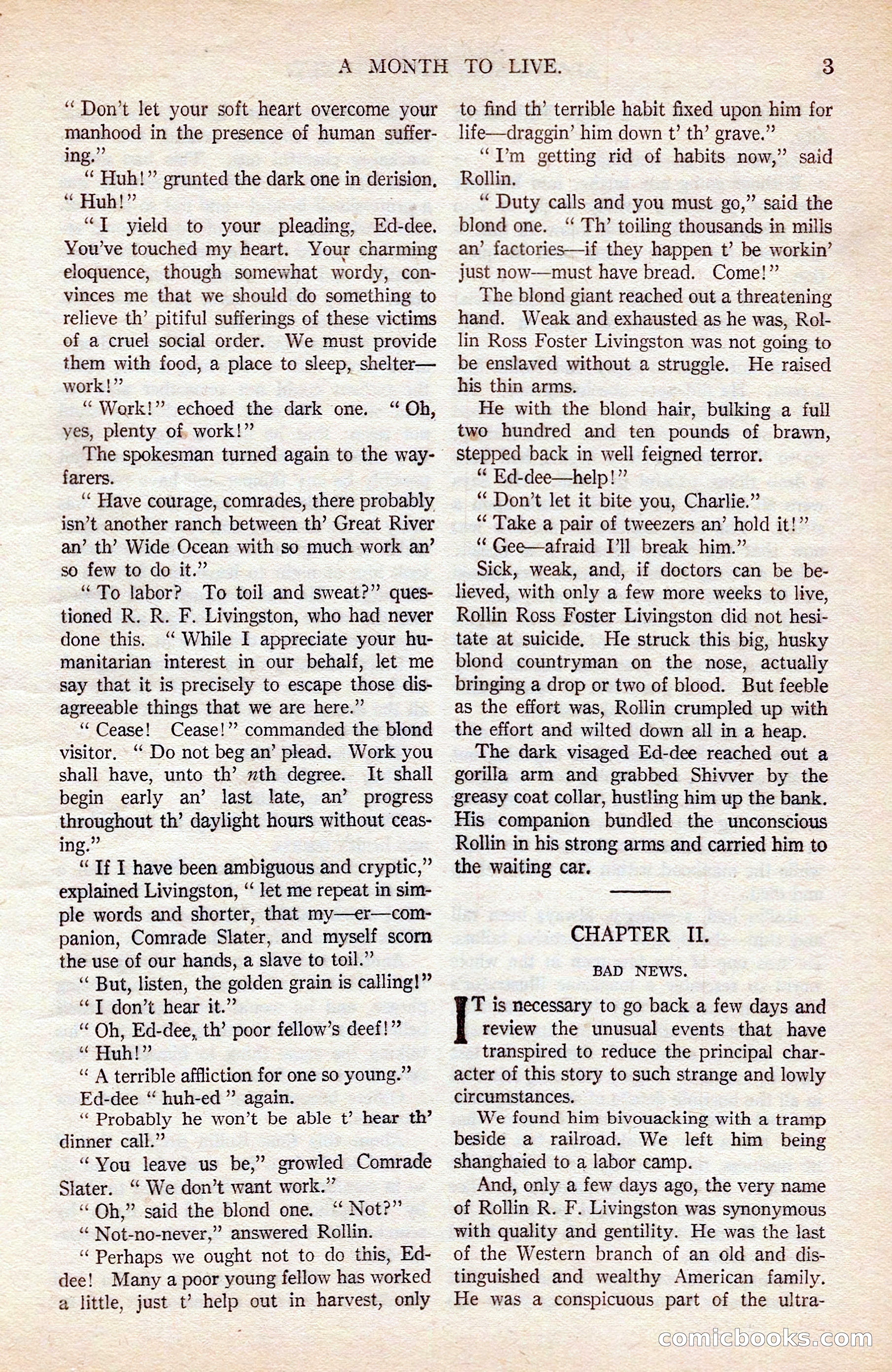
A restored page from Pulp Fiction, 1923. Page through the whole issue in the reader above.
📄 Transcribed text from this page (OCR, searchable)
Machine-transcribed from the original scan — historical spelling and the odd misread are preserved.
A MONTH TO -LIVE. 3 ‘Don’t let your soft heart overcome your manhood in the presence of human suffer- ing.” “Huh!” grunted the dark one in derision, “T yield to your pleading, Ed-dee., You’ve touched my heart. Your charming eloquence, though somewhat wordy, con- vinees me that we should do something to relieve th’ pitiful sufferings of these victims of a cruel social order. We must provide them with food, a place to sleep, shelter— work!” “Work!” echoed the dark one. yes, plenty of, work!” “ Oh, The spokesman turned again to the way- farers. ‘“ Have courage, comrades, there probably isn’t another ranch between th’ Great River an’ th’ Wide Ocean with so much work an’ so few to do it.” “To labor? To toil and sweat?” ques- tioned R. R. F. Livingston, who had never done this. ‘“ While I appreciate your hu- manitarian interest in our behalf, let me say that it is precisely to escape those dis- agreeable things that we are here.” ‘Cease! Cease!’? commanded the blond visitor. ‘“‘ Do not beg an’ plead. Work you shall have, unto th’ wth degree. It shall begin early an’ last late, an’ progress throughout th’ daylight hours without ceas- ing.” “ Tf I have been ambiguous and cryptic,” explained Livingston, ‘“‘ let me repeat in sim- ple words and shorter, that my—er—com- panion, Comrade Slater, and myself scorn the use of our hands, a slave to toil.” ‘But, listen, the golden grain is calling!” ‘“T don’t hear it.” “ Oh, Ed-dee, th’ poor fellow’s deef!” “A terrible affliction for one so young.” Ed-dee “ huh-ed ” again. ‘Probably he won’t be able t’ hear th’ dinner call.” 3 “You leave us be,” growled Comrade Slater. “ We don’t want work.” “Oh,” said the blond one. ‘“ Not?” “‘ Not-no-never,” answered Rollin. “ Perhaps we ought not to do this, Ed- dee! Many a poor young fellow has worked a little, just t’ help out in harvest, only to find th’ terrible habit fixed upon him for life—draggin’ him down t’ th’ grave.” “Tm getting rid of habits now,” said Rollin. ‘“ Duty calls and you must go,” said the blond one. ‘“ Th’ toiling thousands in mills an’ factories—if they happen t’ be workin’ just now—must have bread. Come!” The blond giant reached out a threatening hand. Weak and exhausted as he was, Rol- lin Ross Foster Livingston was not going to be enslaved without a struggle. He raised his thin arms. He with the blond hair, bulking a full two hundred and ten pounds of brawn, Stepped back in well feigned terror. “ Ed-dee—help!” “Don’t let it bite you, Charlie.” “Take a pair of tweezers an’ hold it!” ‘* Gee—afraid Tl break him.” Sick, weak, and, if doctors can be be- lieved, with only a few more weeks to live, Rollin Ross Foster Livingston did not hesi- tate at suicide, He struck this big, husky blond countryman on the nose, actually bringing a drop or two of blood. But feeble as the effort was, Rollin crumpled up with the effort and wilted down all in a heap. The dark visaged Ed-dee reached out a gorilla arm and grabbed Shivver by the greasy coat collar, hustling him up the bank. His companion bundled the unconscious Rollin in his strong arms and carried him to the waiting car. CHAPTER II. BAD NEWS. T is necessary to go back a few days and review the unusual events that have transpired to reduce the principal char- acter of this story to such strange and lowly circumstances. We found him bivouacking with a tramp beside a railroad. We left him being shanghaied to a labor camp. And, only a few days ago, the very name of Rollin R. F. Livingston was synonymous with quality and gentility. He was the last of the Western branch of an old and dis- tinguished and wealthy American family. He was a conspicuous part of the ultra- oO CoOmicdooks: (S@