
Pulp Fiction, 1923 · page 25 of 172
Argosy All-Story Weekly — page 25: what you’re looking at
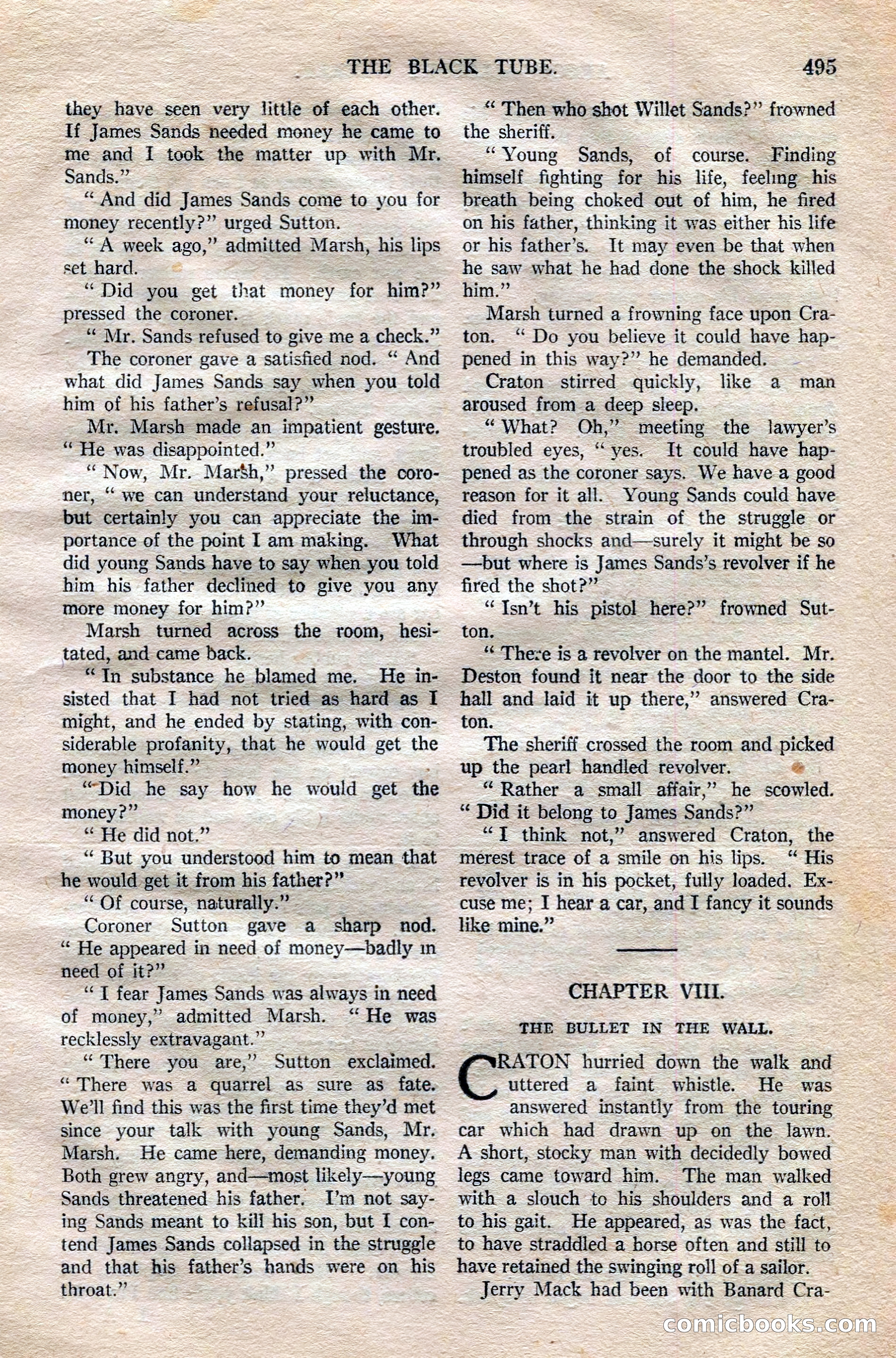
A restored page from Pulp Fiction, 1923. Page through the whole issue in the reader above.
📄 Transcribed text from this page (OCR, searchable)
Machine-transcribed from the original scan — historical spelling and the odd misread are preserved.
‘THE BLACK TUBE. they have seen very little of each other. = If James Sands heeded money he came to me and I took the matter up with Mr. ~~ Sands.” “ And did James Sands come to you for money recently?” urged Sutton. “A week ago,” admitted Marsh, his lips set hard. “ Did you get that money, Stor him?” pressed the coroner. ‘“ Mr. Sands refused to give me a check.” The coroner gave a satisfied nod. “ And what did James Sands say when you told him of his father’s refusal?” Mr. Marsh made an impatient gesture. “He was disappointed.” “ Now, Mr. MarSh,” pressed the coro- er, “ we can understand your reluctance, but certainly you can appreciate the im- portance of the point I am making. What did young Sands have to say when you told him his father declined to give you any more money for him?” Marsh turned across the room, hesi- tated, and came back. si fa substance he blamed me. — He in- sisted that I had not tried as hard as I might, and he ended by stating, with con- siderable profanity, that he would get the money himself.” Did he say how he would get the money?” * He did not.” : “ But you understood him to mean that he would get it from his aiheyr “Of course, naturally.” Coroner Sutton gave a sharp nod. “He appeared in need of money—badly in need of it?” “1 fear James Sands was always in need of money,” admitted Marsh. ‘“ He was recklessly extravagant.” : “There you are,” Sutton exclaimed. “There was a quarrel as sure as fate. We'll find this was the first time they’d met since your talk with young Sands, Mr. Marsh. He came here, demanding money. Both grew angry, and—most likely—young Sands threatened his father. I’m not say- ing Sands meant to kill his son, but I con- tend James Sands collapsed in the struggle and that his father’s hands were on his throat.” 495 ~ “Phen who shot Willet Sands?” frowned the sheriff. * Young Sands, of course. “fF inding himself fighting for his life, feeling -his breath being choked out of him. he fired on his father, thinking it was either his life or his father’s. It may even be that when he saw what he had done the shock killed him = 7 Marsh turned a frowning face upon Cra- ton. “‘ Do you believe it could have hap- pened in this way?” he demanded. _ Craton stirred quickly, like a man aroused from a deep sieep. “What? Oh,” meeting the lawyer’s troubled eyes, “yes. It could have hap- pened as the coroner says. We have a good reason for it all. Young Sands could have died from the strain of the struggle or through shocks and—surely it might be so —but where is James Sands’s revolver if he fired the shot?” “Isn’t his pistol here?” frowned Sut- ton. “ Theze is 2 revolver on the mantel. Mr. Deston found it near the door to the side hall and laid it up there,” answered Cra- ton. The sheriff crossed the room and picked up the pearl handled revolver. a “ Rather a small affair,” he scowled. id it belong to James Sands?” “} think not,” answered Craton, the merest trace of a smile on his lips. 2 His revolver is in his pocket, fully loaded. Ex-. cuse me; I hear a car, and I fancy it sounds like mine.” CHAPTER VIII. THE BULLET IN THE WALL. "VRATON hurried down the walk and uttered a faint whistle. He was answered instantly from the touring car which had drawn up on the lawn. A short, stocky man with decidedly bowed legs came toward him. The man walked with a slouch to his shoulders and a roll to his gait. He appeared, as was the fact, to Fees straddled a horse often and still to have retained the swinging roll of a sailor. Jerry Mack had been with Banard Cra- COMICHOOKS (E@)