
Pulp Fiction, 1923 · page 147 of 172
Argosy All-Story Weekly — page 147: what you’re looking at
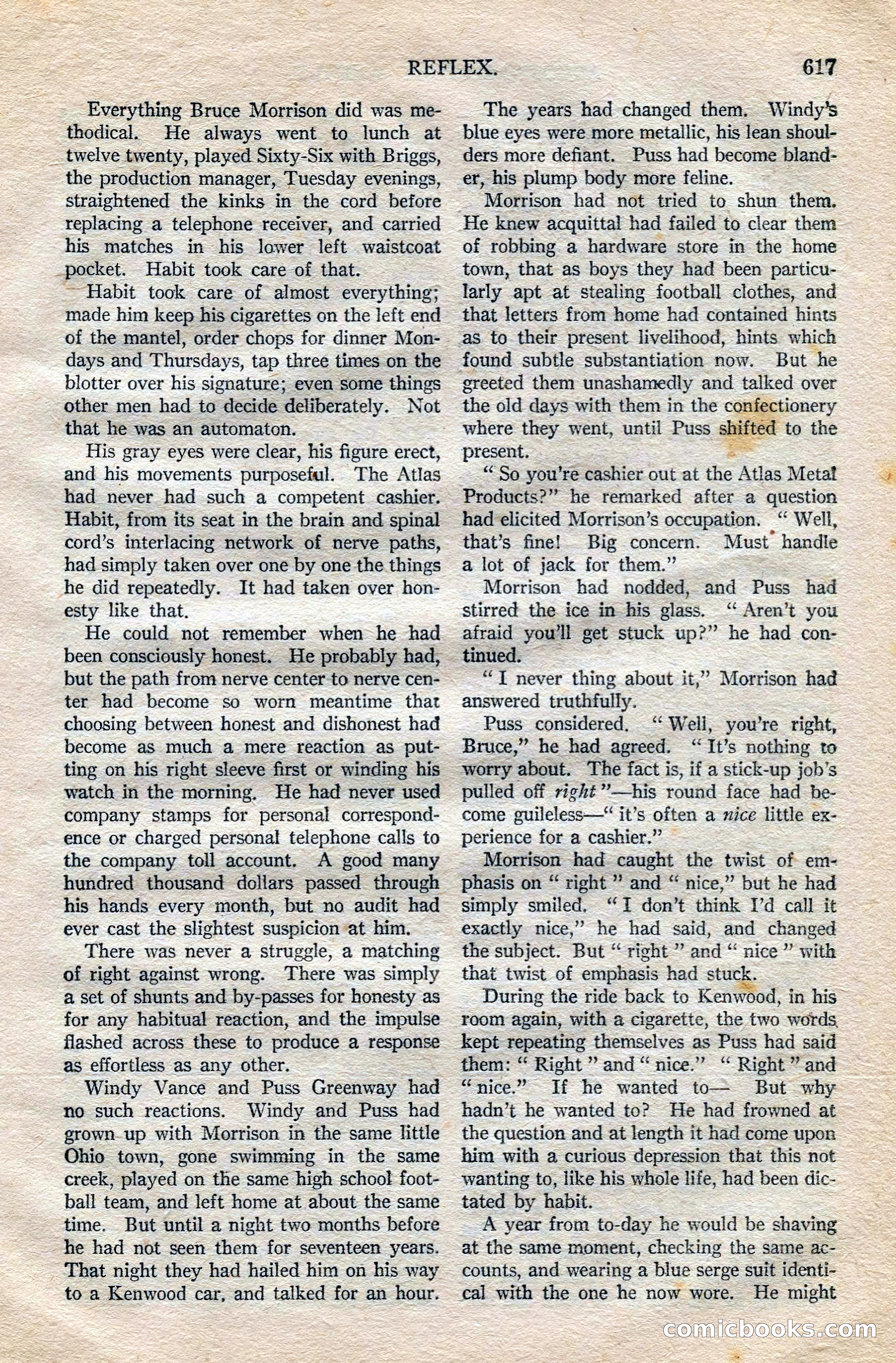
A restored page from Pulp Fiction, 1923. Page through the whole issue in the reader above.
📄 Transcribed text from this page (OCR, searchable)
Machine-transcribed from the original scan — historical spelling and the odd misread are preserved.
Everything Bruce Morrison did was me- thodical. He always went to lunch at _ twelve twenty, played Sixty-Six with Briggs, the production manager, Tuesday evenings, straightened the kinks in the cord before replacing a telephone receiver, and carried his matches in his lower left waistcoat _pocket. Habit took care of that. ~~ Habit took care of almost everything; made him keep his cigarettes on the left end of the mantel, order chops for dinner Mon- days and Thursdays, tap three times on the blotter over his signature; even some things other men had to decide deliberately. Not that he was an automaton. His gray eyes were clear, his figure erect, and his movements purposeful. The Atlas had never had such a competent cashier. Habit, from its seat in the brain and spinal cord’s interlacing network of nerve paths, had simply taken over one by one the things he did repeatedly. It had taken over hon- esty like that. He could not remember when he had been consciously honest. He probably had, but the path from nerve center to nerve cen- ter had become so worn meantime that choosing between honest and dishonest had become as much a mere reaction as put- ting on his right sleeve first or winding his watch in the morning, He had never used company stamps for personal correspond- ence or charged personal telephone calls to the company toll account. A good many hundred thousand dollars passed through his hands every month, but no audit had ever cast the slightest suspicion at him. There was never a Struggle, a matching of right against wrong. There was simply a set of shunts and by-passes for honesty as for any habitual reaction, and the impulse flashed across these to produce a response as effortless as any other. : Windy Vance and Puss Greenway had no such reactions. Windy and Puss had grown-up with Morrison in the same little Ohio town, gone swimming in the same creek, played on the same high school foot- ball team, and left home at about the same time. But until a night two months before he had not seen them for seventeen years. That night they had hailed him on his way to a Kenwood car, and talked for an hour. cal with the one he now wore. blue eyes were more metallic, his lean shoul- ders more defiant. Puss had become bland- er, his plump body more feline. Morrison had not tried to shun them. He knew acquittal had failed to clear them of robbing a hardware store in the home town, that as boys they had been particu- larly apt at stealing football clothes, and that letters from home had contained hints as to their present livelihood, hints which found subtle substantiation now. But he greeted them unashamedly and talked over the old days with them in the confectionery where they went, until Puss shifted to the present, “So you're cashier out at the Atlas Metat Products?” he remarked after a question had elicited Morrison’s occupation. ‘“ Well, that’s fine! Big concern. Must handle a lot of jack for them.” Morrison had nodded, and Puss had stirred the ice in his glass. ‘“ Aren’t you afraid you'll get stuck up?” he had con- “I never thing about it,” Morrison had answered truthfully. Puss considered. ‘ Well, you’re right, Bruce,” he had agreed. “It’s nothing to worry ‘about. The fact is, if a stick-up job’s pulled off right ”’—his round face had be- — come guileless—“ it’s often a nice little ex- perience for a cashier.” Morrison had caught the twist of em- phasis on “ right ” and “ nice,”’ but he had simply smiled, “TI don’t think I’d call it exactly nice,” he had said, and changed the subject. But “ right ” and “ nice ” with that twist of emphasis had stuck. During the ride back to Kenwood, in his’ room again, with a cigarette, the two words, kept repeating themselves as Puss had said them: “ Right ” and “ nice.” “ Right ” and “nice.” If he wanted to— But why hadn’t he wanted to? He had frowned at the question and at length it had come upon him with a curious depression that this not wanting to, like his whole life, had been dic- tated by habit. A year from to-day he would be shaving at the same moment, checking the same ac- counts, and wearing a blue serge suit identi- He might (COPA KOOKS 617 The years had changed them. Windy’s : ~~ (E©)