
Pulp Fiction, 1923 · page 14 of 172
Argosy All-Story Weekly — page 14: what you’re looking at
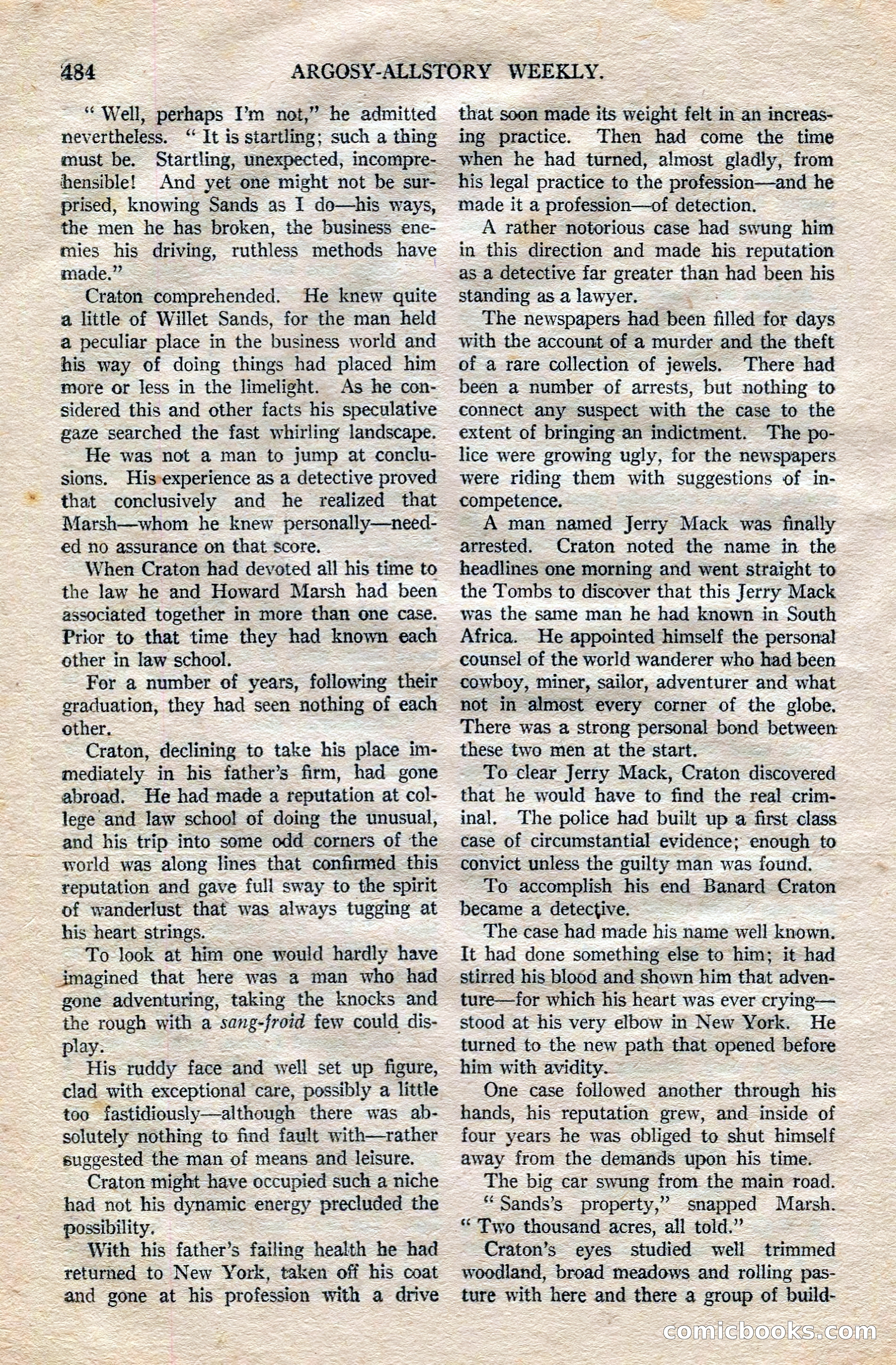
A restored page from Pulp Fiction, 1923. Page through the whole issue in the reader above.
📄 Transcribed text from this page (OCR, searchable)
Machine-transcribed from the original scan — historical spelling and the odd misread are preserved.
ABA * Well, perhaps I’m not,” he admitted nevertheless. “It is startling; such a thing must be. Startling, unexpected, incompre- hensible! And yet one might not be sur- prised, knowing Sands as I do—his ways, the men he has broken, the business ene- mies his driving, ruthless methods have made.” Craton comprehended. He knew quite a little of Willet Sands, for the man held a peculiar place in the business world and his way of doing things had placed him more or less in the limelight. As he con- sidered this and other facts his speculative gaze searched the fast whirling landscape. He was not a man to jump at conclu- sions. His-experience as a detective proved that conclusively and he realized that Marsh—whom he knew personally—need- ed no assurance on that score. When Craton had devoted all his time to the law he and Howard Marsh had been associated together in more than one case. Prior to that time they had known each other in law school. For a number of years, following their graduation, they had seen nothing of each other. Craton, declining to take his place im- mediately in his father’s firm, had gone abroad. He had made a reputation at col- lege and law school of doing the unusual, and his trip into some odd corners of the world was along lines that confirmed this” reputation and gave full sway to the spirit of wanderlust that was always tugging at his heart strings. To look at him one would hardly have imagined that here was a man who had gone adventuring, taking the knocks and the rough with a sang-froid soe could dis- play. His ruddy face and well set up figure, clad with exceptional care, possibly a little too fastidiously although there was ab- solutely nothing to find fault with—rather suggested the man of means and leisure. Craton might have occupied such a niche had not his dynamic energy precluded the poseility: - With his father’s failing health he had returned to New York, taken off his coat and gone at his- profession with a drive ARGOSY-ALLSTORY WEEKLY. that soon made its weight felt in an increas- ing practice. Then had come the time when he had turned, almost gladly, from his legal practice to ‘the profession—and he made it a profession—of detection. A rather notorious case had swung him in this direction and made his reputation as a detective far greater than had been his standing as a lawyer. The newspapers had been filled for days with the account of a murder and the theft of a rare collection of jewels. There had been a number of arrests, but nothing to connect any suspect with the case to the extent of bringing an indictment. The po- lice were growing ugly, for the newspapers were riding them with suggestions of in- competence. A man named Jerry Mack was finally arrested. Craton noted the name in the headlines one morning and went straight to the Tombs to discover that this Jerry Mack was the same man he had known in South Africa. He appointed himself the personal counsel of the world wanderer who had been cowboy, miner, sailor, adventurer and what not in almost every corner of the globe. There was a strong personal bond between: these two men at the start. To clear Jerry Mack, Craton discovered that he would have to find the real crim- inal. The police had built up a first class ease of circumstantial evidence; enough to convict unless the guilty man was found. To accomplish his end Banard Craton became a detective. The case had made his name well known. It had done something else to him; it had stirred his blood and shown him that adven- ture—for which his heart was ever crying— stood at his very elbow in New York. He turned to the new path that opened before him with avidity. One case followed another through his hands, his reputation grew, and inside of four years he was obliged to shut himself away from the demands upon his time. The big car swung from the main road. “Sands’s property,” snapped Marsh. “ Two thousand acres, all told.” Craton’s eyes studied well trimmed woodland, broad meadows and rolling pas- ture with here and there a group of build- 1€O Eomichooks