
Pulp Fiction, 1923 · page 123 of 172
Argosy All-Story Weekly — page 123: what you’re looking at
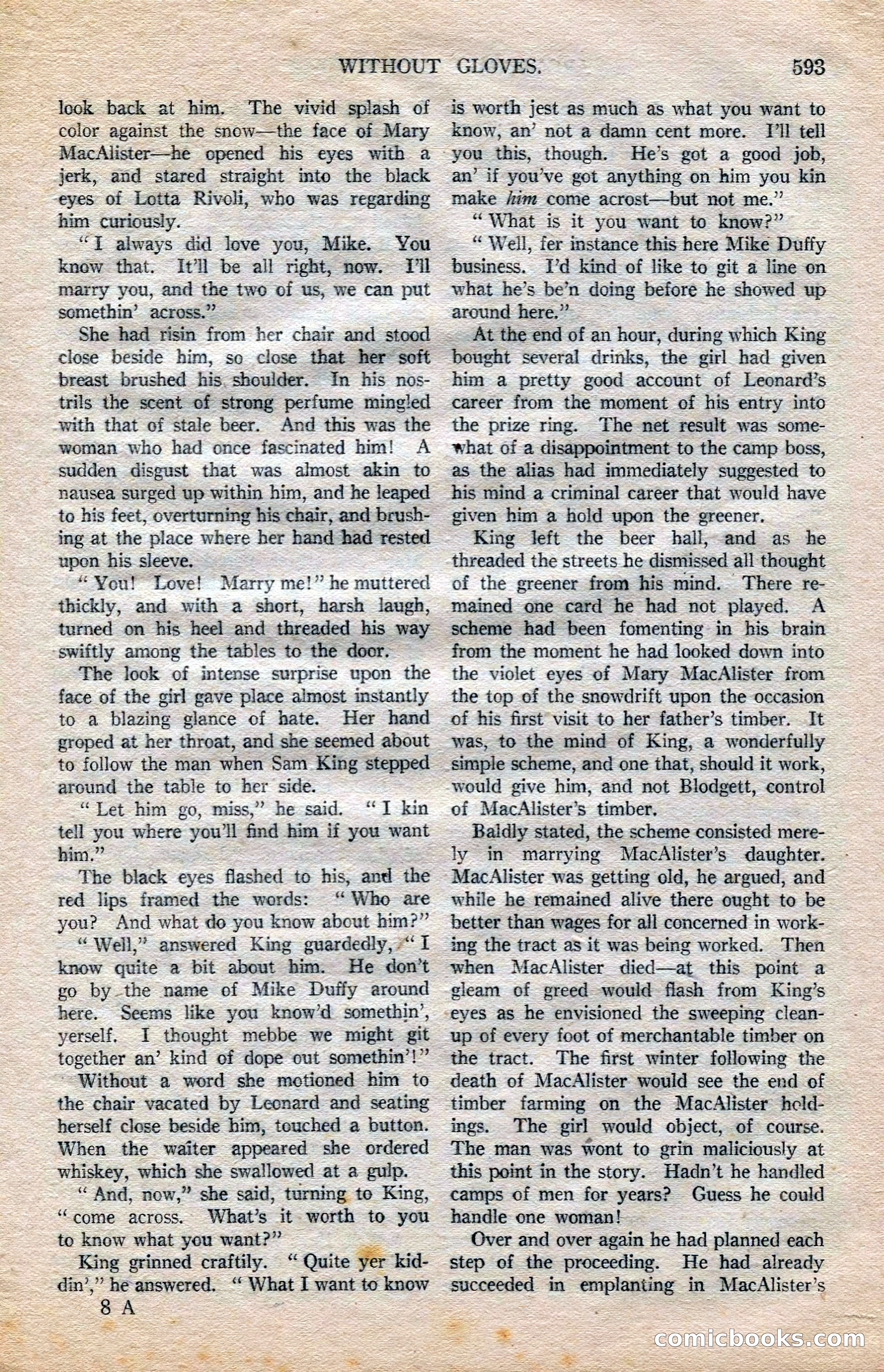
A restored page from Pulp Fiction, 1923. Page through the whole issue in the reader above.
📄 Transcribed text from this page (OCR, searchable)
Machine-transcribed from the original scan — historical spelling and the odd misread are preserved.
= “WITHOUT GLOVES. = —— Sok ot be The ee splash of color against the snow—the face of Mary _ MacAlister—he opened his eyes with a jerk, and stared straight mto the black -eyes of Lotta Rivoli, who was regarding him curiously. “YT always did leve you, Mike. You know that. It7l be all right, now. Til marry you, and the two of us, we can put somethin’ across.” She had risin from her chair and stood close beside him, so close that her~ soft breast brushed bis: shoulder. In his nos- trils the scent of streng perfume mingied with that of stale beer. And this was the woman who had once fascinated him! A sudden disgust that was almost akin to nausea surged up within him, and he leaped to his feet, overturning his chair, and brush- ing at the place where her hand had rested upen his sleeve. “You! Love! Marry me!” he muttered thickly, and with a short, harsh laugh, turned on his heel and threaded his way “swiftly among the tables to the door. The look of intense surprise upon the face of the girl gave place almost mstantly to a blazing glance of hate. Her hand groped at her throat, and she seemed about _ to follow the man when Sam King stepped ‘around the table to her side. “Let him go, miss,” he said. “I kin tell you where you'll find him if you want him.” The black eyes flashed to his, and the red lips framed the words: “ Who are you? And what do you know about him?” “ Well,” answered King guardedly, “I know quite a bit about him. He don't go bythe name of Mike Duify around here. Seems like you know’d somethin’, yerself. I thought mebbe we might git together an’ kind of dope out somethin’!” ‘“Without a word she metioned him to the chair vacated by Leonard and seating herself clese beside him, teuched a button. When the waiter appeared she ordered whiskey, which she swallowed at a gulp. “ And, now,” she said, turning te King, ‘““come across. What’s it worth to you to know what you want?” — ‘King grinned craftily. “ Quite ¥% kid- din’, ” he answered. “ What I want to know SA : step of the proceeding. SS eae is worth jest as much as what you want to — know, an’ not a damn cent more. T’ll tell -you this, though. He’s got a good job, an’ if you’ve got anything on him you kin — make im come acrost—but not me.” “What is it you want to knew?” “ Well, fer instance this here Mike Duffy business. I’d kind of like to git a line on what he’s be’n doing before he showed up around here,” __ . _ At the end of an hour, during which King bought several drinks, the girl had given him a pretty geod account of Leonard’s career from the moment of his entry into the prize ring. The net result was some- what of a disappointment to the camp boss, as the alias had immediately suggested to his mind a criminal career that would have given him a hold upon the greener. King left the beer hall,and as he threaded the streets he dismissed all thought of the greener from his mind. There re- mained one card he had not played. A scheme had been fomenting in his brain from the moment he had looked down into the violet eyes of Mary MacAlister from — the top of the snewdrift upon the occasion of his first’ visit to her father’s timber. It was, to the mind of King, a wonderfully simple scheme, and one that, should it work, would give him, and not Blodgett, control of MacAlister’s timber, Baidly stated, the scheme consisted mere- ly in- marrying MacAlister’s daughter. MacAlister was getting old, he argued, and while he remained alive there ought to be better than wages for all concerned in work- ing the tract as it was being worked. Then when MacAlister died—at this point a gleam of greed would fiash from King’s -eyes as he envisioned the sweeping clean- up of every foot of merchantable timber on the tract. The first winter following the death of MacAlister would see the end of — timber farming on the MacAlister held- ings. The girl would object, of course. The man was wont to grin maliciously at this point in the story.. Hadn’t he handled — camps of men for years? Guess he could handle one woman! Over and over again he had sigue eet He had_ already oes in eoplaping. in MacAlister’ S 593