
Pulp Fiction, 1923 · page 83 of 180
Argosy All-Story Weekly — page 83: what you’re looking at
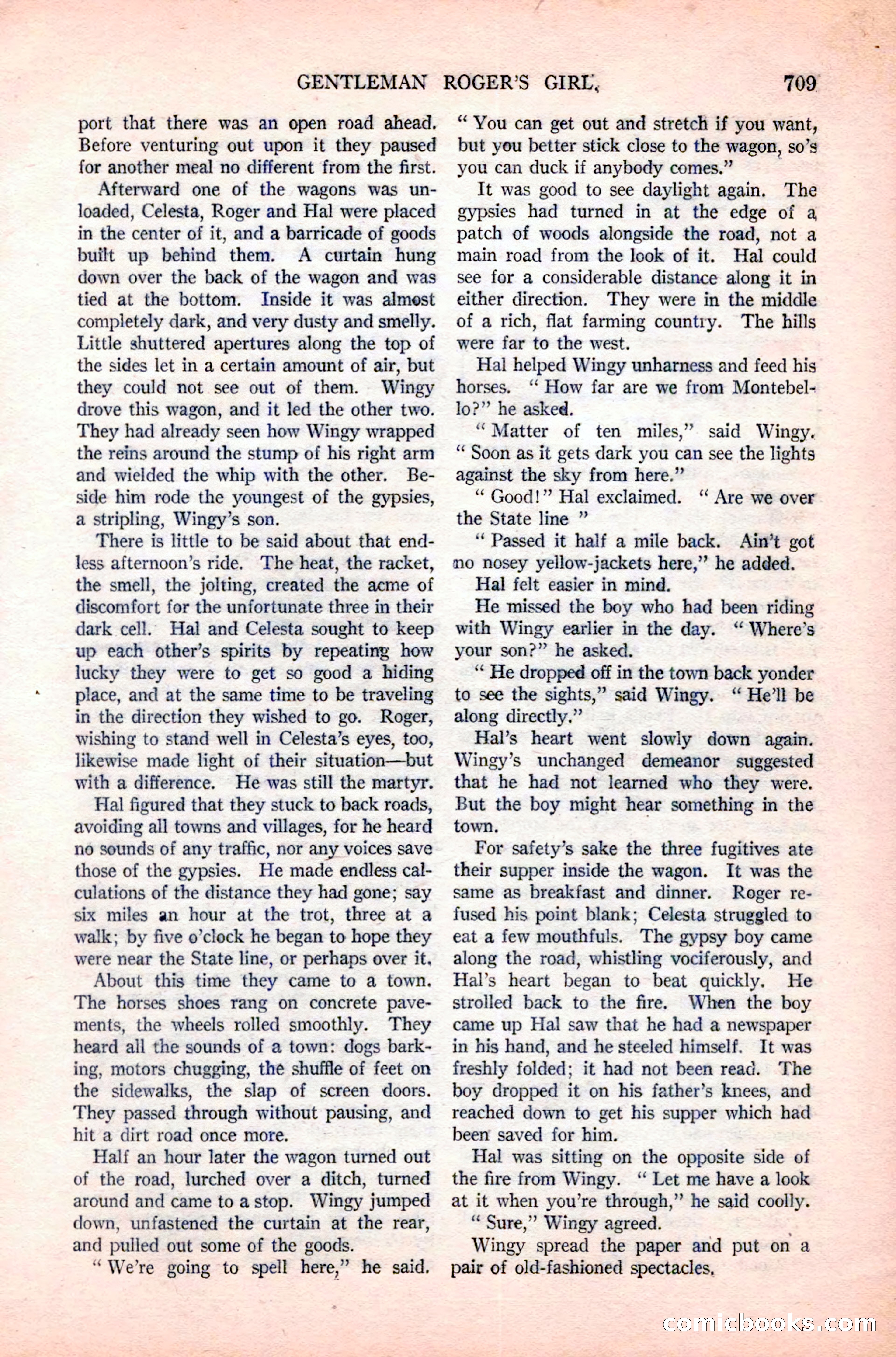
A restored page from Pulp Fiction, 1923. Page through the whole issue in the reader above.
📄 Transcribed text from this page (OCR, searchable)
Machine-transcribed from the original scan — historical spelling and the odd misread are preserved.
GENTLEMAN ROGER’S GIRL, port that there was an open road ahead. Before venturing out upon it they paused for another meal no different from the first. Afterward one of the wagons was un- loaded, Celesta, Roger and Hal were placed in the center of it, and a barricade of goods built up behind them. A curtain hung down over the back of the wagon and was tied at the bottom. Inside it was almest completely dark, and very dusty and smelly. Little shuttered apertures along the top of the sides let in a certain amount of air, but they could not see out of them. Wingy drove this wagon, and it led the other two. They had already seen how Wingy wrapped the reins around the stump of his right arm and wielded the whip with the other. Be- side him rode the youngest of the gypsies, a stripling, Wingy’s son. There is little to be said about that end- less afternoon’s ride. The heat, the racket, the smell, the jolting, created the acme of discomfort for the unfortunate three in their dark cell. Hal and Celesta sought to keep up each other’s spirits by repeating how lucky they were to get so good a hiding place, and at the same time to be traveling in the direction they wished to go. Roger, wishing to stand well in Celesta’s eyes, too, likewise made light of their situation—but with a difference. He was still the martyr. Hal figured that they stuck to back roads, avoiding all towns and villages, for he heard no sounds of any traffic, nor any voices save those of the gypsies. He made endless cal- culations of the distance they had gone; say six miles an hour at the trot, three at a walk; by five o’clock he began to hope they were near the State line, or perhaps over it. About this time they came to a town. The horses shoes rang on concrete pave- ments, the wheels rolled smoothly. They heard all the sounds of a town: dogs bark- ing, motors chugging, the shuffle of feet on the sidewalks, the slap of screen doors. They passed through without pausing, and hit a dirt road once more. Half an hour later the wagon turned out of the road, lurched over a ditch, turned around and came to astop. Wingy jumped down, unfastened the curtain at the rear, and pulled out some of the goods. “We're going to spell here,” he said. “You can get out and stretch if you want, but you better stick close to the wagon, so’s you can duck if anybody comes.” It was good to see daylight again. The gypsies had turned in at the edge of a patch of woods alongside the road, not a main road from the look of it. Hal could see for a considerable distance along it in either direction. They were in the middle of a rich, flat farming country. The hills were far to the west. Hal helped Wingy unharness and feed his horses. ‘‘ How far are we from Montebel- lo?” he asked. “Matter of ten miles,” said Wingy. “Soon as it gets dark you can see the lights against the sky from here.” “Good!” Hal exclaimed. the State line ” ‘Passed it half a mile back. Ain’t got mo nosey yellow-jackets here,’”’ he added. Hal felt easier in mind. He missed the boy who had been riding with Wingy earlier in the day. ‘“ Where’s your son?” he asked. ‘* He dropped off in the town back yonder to see the sights,” said Wingy. “ He’ll be along directly.” Hal’s heart went slowly down again. Wingy’s unchanged demeanor suggested that he had not learned who they were. But the boy might hear something in the town. For safety’s sake the three fugitives ate their supper inside the wagon. It was the same as breakfast and dinner. Roger re- fused his point blank; Celesta struggled to eat a few mouthfuls. The gypsy boy came along the road, whistling vociferously, and Hal’s heart began to beat quickly. He strolled back to the fire. When the boy came up Hal saw that he had a newspaper in his hand, and he steeled himself. It was freshly folded; it had not been read. The boy dropped it on his father’s knees, and reached down to get his supper which had been saved for him. Hal was sitting on the opposite side of the fire from Wingy. ‘“ Let me have a look at it when you’re through,” he said coolly. “ Sure,” Wingy agreed. : Wingy spread the paper and put on a pair of old-fashioned spectacles, “ Are we over Gomicbooks 709, (C@