
Pulp Fiction, 1923 · page 74 of 180
Argosy All-Story Weekly — page 74: what you’re looking at
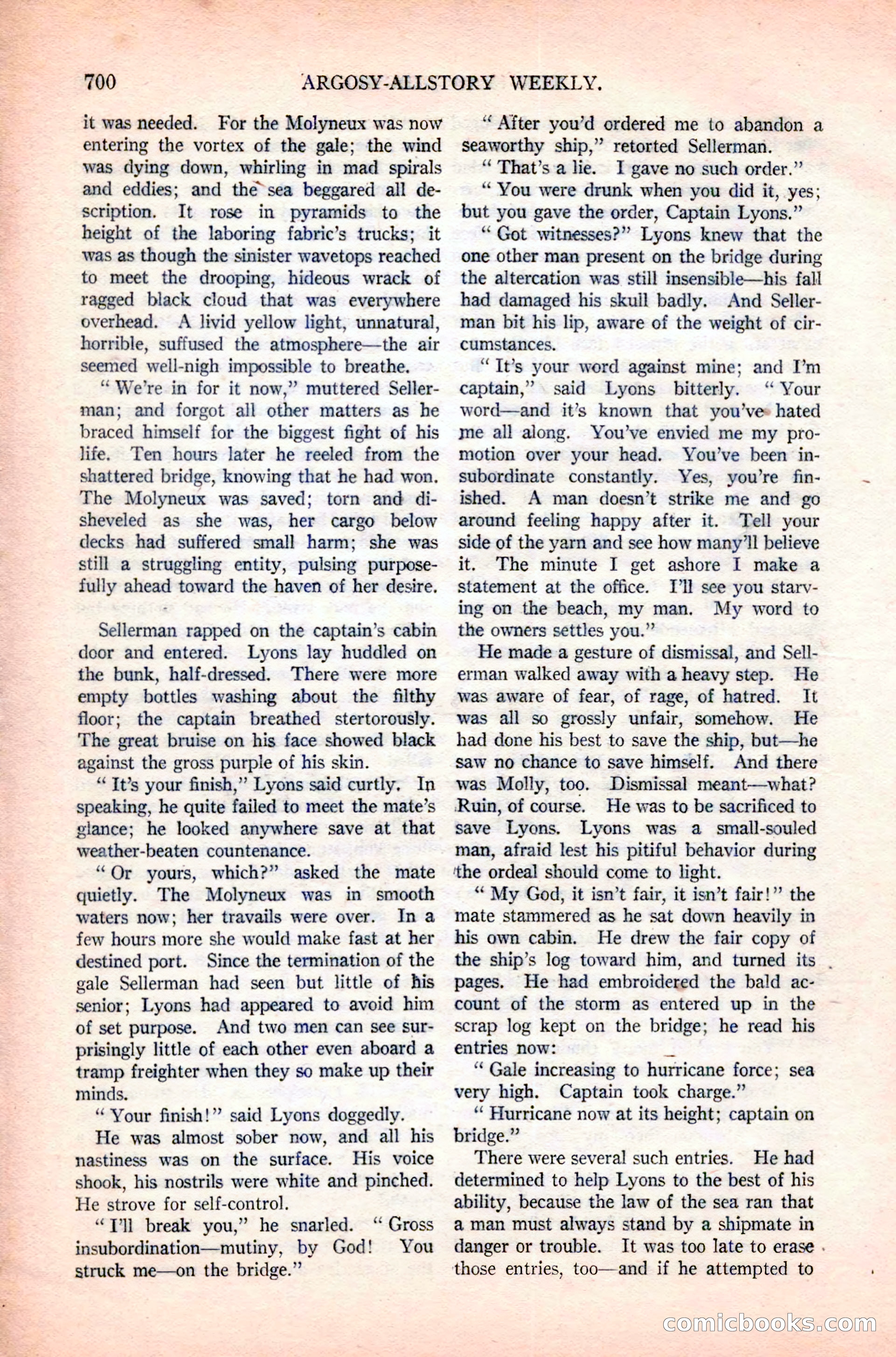
A restored page from Pulp Fiction, 1923. Page through the whole issue in the reader above.
📄 Transcribed text from this page (OCR, searchable)
Machine-transcribed from the original scan — historical spelling and the odd misread are preserved.
700 it was needed. For the Molyneux was now entering the vortex of the gale; the wind was dying down, whirling in mad spirals and eddies; and the sea beggared all de- scription. It rose in pyramids to the height of the laboring fabric’s trucks; it was as though the sinister wavetops reached to meet the drooping, hideous wrack of ragged black cloud that was everywhere overhead. <A livid yellow light, unnatural, horrible, suffused the atmosphere—the air seemed well-nigh impossible to breathe. “We're in for it now,” muttered Seller- man; and forgot all other matters as he braced himself for the biggest fight of his life. Ten hours later he reeled from the shattered bridge, knowing that he had won. The Molyneux was saved; torn and di- sheveled as she was, her cargo below decks had suffered small harm; she was still a struggling entity, pulsing purpose- fully ahead toward the haven of her desire. Sellerman rapped on the captain’s cabin door and entered. Lyons lay huddled on the bunk, half-dressed. There were more empty bottles washing about the filthy floor; the captain breathed stertorously. The great bruise on his face showed black against the gross purple of his skin. “ It’s your finish,” Lyons said curtly, In speaking, he quite failed to meet the mate’s glance; he looked anywhere save at that weather-beaten countenance. “Or yours, which?” asked the mate quietly. The Molyneux was in smooth waters now; her travails were over. In a few hours more she would make fast at her destined port. Since the termination of the gale Sellerman had seen but little of his senior; Lyons had appeared to avoid him of set purpose. And two men can see sur- prisingly little of each other even aboard a tramp freighter when they so make up their minds. “Your finish!” said Lyons doggedly. He was almost sober now, and all his nastiness was on the surface. His voice shook, his nostrils were white and pinched. He strove for self-control. “T’ll break you,” he snarled. insubordination—mutiny, by God! struck me—on the bridge.” “ Gross You ARGOSY-ALLSTORY WEEKLY. “ After you’d ordered me to abandon a seaworthy ship,” retorted Sellerman. “ That’s a lie. I gave no such order.” “You were drunk when you did it, yes; but you gave the order, Captain Lyons.” “ Got witnesses?” Lyons knew that the one other man present on the bridge during the altercation was still insensible—his fall had damaged his skuil badly. And Seller- man bit his lip, aware of the weight of cir- cumstances. “It’s your word against mine; and I’m captain,’ said Lyons bitterly. “ Your word—and it’s known that you’ve» hated me all along. You’ve envied me my pro- motion over your head. You’ve been in- subordinate constantly. Yes, you’re fin- ished. A man doesn’t strike me and go around feeling happy after it. Tell your side of the yarn and see how many’ll believe it. The minute I get ashore I make a statement at the office. I'll see you starv- ing on the beach, my man. My word to the owners settles you.” He made a gesture of dismissal, and Sell- erman walked away with a heavy step. He was aware of fear, of rage, of hatred. It was all so grossly unfair, somehow. He had done his best to save the ship, but—he saw no chance to save himself. And there was Molly, too. Dismissal meant—what? ‘Ruin, of course. He was to be sacrificed to save Lyons. Lyons was a_ small-souled man, afraid lest his pitiful behavior during ‘the ordeal should come to light. “ My God, it isn’t fair, it isn’t fair!” the mate stammered as he sat down heavily in his own cabin. He drew the fair copy of the ship’s log toward him, and turned its . pages. He had embroidered the bald ac- count of the storm as entered up in the scrap log kept on the bridge; he read his entries now: ie “Gale increasing to hurricane force; sea very high. Captain took charge.” “ Hurricane now at its height; captain on bridge.” There were several such entries. He had determined to help Lyons to the best of his ability, because the law of the sea ran that a man must always stand by a shipmate in danger or trouble. those entries, too—and if he attempted to COmMicloooks It was too late to erase . (C@