
Pulp Fiction, 1923 · page 54 of 180
Argosy All-Story Weekly — page 54: what you’re looking at
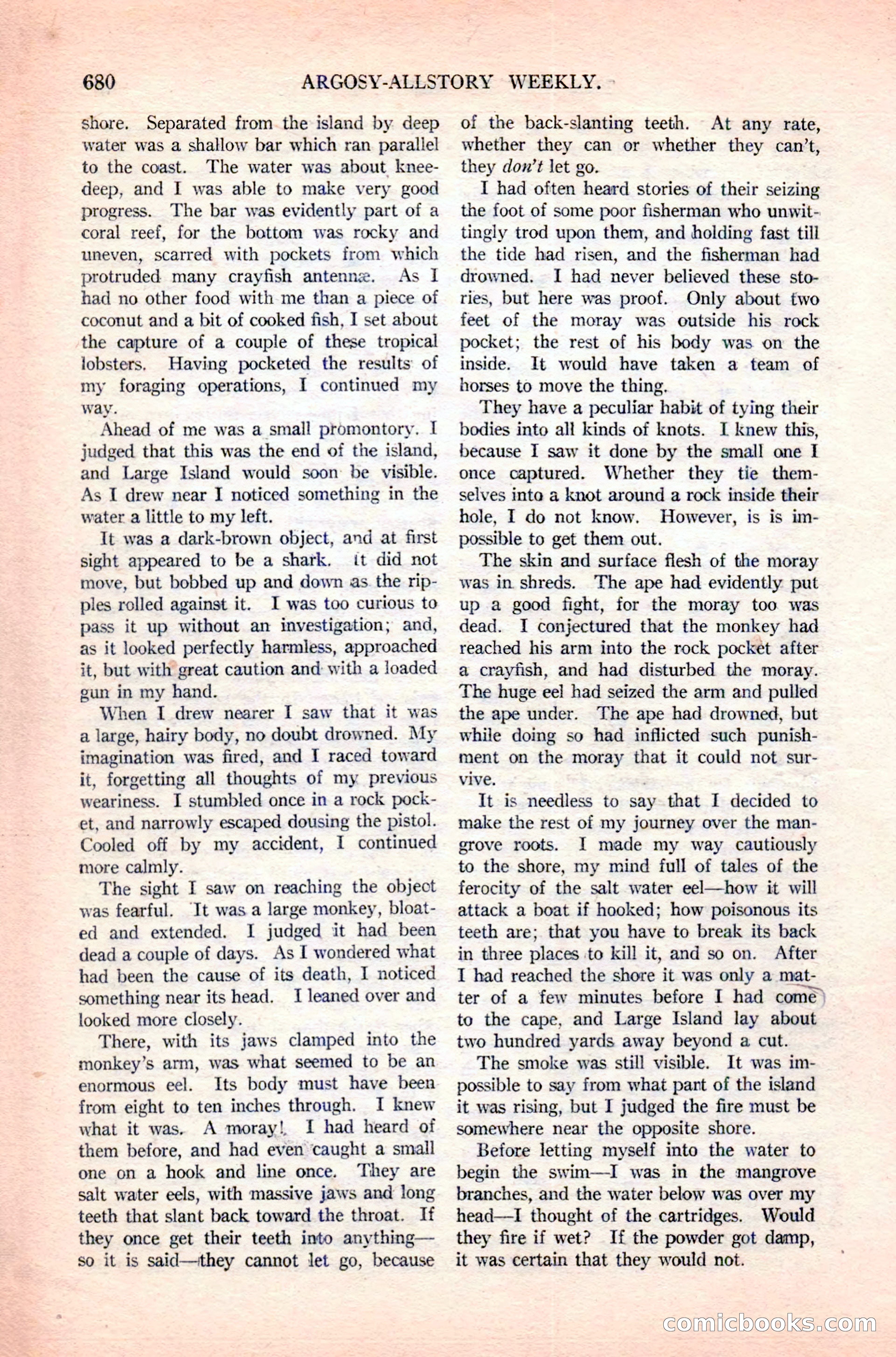
A restored page from Pulp Fiction, 1923. Page through the whole issue in the reader above.
📄 Transcribed text from this page (OCR, searchable)
Machine-transcribed from the original scan — historical spelling and the odd misread are preserved.
680 Shore. Separated from the island by deep water was a shallow bar which ran parallel to the coast. The water was about knee- deep, and I was able to make very good progress. The bar was evidently part of a coral reef, for the bottom was rocky and uneven, scarred with pockets from which protruded many crayfish antennz. As I had no other food with me than a piece of coconut and a bit of cooked fish, I set about the capture of a couple of these tropical lobsters. Having pocketed the results of my foraging operations, I continued my way. Ahead of me was a small promontory. I judged that this was the end of the island, and Large Island would soon be visible. As I drew near I noticed something in the water a little to my left. It was a dark-brown object, and at first sight appeared to be a shark. it did not move, but bobbed up and down as. the rip- ples rolled against it. I was too curious to pass it up without an investigation; and, as it looked perfectly harmless, approached it, but with great caution and with a loaded eun in my hand. When I drew nearer I saw that it was a large, hairy body, no doubt drowned. My imagination was fired, and I raced toward it, forgetting all thoughts of my previous weariness. I stumbled once in a rock pock- et, and narrowly escaped dousing the pistol. Cooled off by my accident, I continued more calmly. The sight I saw on reaching the object was fearful. It was a large monkey, bloat- ed and extended. I judged it had been dead a couple of days. As I wondered what had been the cause of its death, I noticed something near its head. I leaned over and looked more closely. There, with its jaws clamped into the monkey’s arm, was what seemed to be an enormous eel. Its body must have been from eight to ten inches through. I knew what it was. A moray! I had heard of them before, and had even caught a small one on a hook and line once. They are salt water eels, with massive jaws and long teeth that slant back toward the throat. If they once get their teeth into anything— so it is said—they cannot let go, because ARGOSY-ALLSTORY WEEKLY. > of the back-slanting teeth. At any rate, whether they can or whether they can’t, they don’t let go. I had often heard stories of their seizing the foot of some poor fisherman who unwit- tingly trod upon them, and holding fast till the tide had risen, and the fisherman had drowned. I had never believed these sto- ries, but here was proof. Only about two feet of the moray was outside his rock pocket; the rest of his body was on the inside. It would have taken a team of horses to move the thing. They have a peculiar habit of tying their bodies into all kinds of knots. I knew this, because I saw it done by the small one I once captured. Whether they tie them- selves into a knot around a rock inside their hole, I do not know. However, is is im- possible to get them out. The skin and surface flesh of the moray was in shreds. The ape had evidently put up a good fight, for the moray too was dead. I conjectured that the monkey had reached his arm into the rock pocket after a crayfish, and had disturbed the moray. The huge eel had seized the arm and pulled the ape under. The ape had drowned, but while doing so had inflicted such punish- ment on the moray that it could not sur- vive. ; It is needless to say that I decided to make the rest of my journey over the man- grove roots. I made my way cautiously to the shore, my mind full of tales of the ferocity of the salt water eel—how it will attack a boat if hooked; how poisonous its teeth are; that you have to break its back in three places to kill it, and so on. After I had reached the shore it was only a mat- ter of a few minutes before I had come) to the cape, and Large Island lay about two hundred yards away beyond a cut. The smoke was still visible. It was im- possible to say from what part of the island it was rising, but I judged the fire must be somewhere near the opposite shore. Before letting myself into the water to begin the swim—I was in the mangrove branches, and the water below was over my head—I thought of the cartridges. Would they fire if wet? If the powder got damp, it was certain that they would not. CORmMICLOoOokKs (C@)