
Pulp Fiction, 1923 · page 149 of 180
Argosy All-Story Weekly — page 149: what you’re looking at
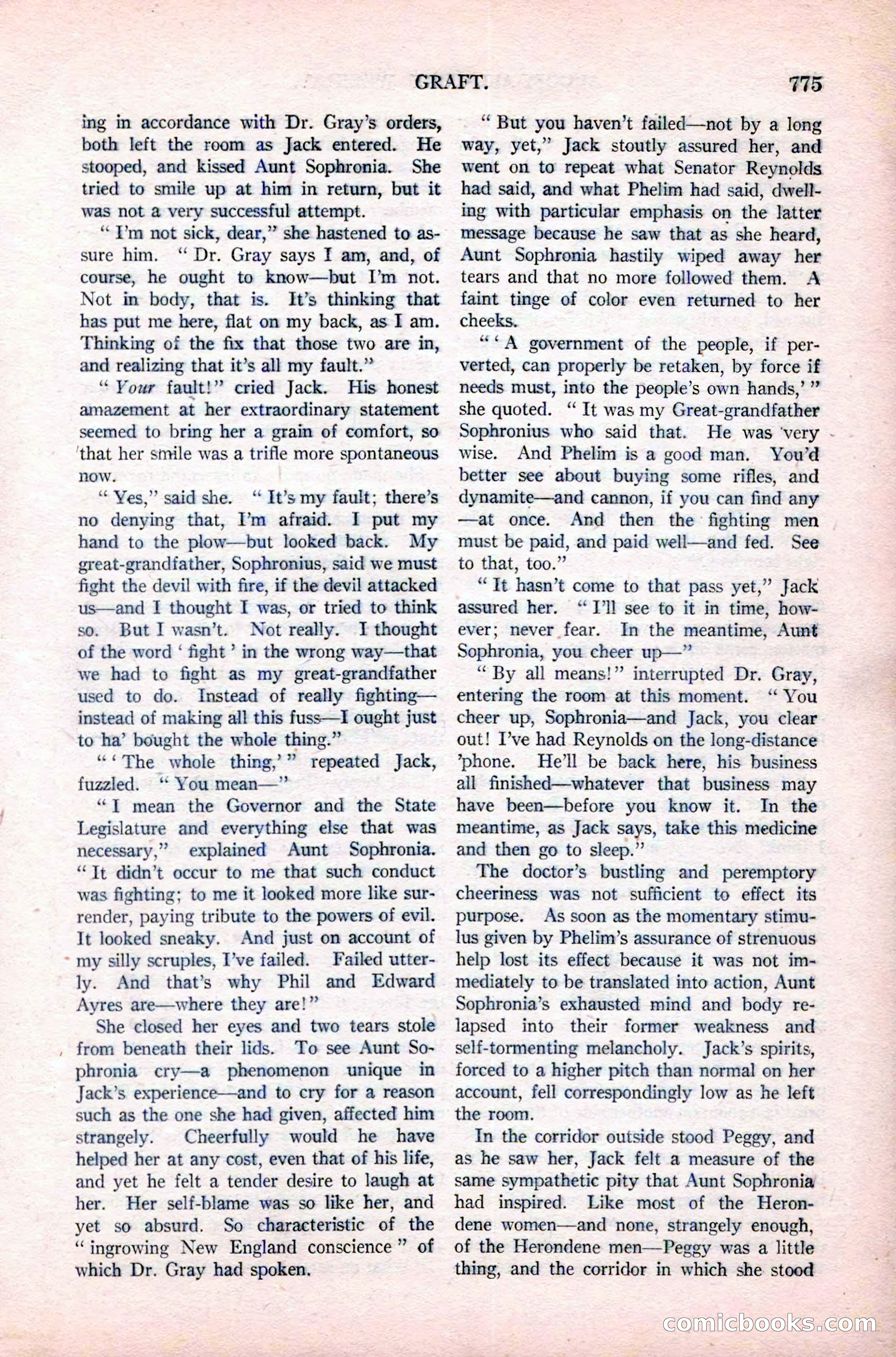
A restored page from Pulp Fiction, 1923. Page through the whole issue in the reader above.
📄 Transcribed text from this page (OCR, searchable)
Machine-transcribed from the original scan — historical spelling and the odd misread are preserved.
GRAFT. ing in accordance with Dr. Gray’s orders, both left the reom as Jack entered. He stooped, and kissed Aunt Sophronia. She tried to smile up at him in return, but it was not a very successful attempt. ‘‘ I’m not sick, dear,” she hastened to as- sure him. “ Dr. Gray says I am, and, of course, he ought to know—but I’m not. Not in body, that is. It’s thinking that has put me here, flat on my back, as I am. Thinking of the fix that those two are in, and realizing that it’s all my fault.” ‘“ Your fault!” cried Jack. His honest amazement at her extraordinary statement seemed to bring her a grain of comfort, so that her smile was a trifle more spontaneous now. “ Ves,’ said she. “ It’s my fault; there’s no denying that, I’m afraid. I put my hand to the plow—but looked back. My great-grandfather, Sophronius, said we must fight the devil with fire, if the devil attacked us—and I thought I was, or tried to think so. But I wasn’t. Not really. I thought of the word ‘ fight’ in the wrong way—that we had to fight as my great-grandfather used to do. Instead of really fighting— instead of making all this fuss—I ought just to ha’ bought the whole thing.” “<The whole thing,” repeated Jack, fuzzled. ‘“* You mean—”’ “I mean the Governor and the State Legislature and everything else that was necessary,” explained Aunt Sophronia. “Tt didn’t occur to me that such conduct was fighting; to me it looked more like sur- render, paying tribute to the powers of evil. It looked sneaky. And just on account of * my silly scruples, I’ve failed. Failed utter- ly. And that’s why Phil and Edward Ayres are—where they are!” She closed her eyes and two tears stole _ from beneath their lids. To see Aunt So- phronia cry—a phenomenon unique in Jack’s experience—and to cry for a reason such as the one she had given, affected him strangely. Cheerfully would he have helped her at any cost, even that of his life, and yet he felt a tender desire to laugh at her. Her self-blame was so like her, and yet so absurd. So characteristic of the ‘“ingrowing New England conscience” of which Dr. Gray had spoken. 745 ‘But you haven’t failed—not by a long way, yet,” Jack stoutly assured her, and went on to repeat what Senator Reynolds had said, and what Phelim had said, dwell- ing with particular emphasis on the latter message because he saw that as she heard, Aunt Sophronia hastily wiped away her tears and that no more followed them. A faint tinge of color even returned to her cheeks. ““A government of the people, if per- verted, can properly be retaken, by force if needs must, into the people’s own hands,’ ” she quoted. “ It was my Great-grandfather Sophronius who said that. wise. And Phelim is a good man. You’d better see about buying some rifles, and dynamite—and cannon, if you can find any —at once. And then the fighting men must be paid, and paid well—and fed. See to that, too.” “Tt hasn’t come to that pass yet,” Jack assured her. “I'll see to it in time, how- ever; never fear. In the meantime, Aunt Sophronia, you cheer up—” “By all means!” interrupted Dr. Gray, entering the room at this moment. ‘“‘ You cheer up, Sophronia—and Jack, you clear out! I’ve had Reynolds on the long-distance phone. He'll be back here, his business all finished—whatever that business may have been—before you know it. In the meantime, as Jack says, take this medicine and then go to sleep.” The doctor’s bustling and peremptory cheeriness was not sufficient to effect its purpose. As soon as the momentary stimu- lus given by Phelim’s assurance of strenuous help lost its effect because it was not im- mediately to be translated into action, Aunt Sophronia’s exhausted mind and body re- lapsed into their former weakness and self-tormenting melancholy. Jack’s spirits, forced to a higher pitch than normal on her account, fell correspondingly low as he left the room. In the corridor outside stood Peggy, and as he saw her, Jack felt a measure of the same sympathetic pity that Aunt Sophronia had inspired. Like most of the Heron- dene women—and none, strangely enough, of the Herondene men—Peggy was a little thing, and the corridor in which she stood COMmicoooks He was ‘very - (E@