
Pulp Fiction, 1923 · page 147 of 180
Argosy All-Story Weekly — page 147: what you’re looking at
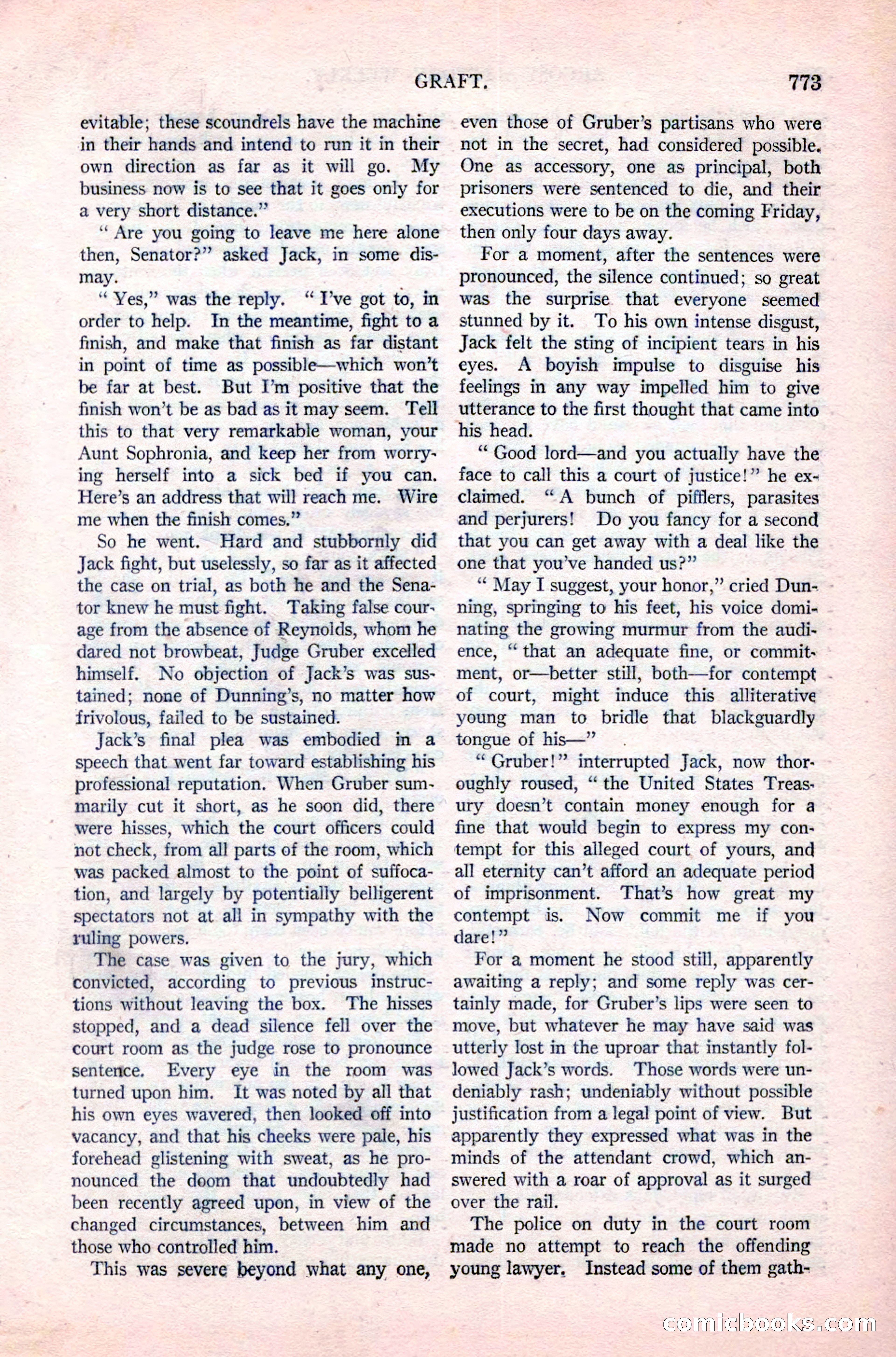
A restored page from Pulp Fiction, 1923. Page through the whole issue in the reader above.
📄 Transcribed text from this page (OCR, searchable)
Machine-transcribed from the original scan — historical spelling and the odd misread are preserved.
GRAFT. evitable; these scoundrels have the machine in their hands and intend to run it in their own direction as far as it will go. My business now Is to see that it goes only for a very short distance.” ‘Are you going to leave me here alone then, Senator?” asked Jack, in some dis- may. “ Ves,” was the reply. “I’ve got to, in order to help. In the meantime, fight to a finish, and make that finish as far distant in point of time as possible—which won’t be far at best. But I’m positive that the finish won’t be as bad as it may seem. Tell this to that very remarkable woman, your Aunt Sophronia, and keep her from worry- ing herself into a sick bed if you can. Here’s an address that will reach me. Wire me when the finish comes.” So he went. Hard and stubbornly did Jack fight, but uselessly, so far as it affected the case on trial, as both he and the Sena- tor knew he must fight. Taking false cour- age from the absence of Reynolds, whom he dared not browbeat, Judge Gruber excelled himself. No objection of Jack’s was sus- tained; none of Dunning’s, no matter how frivolous, failed to be sustained. Jack’s final plea was embodied m a speech that went far toward establishing his professional reputation. When Gruber sum- marily cut it short, as he soon did, there were hisses, which the court officers could not check, from all parts of the room, which was packed almost to the point of suffoca- tion, and largely by potentially belligerent spectators not at all in sympathy with the ruling powers. The case was given to the jury, which convicted, according to previous instruc- tions without leaving the box. The hisses stopped, and a dead silence fell over the court room as the judge rose to pronounce senterice. Every eye in the room was turned upon him. It was noted by all that his own eyes wavered, then looked off into vacancy, and that his cheeks were pale, his forehead glistening with sweat, as he pro- nounced the deom that undoubtedly had been recently agreed upon, in view of the changed circumstances, between him and those who controlled him. This was severe beyond what any one, 773 even those of Gruber’s partisans who were not in the secret, had considered possible. One as accessory, one as principal, both prisoners were sentenced to die, and their executions were to be on the coming Friday, then only four days away. For a moment, after the sentences were pronounced, the silence continued; so great was the surprise that everyone seemed stunned by it. To his own intense disgust, Jack felt the sting of incipient tears in his eyes. A boyish impulse to disguise his feelings in any way impelled him to give utterance to the first thought that came into his head. “Good lord—and you actually have the face to call this a court of justice!” he ex- claimed. “A bunch of pifflers, parasites and perjurers! Do you fancy for a second that you can get away with a deal like the one that you’ve handed us?” ‘“* May I suggest, your honor,” cried Dun- - ning, springing to his feet, his voice domi- nating the growing murmur from the audi- ence, “that an adequate fine, or commit- ment, or—better still, both—for contempt - of court, might induce this alliterative young man to bridle that blackguardly tongue of his—” “Gruber!” interrupted Jack, now thor- oughly roused, “the United States Treas- ury doesn’t contain money enough for a fine that would begin to express my con- tempt for this alleged court of yours, and all eternity can’t afford an adequate period of imprisonment. That’s how great my contempt is. Now commit me if you dare!” For a moment he stood still, apparently awaiting a reply; and some reply was cer- tainly made, for Gruber’s lips were seen to move, but whatever he may have said was utterly lost in the uproar that instantly fol- lowed Jack’s words. Those words were un- deniably rash; undeniably without possible justification from a legal point of view. But apparently they expressed what was in the minds of the attendant crowd, which an- swered with a roar of approval as it surged over the rail. The police on duty in the court room made no attempt to reach the offending young lawyer. COmMicoooks Instead some of them gath- - (E@