
Pulp Fiction, 1923 · page 138 of 180
Argosy All-Story Weekly — page 138: what you’re looking at
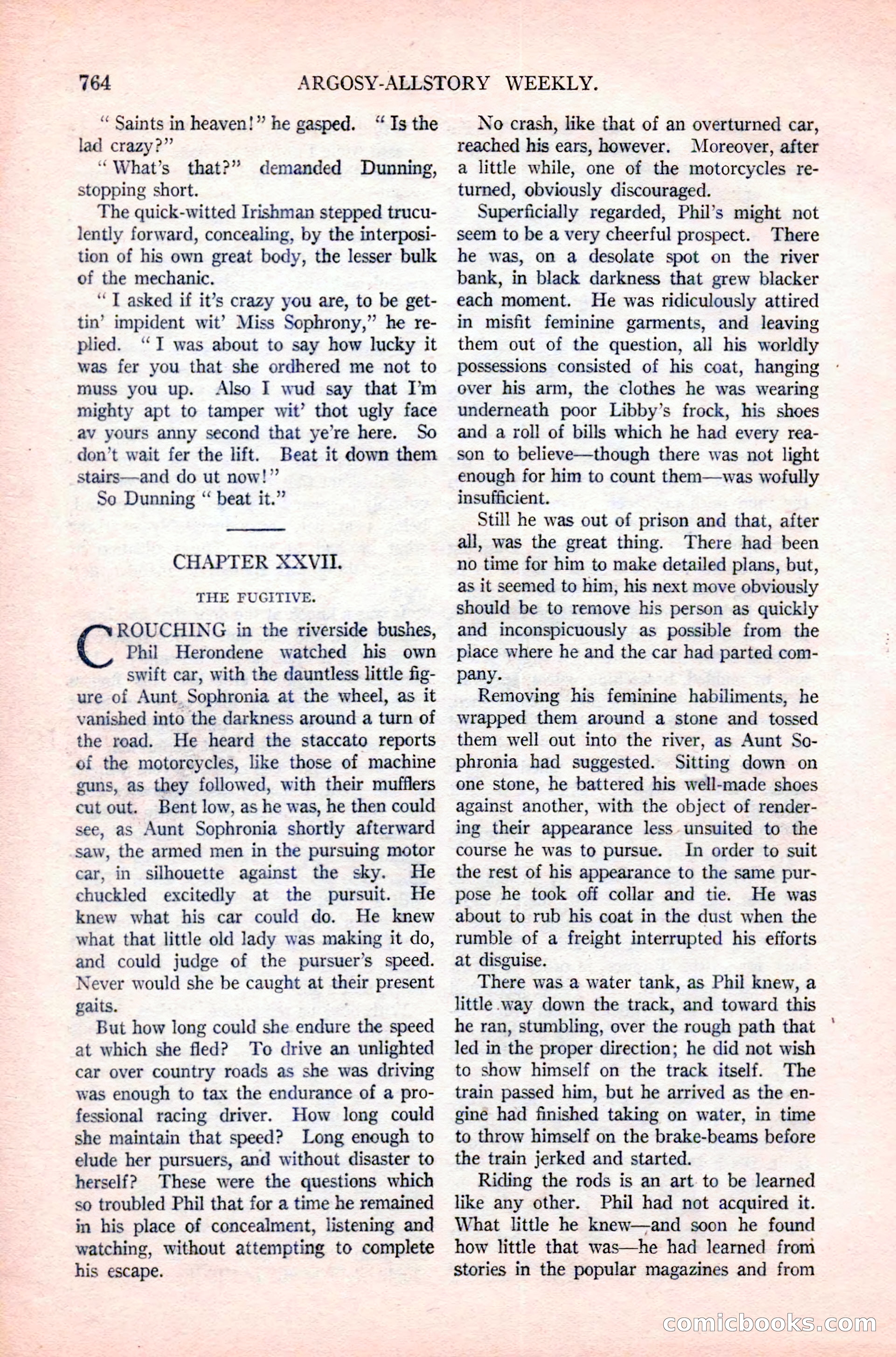
A restored page from Pulp Fiction, 1923. Page through the whole issue in the reader above.
📄 Transcribed text from this page (OCR, searchable)
Machine-transcribed from the original scan — historical spelling and the odd misread are preserved.
764 ‘‘ Saints in heaven!” he gasped. “Is the lad crazy?” ‘“What’s that?” demanded Dunning, stopping short. The quick-witted Irishman stepped trucu- lently forward, concealing, by the interposi- tion of his own great body, the lesser bulk of the mechanic. ‘I asked if it’s crazy you are, to be get- tin’ impident wit’ Miss Sophrony,” he re- plied. ‘I was about to say how lucky it was fer you that she ordhered me not to muss you up. Also I wud say that I’m mighty apt to tamper wit’ thot ugly face av yours anny second that ye’re here. So don’t wait fer the lift. Beat it down them stairs—and do ut now!” So Dunning “ beat it.” CHAPTER XXVII. THE FUGITIVE. ROUCHING in the riverside bushes, Phil Herondene watched his own swift car, with the dauntless little fig- ure of Aunt. Sophronia at the wheel, as it vanished into the darkness around a turn of the read. He heard the staccato reports of the motoreycles, like those of machine guns, as they followed, with their mufflers cut out. Bent low, as he was, he then could see, as Aunt Sophronia shortly afterward saw, the armed men in the pursuing motor car, in silhouette against the sky. He chuckled excitedly at the pursuit. He knew what his car could do. He knew what that little old lady was making it do, and could judge of the pursuer’s speed. Never would she be caught at their present gaits. But how long could she endure the speed at which she fled? To drive an unlighted car over country roads as she was driving was enough to tax the endurance of a pro- fessional racing driver. How long could she maintain that speed? Long enough to elude her pursuers, and without disaster to herself? These were the questions which so troubled Phil that for a time he remained in his place of concealment, listening and watching, without attempting to complete his escape. ARGOSY-ALLSTORY WEEKLY. No crash, like that of an overturned car, reached his ears, however. Moreover, after a little while, one of the motorcycles re- turned, obviously discouraged. Superficially regarded, Phil’s might not seem to be a very cheerful prospect. There he was, on a desolate spot on the river bank, in black darkness that grew blacker each moment. He was ridiculously attired in misfit feminine garments, and leaving them out of the question, all his worldly possessions consisted of his coat, hanging - over his arm, the clothes he was wearing underneath poor Libby’s frock, his shoes and a roll of bills which he had every rea- son to believe—though there was not light enough for him to count them—was wofully insufficient. Still he was out of prison and that, after all, was the great thing. There had been no time for him to make detailed plans, but, as it seemed to him, his next move obviously should be to remove his person as quickly and inconspicuously as possible from the piace where he and the car had parted com- pany. Removing his feminine habiliments, he wrapped them around a stone and tossed them well out into the river, as Aunt So- phronia had suggested. Sitting down on one stone, he battered his well-made shoes against another, with the object of render- ing their appearance less unsuited to the course he was to pursue. In order to suit the rest of his appearance to the same pur- pose he took off collar and tie. He was about to rub his coat in the dust when the rumble of a freight interrupted his efforts at disguise. There was a water tank, as Phil knew, a little way down the track, and toward this he ran, stumbling, over the rough path that led in the proper direction; he did not wish to show himself on the track itself. The train passed him, but he arrived as the en- gine had finished taking on water, in time to throw himself on the brake-beams before the train jerked and started. Riding the rods is an art to be learned like any other. Phil had not acquired it. What little he knew—and soon he found how little that was—he had learned from stories in the popular magazines and from COmicoooks = (C@