
Pulp Fiction, 1922 · page 95 of 176
Argosy All-Story Weekly — page 95: what you’re looking at
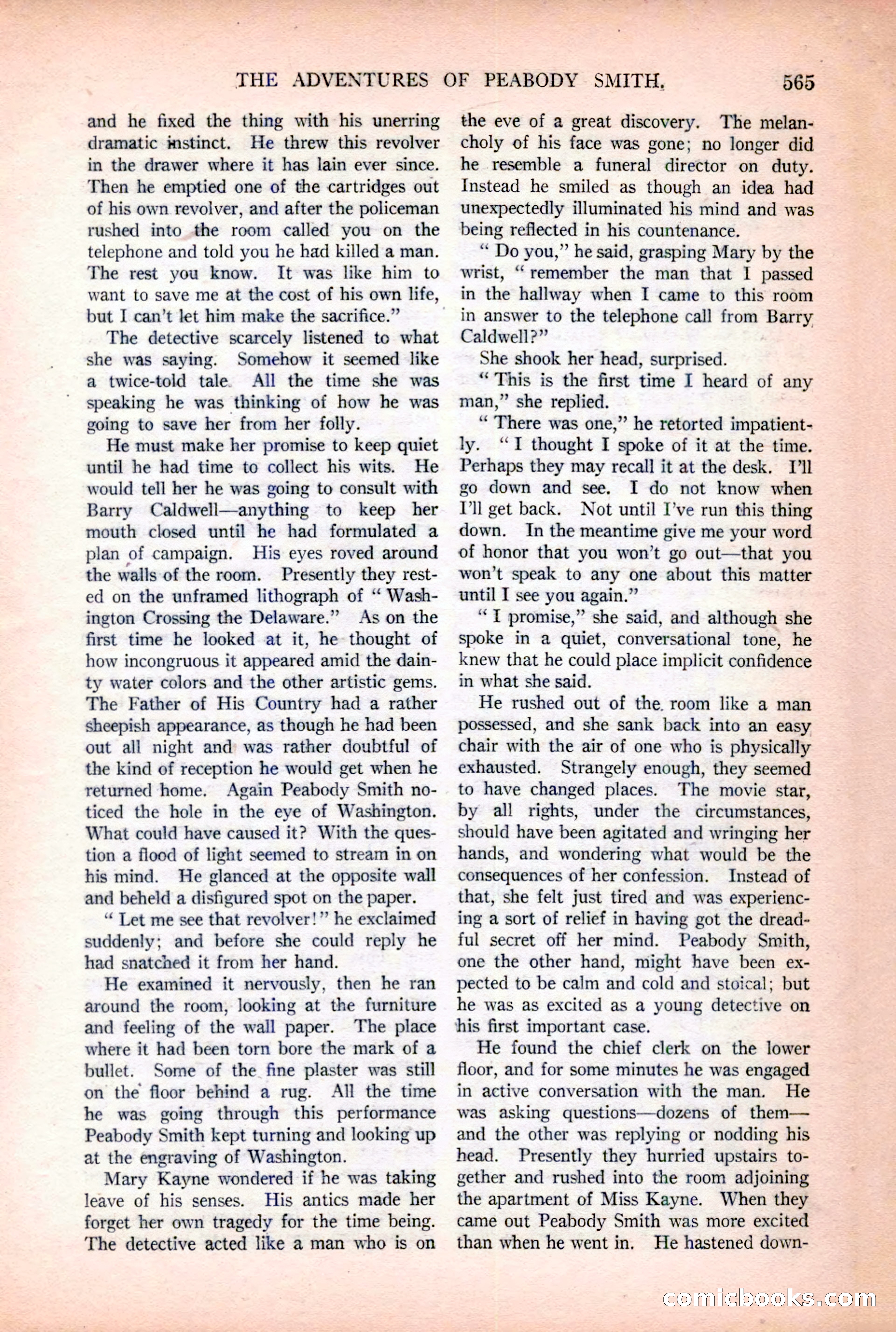
A restored page from Pulp Fiction, 1922. Page through the whole issue in the reader above.
📄 Transcribed text from this page (OCR, searchable)
Machine-transcribed from the original scan — historical spelling and the odd misread are preserved.
THE ADVENTURES OF PEABODY SMITH. 565 and he fixed the thing with his unerring dramatic mstinct. He threw this revolver in the drawer where it has lain ever since. Then he emptied one of the cartridges out of his own revolver, and after the policeman rushed into the room called you on the telephone and told you he had killed a man. The rest you know. It was like him to want to save me at the cost of his own life, but I can’t let him make the sacrifice.” The detective scarcely listened te what she was saying. Somehow it seemed like a twice-told tale. All the time she was speaking he was thinking of how he was going to save her from her folly. He must make her promise to keep quiet until he had time to collect his wits. He would tell her he was going to consult with Barry Caldwell—anything to keep her mouth closed until he had formulated a plan of campaign. His eyes roved around the walls of the room. Presently they rest- ed on the unframed lithograph of “‘ Wash- ington Crossing the Delaware.” As on the first time he looked at it, he thought of how incongruous it appeared amid the dain- ty water colors and the other artistic gems. The Father of His Country had a rather sheepish appearance, as though he had been out all night and was rather doubtful of the kind of reception he would get when he returned home. Again Peabody Smith no- ticed the hole in the eye of Washington. What could have caused it? With the ques- tion a flood of light seemed to stream in on his mind. He glanced at the opposite wall and beheld a disfigured spot on the paper. “ Let me see that revolver!” he exclaimed suddenly; and before she could reply he had snatched it from her hand. He examined it nervously, then he ran around the room, looking at the furniture and feeling of the wall paper. The place where it had been torn bore the mark of a bullet. Some of the fine plaster was still on the floor behind a rug. All the time he was going through this performance Peabody Smith kept turning and looking up at the engraving of Washington. Mary Kayne wondered if he was taking leave of his senses. His antics made her forget her own tragedy for the time being. The detective acted like a man who is on the eve of a great discovery. The melan- choly of his face was gone; no longer did he resemble a funeral director on duty. Instead he smiled as though an idea had unexpectedly illuminated his mind and was being reflected in his countenance. “ Do you,” he said, grasping Mary by the wrist, “remember the man that I passed in the hallway when I came to this room in answer to the telephone call from Barry Caldwell?” She shook her head, surprised. “This is the first time I heard of any man,” she replied. “There was one,” he retorted impatient- ly. “TI thought I spoke of it at the time. Perhaps they may recall it at the desk. I'll go down and see. I do not know when I'll get back. Not until I’ve run this thing down. In the meantime give me your word of honor that you won’t go out—that you won’t speak to any one about this matter until I see you again.” ‘“{ promise,” she said, and although she spoke in a quiet, conversational tone, he knew that he could place implicit confidence in what she said. He rushed out of the room like a man possessed, and she sank back into an easy chair with the air of one who is physically exhausted. Strangely enough, they seemed to have changed places. The movie star, by all rights, under the circumstances, should have been agitated and wringing her hands, and wondering what would be the consequences of her confession. Instead of that, she felt just tired and was experienc- ing a sort of relief in having got the dread- ful secret off her mind. Peabody Smith, one the other hand, might have been ex- pected to be calm and cold and stoical; but he was as excited as a young detective on his first important case. He found the chief clerk on the lower floor, and for some minutes he was engaged in active conversation with the man. He was asking questions—dozens of them— and the other was replying or nodding his head. Presently they hurried upstairs to- gether and rushed into the room adjoining the apartment of Miss Kayne. When they came out Peabody Smith was more excited than when he went in. He hastened down- Gomichbooks.com