
Pulp Fiction, 1922 · page 156 of 176
Argosy All-Story Weekly — page 156: what you’re looking at
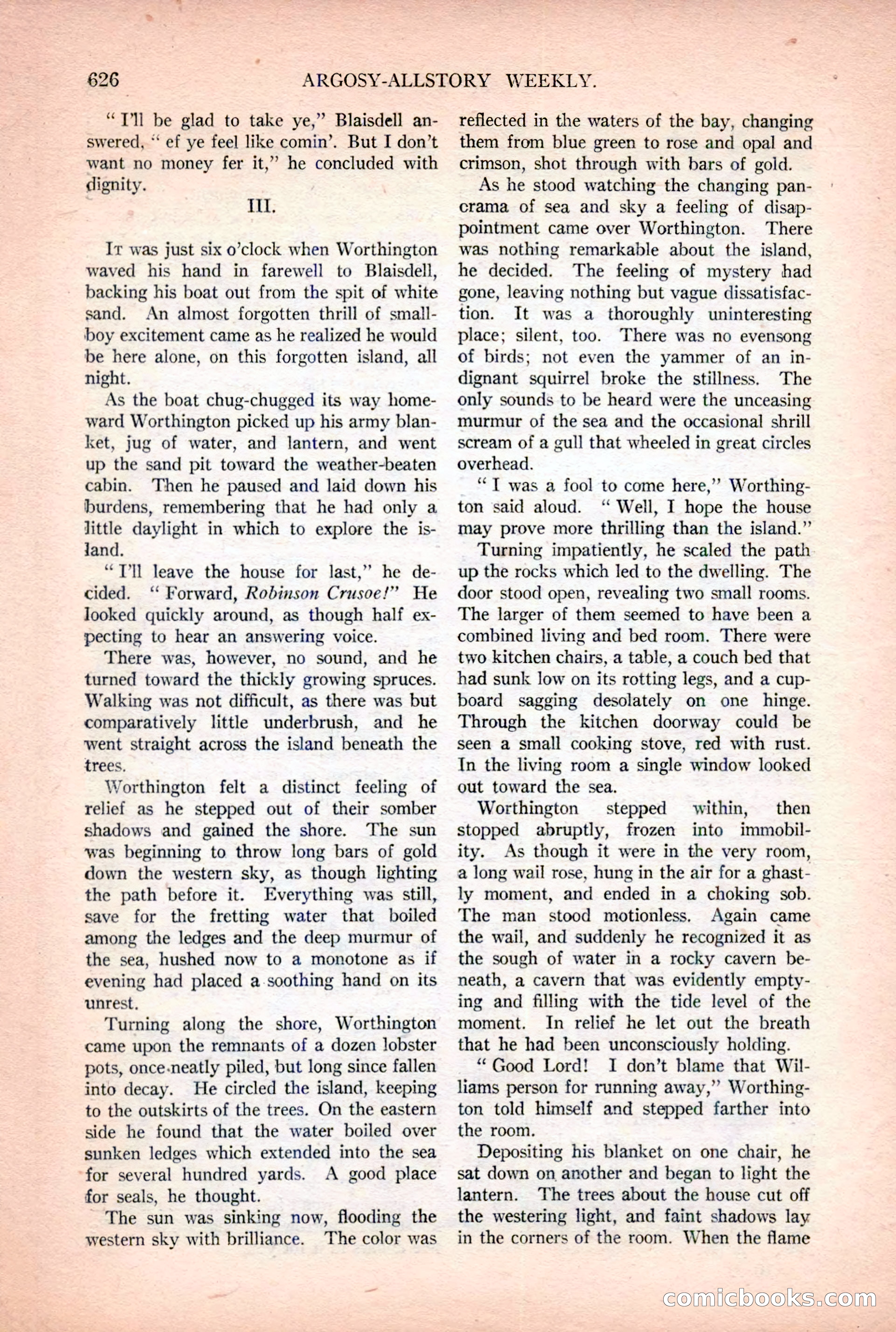
A restored page from Pulp Fiction, 1922. Page through the whole issue in the reader above.
📄 Transcribed text from this page (OCR, searchable)
Machine-transcribed from the original scan — historical spelling and the odd misread are preserved.
626 “Tl be glad to take ye,” Blaisdell an- swered, *‘ ef ye feel like comin’. But I don’t want no money fer it,” he concluded with dignity. II, It was just six o’clock when Worthington waved his hand in farewell to Blaisdell, backing his boat out from the spit of white sand. An almost forgotten thrill of small- boy excitement came as he realized he would be here alone, on this forgotten island, all night. As the boat chug-chugged its way home- ward Worthington picked up his army blan- ket, jug of water, and lantern, and went up the sand pit toward the weather-beaten cabin. Then he paused and laid down his burdens, remembering that he had only a little daylight in which to explore the is- jand. “T'll leave the house for last,” he de- cided. ‘‘ Forward, Robinson Crusoe!’ He looked quickly around, as though half ex- pecting to hear an answering voice. There was, however, no sound, and he turned toward the thickly growing spruces. Walking was not difficult, as there was but comparatively little underbrush, and he went straight across the island beneath the trees. Worthington felt a distinct feeling of relief as he stepped out of their somber shadows and gained the shore. The sun was beginning to throw long bars of gold down the western sky, as though lighting the path before it. Everything was still, save for the fretting water that boiled among the ledges and the deep murmur of the sea, hushed now to a monotone as if evening had placed a-soothing hand on its unrest. Turning along the shore, Worthington came upon the remnants of a dozen lobster pots, once-neatly piled, but long since fallen into decay. He circled the island, keeping to the outskirts of the trees. On the eastern side he found that the water boiled over sunken ledges which extended into the sea ‘for several hundred yards. A good place for seals, he thought. The sun was sinking now, flooding the western sky with brilliance. The color was ARGOSY-ALLSTORY WEEKLY. reflected in the waters of the bay, changing them from blue green to rose and opal and crimson, shot through with bars of gold. As he stood watching the changing pan- crama of sea and sky a feeling of disap- pointment came over Worthington. There was nothing remarkable about the island, he decided. The feeling of mystery had gone, leaving nothing but vague dissatisfac- tion. It was a thoroughly uninteresting place; silent, too. There was no evensong of birds; not even the yammer of an in- dignant squirrel broke the stillness. The only sounds to be heard were the unceasing murmur of the sea and the occasional shrill scream of a gull that wheeled in great circles overhead. “IT was a fool to come here,’’ Worthing- ton said aloud. “ Well, I hope the house may prove more thrilling than the island.” Turning impatiently, he scaled the path up the rocks which led to the dwelling. The door stood open, revealing two small rooms. The larger of them seemed to have been a combined living and bed room. There were two kitchen chairs, a table, a couch bed that had sunk low on its rotting legs, and a cup- board sagging desolately on one hinge. Through the kitchen doorway could be seen a small cooking stove, red with rust. In the living room a single window looked out toward the sea. Worthington stepped within, then stopped abruptly, frozen into immobil- ity. As though it were in the very room, a long wail rose, hung in the air for a ghast- ly moment, and ended in a choking sob. The man stood motionless, Again came the wail, and suddenly he recognized it as the sough of water in a rocky cavern be- neath, a cavern that was evidently empty- ing and filling with the tide level of the moment. In relief he let out the breath that he had been unconsciously holding. “Good Lord! I don’t blame that Wil- liams person for running away,” Worthing- ton told himself and stepped farther into the room. Depositing his blanket on one chair, he sat down on another and began to light the lantern. The trees about the house cut off the westering light, and faint shadows lay in the corners of the room. When the flame CommicoookxS.CGOnn