
Pulp Fiction, 1922 · page 153 of 176
Argosy All-Story Weekly — page 153: what you’re looking at
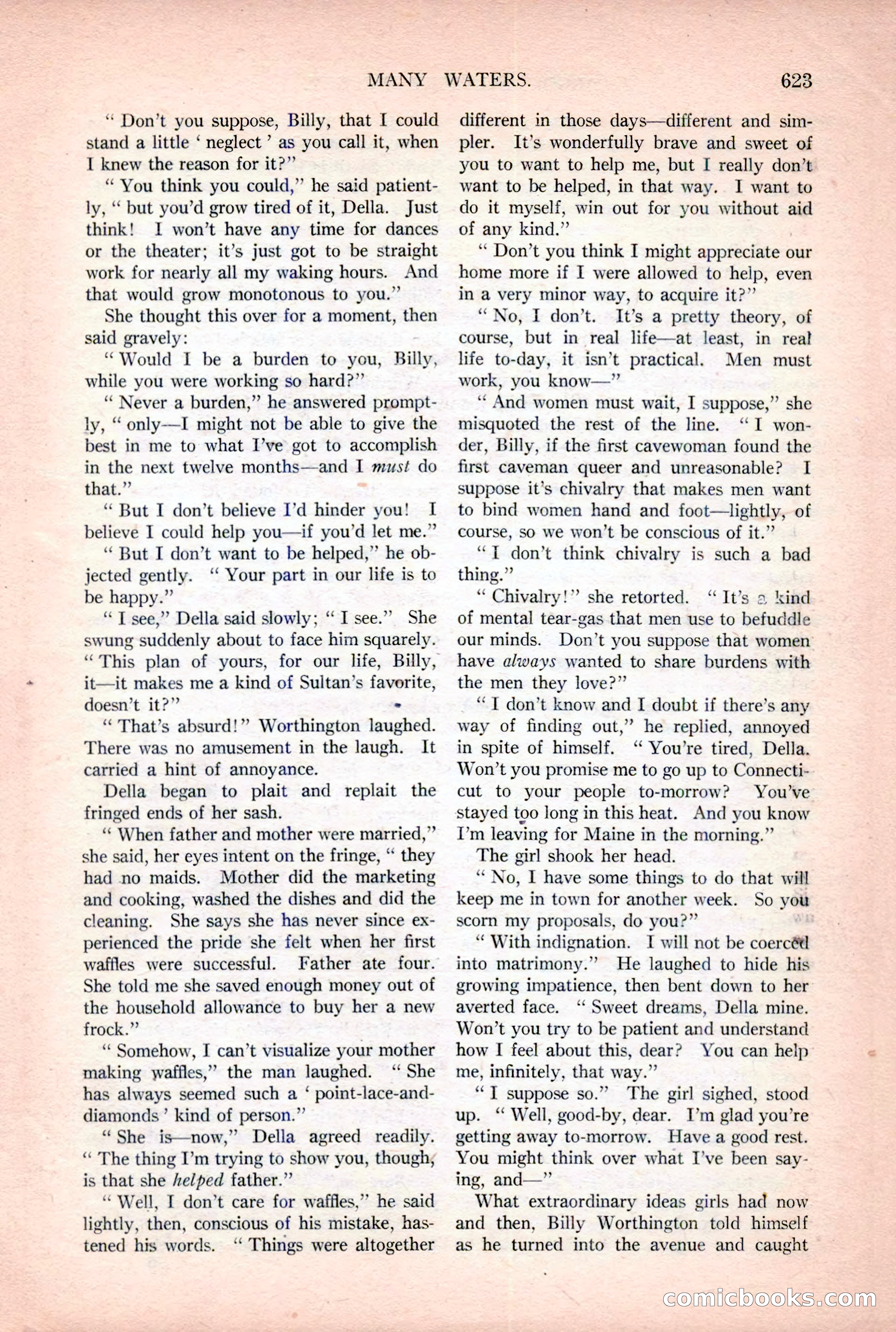
A restored page from Pulp Fiction, 1922. Page through the whole issue in the reader above.
📄 Transcribed text from this page (OCR, searchable)
Machine-transcribed from the original scan — historical spelling and the odd misread are preserved.
MANY WATERS. ‘“ Don’t you suppose, Billy, that I could stand a little ‘ neglect ’ as you call it, when I knew the reason for it?” “ You think you could,” he said patient- ly, “‘ but you’d grow tired of it, Della. Just think! I won’t have any time for dances or the theater; it’s just got to be straight work for nearly all my waking hours. And that would grow monotonous to you.” She thought this over for a moment, then said gravely: ‘Would I be a burden to you, Billy, while you were working so hard?” ‘““ Never a burden,” he answered prompt- ly, “ only—I might not be able to give the best in me to what I’ve got to accomplish in the next twelve months—and I must do that.” ‘“ But I don’t believe I’d hinder you! I believe I could help you—if you’d let me.” ‘‘ But I don’t want to be helped,” he ob- jected gently. ‘‘ Your part in our life is to be happy.” “ T see,” Della said slowly; “I see.”’ She swung suddenly about to face him squarely. “This plan of yours, for our life, Billy, it—it makes me a kind of Sultan’s favorite, doesn’t it?” - ‘“That’s absurd!” Worthington laughed. There was no amusement in the laugh. It carried a hint of annoyance. Della began to plait and replait the fringed ends of her sash. ‘‘ When father and mother were married,” she said, her eyes intent on the fringe, “ they had no maids. Mother did the marketing and cooking, washed the dishes and did the cleaning. She says she has never since ex- perienced the pride she felt when her first waffles were successful. Father ate four. She told me she saved enough money out of the household allowance to buy her a new frock.”’ ‘“ Somehow, I can’t visualize your mother making waffles,” the man laughed. ‘ She has always seemed such a ‘ point-lace-and- diamonds ’ kind of person.” “She is—now,” Della agreed readily. “ The thing I’m trying to show you, though, is that she Helped father.” “ Well, I don’t care for waffles,” he said lightly, then, conscious of his mistake, has- tened his words. “ Things were altogether 623 different in those days—different and sim- pler. It’s wonderfully brave and sweet of you to want to help me, but I really don’t want to be helped, in that way. I want to do it myself, win out for you without aid of any kind.” ‘* Don’t you think I might appreciate our home more if I were allowed to help, even in a very minor way, to acquire it?” ‘No, I don’t. It’s a pretty theory, of course, but in real life—at least, in real life to-day, it isn’t practical. Men must work, you know—”’ ‘And women must wait, I suppose,’’ she misquoted the rest of the line. “I won- der, Billy, if the first cavewoman found the first caveman queer and unreasonable? I suppose it’s chivalry that makes men want to bind women hand and foot—lightly, of course, so we won’t be conscious of it.” ‘“{ don’t think chivalry is such a bad thing.” “Chivalry!” she retorted. “It’s a kind of mental tear-gas that men use to befuddle our minds. Don’t you suppose that women have always wanted to share burdens with the men they love?” ‘“ T don’t know and I doubt if there’s any way of finding out,” he replied, annoyed in spite of himself. ‘“ You’re tired, Della. Won’t you promise me to go up to Connecti- cut to your people to-morrow? You’ve stayed too long in this heat. And you know I’m leaving for Maine in the morning.” The girl shook her head. ‘“ No, I have some things to do that will keep me in town for another week. So you scorn my proposals, do you?” “ With indignation. I will not be coercél into matrimony.” He laughed to hide his growing impatience, then bent down to her averted face. ‘‘ Sweet dreams, Della mine. Won’t you try to be patient and understand how I feel about this, dear? You can help me, infinitely, that way.” ““T suppose so.” The girl sighed, stood up. “ Well, good-by, dear. I’m glad you’re getting away to-morrow. Have a good rest. You might think over what I’ve been say- ing, and—”’ What extraordinary ideas girls had now and then, Billy Worthington told himself as he turned into the avenue and caught Gomichbooks;com