
Pulp Fiction, 1919 · page 99 of 196
Argosy and Railroad Man's Magazine — page 99: what you’re looking at
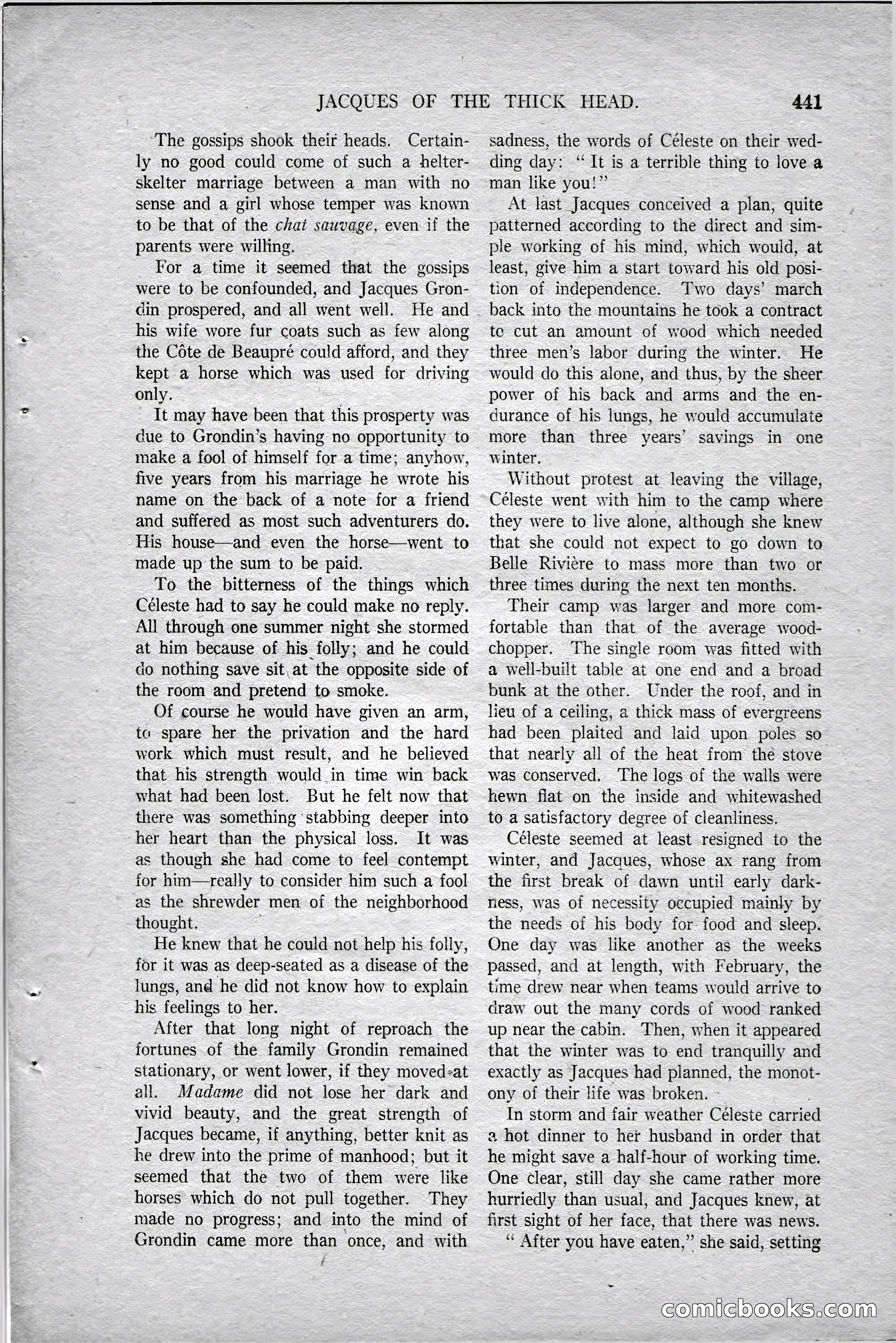
A restored page from Pulp Fiction, 1919. Page through the whole issue in the reader above.
📄 Transcribed text from this page (OCR, searchable)
Machine-transcribed from the original scan — historical spelling and the odd misread are preserved.
JACQUES OF THE THICK HEAD. “The gossips shook their heads. Certain- ly no good could come of such a helter- skelter marriage between a man with no sense and a girl whose temper was known to be that of the chai sauvage, even if the parents were willing. For a time it seemed that the gossips were to be confounded, and Jacques Gron- cin prospered, and all went well. his wife wore fur coats such as few along the Cote de Beaupré could afford, and they kept a horse which was used for driving only. It may have been that this prosperty was due to Grondin’s having no opportunity to make a fool of himself for a time; anyhow, five years from his marriage he wrote his name on the back of a note for a friend and suffered as most such adventurers do. His house—and even the horse—went to made up the sum to be paid. To the bitterness of the things which Céleste had to say he could make no reply. All through one summer night she stormed at him because of his folly; and he could do nothing save sit, at the opposite side of the room and pretend to smoke. Of course he would have given an arm, to spare her the privation and the hard work which must result, and he believed that his strength would in time win back what had been lost. But he felt now that there was something ‘stabbing deeper into her heart than the physical loss. It was as though she had come to feel contempt for him—really to consider him such a fool as the shrewder men of the neighborhood thought. : He knew that he could not help his folly, for it was as deep-seated as a disease of the lungs, and he did not know how to explain his feelings to her. After that long night of reproach the fortunes of the family Grondin remained stationary, or went lower, if they moved-at all. Madame did not lose her dark and vivid beauty, and the great strength of Jacques became, if anything, better knit as he drew into the prime of manhood; but it seemed that the two of them were like horses which do not pull together. They made no progress; and into the mind of Grondin came more than once, and with f He and . 441 sadness, the words of Céleste on their wed- ding day: “It is a terrible thing to love a man like you!” At last Jacques conceived a plan, quite patterned according to the direct and sim- ple working ef his mind, which would, at least, give him a start toward his old posi- tion of independence. Two days’ march back into the mountains he took a contract te cut an amount of wood which needed three men’s labor during the winter. He would do this alone, and thus, by the sheer power of his back and arms and the en- durance of his lungs, he would accumulate more than three years’ savings in one winter. Without protest at leaving the village, Céleste went with him to the camp where they were to live alone, although she knew that she could not expect to go down to Belle Riviere to mass more than two or three times during the next ten months. Their camp was larger and more com- fortable than that of the average wood- chopper. The single room was fitted with a well-built table at one end and a broad bunk at the other. Under the roof, and in lieu of a ceiling, a thick mass of evergreens had been plaited and laid upon poles so that nearly all of the heat from thé stove was conserved, The logs of the walls were hewn flat on the inside and whitewashed to a satisfactory degree of cleanliness. Céleste seemed at least resigned to the winter, and Jacques, whose ax rang from the first break of dawn until early dark- ness, was of necessity occupied mainly by the needs of his body for- food and sleep. One day was like another as the weeks passed, and at length, with February, the time drew near when teams would arrive to draw out the many cords of wood ranked up near the cabin. Then, when it appeared that the winter was to end tranquilly and exactly as Jacques had planned, the monot- ony of their life was broken. - In storm and fair weather Céleste carried a hot dinner to her husband in order that he might save a half-hour of working time. One clear, still day she came rather more hurriedly than usual, and Jacques knew, at first sight of her face, that there was news. “ After you have eaten,” she said, setting ComnmiclooolkxS.conn