
Pulp Fiction, 1919 · page 65 of 196
Argosy and Railroad Man's Magazine — page 65: what you’re looking at
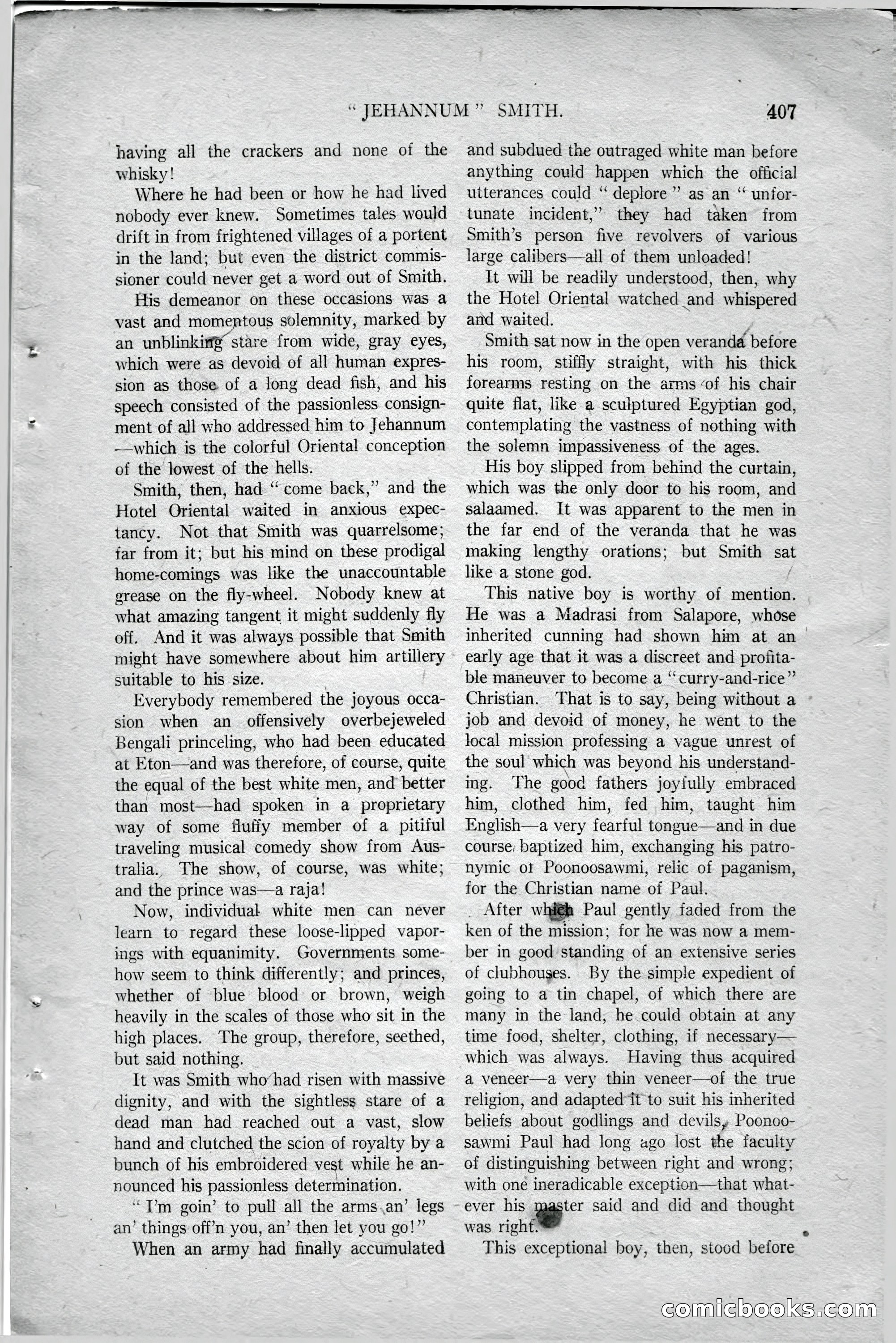
A restored page from Pulp Fiction, 1919. Page through the whole issue in the reader above.
📄 Transcribed text from this page (OCR, searchable)
Machine-transcribed from the original scan — historical spelling and the odd misread are preserved.
a ‘“ JEHANNUM” SMITH. 407 having all the crackers and none of the whisky! Where he had been or how he had lived nobody ever knew. Sometimes tales would drift in from frightened villages of a portent in the land; but even the district commis- sioner could never get a word out of Smith. His demeanor on these occasions was a vast and momentous solemnity, marked by an unblinkirf® stare from wide, gray eyes, which were as devoid of all human expres- sion as those of a long dead fish, and his speech consisted of the passionless consign- ment of all who addressed him to Jehannum —which is the colorful Oriental conception of the lowest of the hells. Smith, then, had “come back,” and the Hotel Oriental waited in anxious expec- tancy. Not that Smith was quarrelsome; far from it; but his mind on these prodigal home-comings was like the unaccountable grease on the fly-wheel. Nobody knew at what amazing tangent it might suddenly fly off. And it was always possible that Smith might have somewhere about him artillery suitable to his size. Everybody remembered the joyous occa- sion when an offensively overbejeweled Bengali princeling, who had been educated at Eton—and was therefore, of course, quite the equal of the best white men, and better than most—had spoken in a proprietary way of some fluffy member of a pitiful traveling musical comedy show from Aus- tralia. The show, of course, was white; and the prince was—a raja! Now, individual white men can never learn to regard these loose-lipped vapor- ings with equanimity. Governments some- how seem to think differently; and princes, whether of blue blood or brown, weigh heavily in the scales of those who sit in the high places. The group, therefore, seethed, but said nothing. It was Smith who’had risen with massive dignity, and with the sightless stare of a dead man had reached out a vast, slow hand and clutched the scion of royalty by a bunch of his embroidered vest while he an- nounced his passionless determination. “Tm goin’ to pull all the arms.an’ legs an’ things off’n you, an’ then let you go!” When an army had finally accumulated and subdued the outraged white man before anything could happen which the official utterances could ‘“‘ deplore’ as an ‘ unfor- tunate incident,” they had taken from Smith’s person five revolvers of various large calibers—all of them unloaded! It will be readily understood, then, why the Hotel Oriental watched and whispered and waited. : Smith sat now in the open veranda before his room, stiffly straight, with his thick forearms resting on the arms ‘of his chair quite flat, like a sculptured Egyptian god, contemplating the vastness of nothing with the solemn impassiveness of the ages. His boy slipped from behind the curtain, which was the only door to his room, and salaamed. It was apparent to the men in the far end of the veranda that he was making lengthy orations; but Smith sat like a stone god. ; This native boy is worthy of mention. He was a Madrasi from Salapore, whose inherited cunning had shown him at an early age that it was a discreet and profita- ble maneuver to become a “curry-and-rice” Christian. That is to say, being without a job and devoid of money, he went to the local mission professing a vague unrest of the soul which was beyond his understand- ing. The good fathers joyfully embraced him, clothed him, fed him, taught him English—a very fearful tongue—and in due course: baptized him, exchanging his patro- nymic of Poonoosawmi, relic of paganism, for the Christian name of Paul. . After whih Paul gently faded from the ken of the mission; for he was now a mem- ber in good standing of an extensive series of clubhouses. By the simple expedient of going to a tin chapel, of which there are many in the land, he could obtain at any time food, shelter, clothing, if necessary— which was always. Having thus acquired a veneer—a very thin veneer—of the true religion, and adapted it to suit his inherited beliefs about godlings and devilsy Poonoo- sawmi Paul had long ago lost the faculty of distinguishing between right and wrong; with one ineradicable exception—that what- ever his a said and did and thought was right. 2 This exceptional boy, then, stood before comicbooks-com