
Pulp Fiction, 1919 · page 47 of 196
Argosy and Railroad Man's Magazine — page 47: what you’re looking at
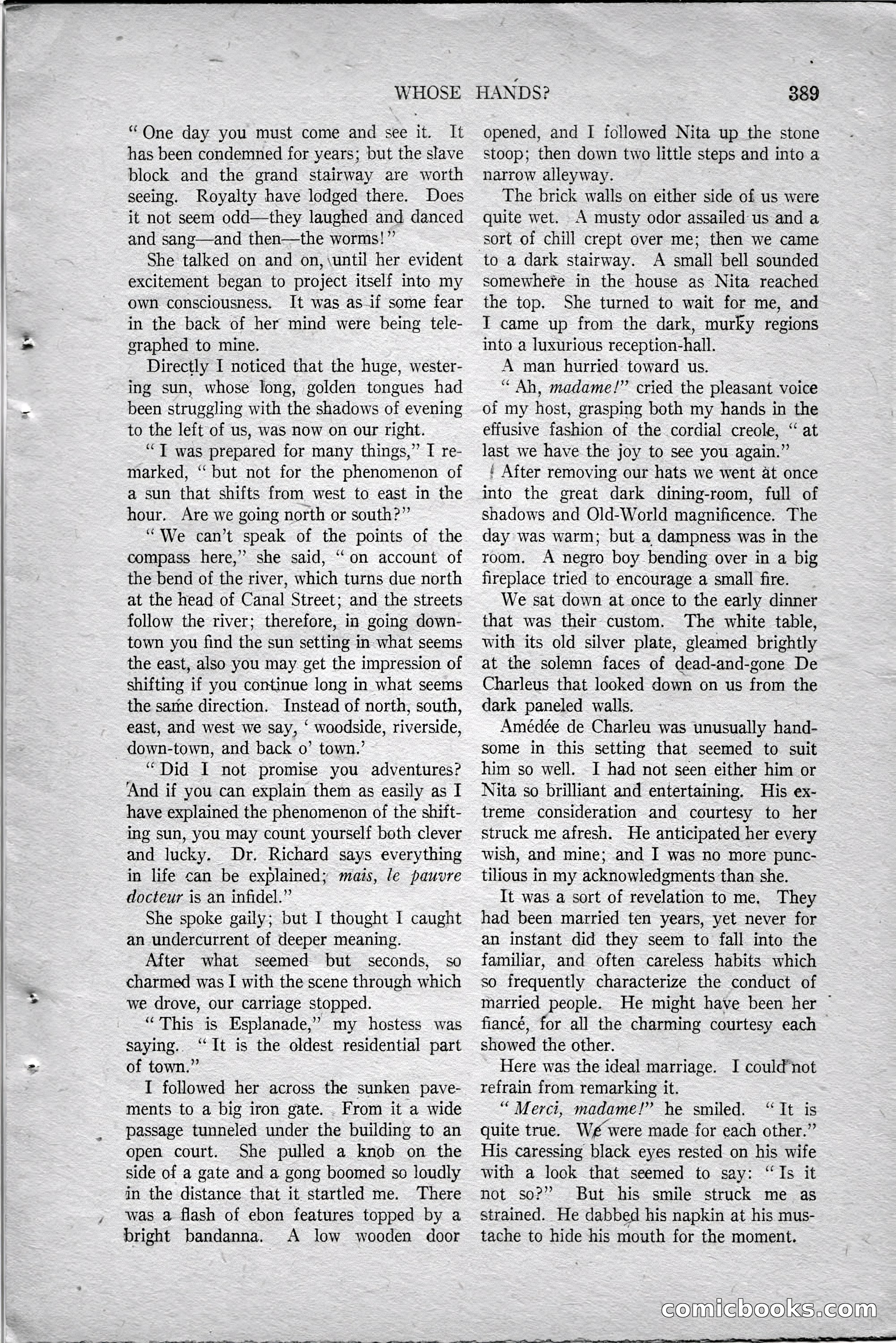
A restored page from Pulp Fiction, 1919. Page through the whole issue in the reader above.
📄 Transcribed text from this page (OCR, searchable)
Machine-transcribed from the original scan — historical spelling and the odd misread are preserved.
sy ot WHOSE HANDS? 389 “One day you must come and see it. It has been condemned for years; but the slave block and the grand stairway are worth seeing. Royalty have lodged there. Does it not seem odd—they laughed and danced and sang—and then—the worms!” She talked on and on, \until her evident excitement began to project itself into my own consciousness. It was asif some fear in the back of her mind were being tele- graphed to mine. Directly I noticed that the huge, wester- ing sun, whose long, golden tongues had been struggling with the shadows of evening to the left of us, was now on our right. “T was prepared for many things,” I re- marked, “but not for the phenomenon of a sun that shifts from west to east in the hour. Are we going north or south?” “We can’t speak of the points of the compass here,’’ she said, “on account of the bend of the river, which turns due north at the head of Canal Street; and the streets follow the river; therefore, in going down- town you find the sun setting in what seems the east, also you may get the impression of shifting if you continue long in what seems the same direction. Instead of north, south, east, and west we say, ‘ woodside, riverside, down-town, and back o’ town.’ “Did I not promise you adventures? ‘And if you can explain them as easily as I have explained the phenomenon of the shift- ing sun, you may count yourself both clever and lucky. Dr. Richard says everything in life can be explained; mais, le pauvre docteur is an infidel.” She spoke gaily; but I thought I caught an undercurrent of deeper meaning. After what seemed but seconds, so charmed was I with the scene through which we drove, our carriage stopped. “This is Esplanade,” my hostess was saying. “It is the oldest residential part of town.” I followed her across the sunken pave- ments to a big iron gate. . From it a wide passage tunneled under the building to an open court. She pulled a knob on the side of a gate and a gong boomed so loudly in the distance that it startled me. There was a flash of ebon features topped by a bright bandanna. A low wooden door opened, and I followed Nita up the stone stoop; then down two little steps and into a narrow alleyway. The brick walls on either side of us were quite wet. A musty odor assailed us and a sort of chill crept over me; then we came to a dark stairway. A small bell sounded somewhete in the house as Nita reached the top. She turned to wait for me, and I came up from the dark, murky regions into a luxurious reception-hall. A man hurried toward us. “Ah, madame!” cried the pleasant voice of my host, grasping both my hands in the effusive fashion of the cordial creole, “ at last we have the joy to see you again.” ! After removing our hats we went at once into the great dark dining-room, full of shadows and Old-World magnificence. The day was warm; but a dampness was in the room. A negro boy bending over in a big fireplace tried to encourage a small fire. We sat down at once to the early dinner that was their custom. The white table, with its old silver plate, gleamed brightly at the solemn faces of dead-and-gone De Charleus that looked down on us from the dark paneled walls. Amédée de Charleu was unusually hand- some in this setting that seemed to suit him so well. I had not seen either him or Nita so brilliant and entertaining, His ex- treme consideration and courtesy to her struck me afresh. He anticipated her every wish, and mine; and I was no more punc- tilious in my acknowledgments than she. It was a sort of revelation to me. They had been married ten years, yet never for an instant did they seem to fall into the familiar, and often careless habits which so frequently characterize the conduct of married people. He might have been her ~ fiancé, for all the charming courtesy each showed the other. Here was the ideal marriage. I couldnot refrain from remarking it. “ Merci, madame!” he smiled. “It is quite true. Wé were made for each other.” His caressing black eyes rested on his wife with a look that seemed to say: “Is it not so?” But his smile struck me as strained. He dabbed his napkin at his mus- tache to hide his mouth for the moment. comicbooksscom