
Pulp Fiction, 1919 · page 31 of 196
Argosy and Railroad Man's Magazine — page 31: what you’re looking at
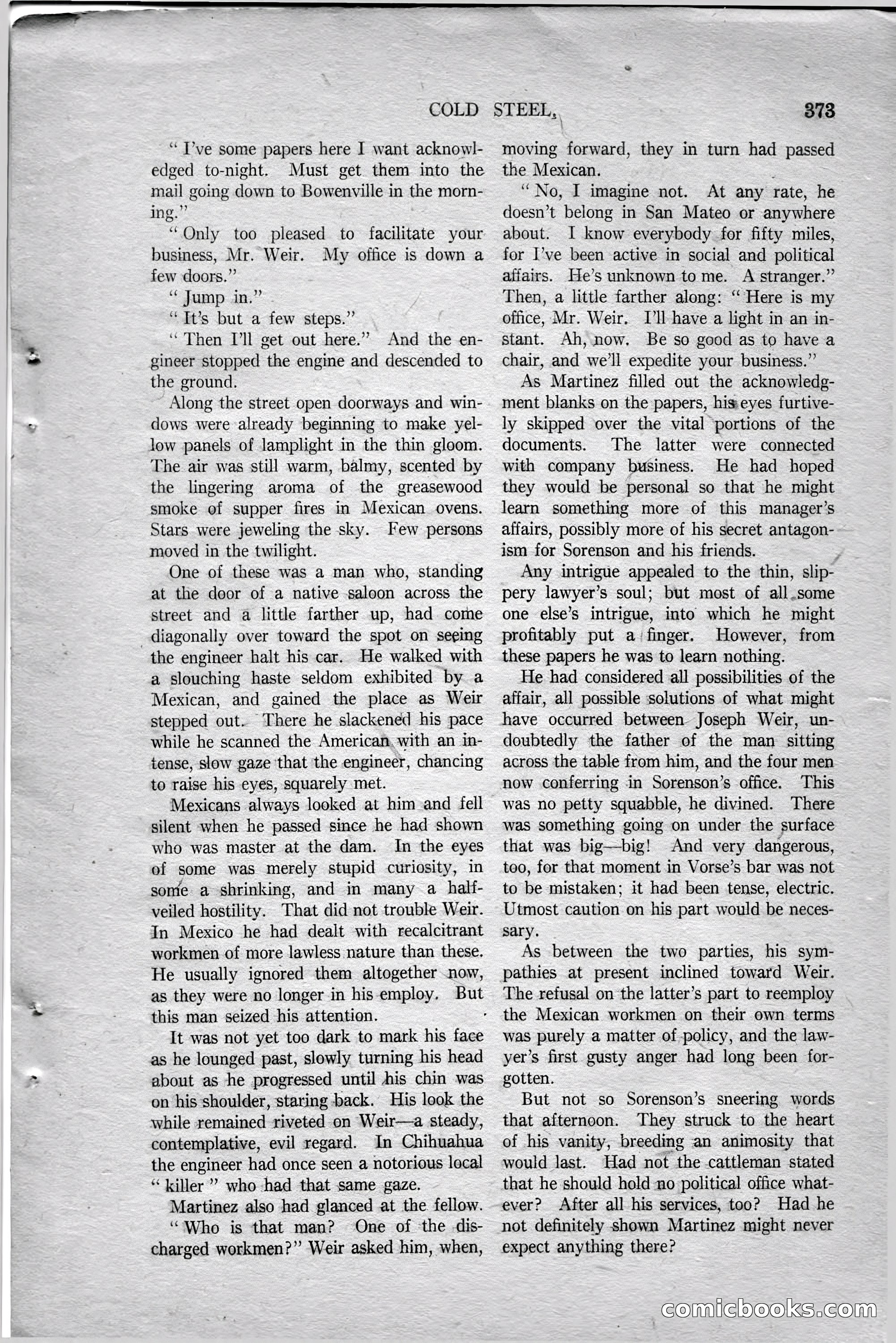
A restored page from Pulp Fiction, 1919. Page through the whole issue in the reader above.
📄 Transcribed text from this page (OCR, searchable)
Machine-transcribed from the original scan — historical spelling and the odd misread are preserved.
an ‘7 ia COLD STEEL,, “ I’ve some papers here I want acknowl- edged to-night. Must get them into the mail going down to Bowenville in the morn- ing.” “Only too pleased to facilitate your business, Mr. Weir. My office is down a few doors.” «¢ Jump in.” “ Tt’s but a few steps.” “Then [ll get out here.’’ And the en- gineer stopped the engine and descended to the ground. Along the street open doorways and win- dows were already beginning to make yel- low panels of lamplight in the thin gloom. The air was still warm, balmy, scented by the lingering aroma of the greasewood smoke of supper fires in Mexican. ovens. Stars were jeweling the sky. Few persons moved in the twilight. One of these was a man who, standing at the door of a native saloon across the street and a little farther up, had come diagonally over toward the spot on seeing the engineer halt his car. He walked with a slouching haste seldom exhibited by a Mexican, and gained the place as Weir stepped out. There he slackened his pace while he scanned the American.with an in- tense, slow gaze that the engineer, chancing to raise his eyes, squarely met. Mexicans always looked at him and fell silent when he passed since he had shown who was master at the dam. In the eyes of some was merely stupid curiosity, in some a shrinking, and in many a half- veiled hostility. That did not trouble Weir. In Mexico he had dealt with recalcitrant workmen. of more lawless nature than these. He usually ignored them altogether now, as they were no longer in his employ, But this man seized his attention. It was not yet too dark to mark his oe as he lounged past, slowly turning his head about as he progressed until his chin was on his shoulder, staring back. His look the while xemained riveted on Weir—a steady, contemplative, evil regard. In Chihuahua the engineer had once seen a notorious local “ killer’ who had that same gaze. Martinez also had glanced at the fellow. ‘“Who is that man? One of the dis- charged workmen?” Weir asked him, when, 373 moving forward, they in turn had passed the Mexican. : “No, I imagine not. At any rate, he doesn’t belong in San Mateo or anywhere about. I know everybody for fifty miles, for I’ve been active in social and political affairs. He’s unknown to me. A stranger.” Then, a little farther along: “Here is my office, Mr. Weir. Il have a light in an in- stant. Ah, now. Be so good as to have a chair, and we'll expedite your business.” As Martinez filled out the acknowledg- ment blanks on the papers, his: eyes furtive- ly skipped over the vital ‘portions of the documents. The latter were connected with company business. He had hoped they would be personal so that he might learn something more of this manager’s affairs, possibly more of his secret antagon- ism for Sorenson and his friends. : Any intrigue appealed to the thin, slip- pery lawyer’s soul; but most of all.some one else’s intrigue, into which he might profitably put a/finger. However, from these papers he was to learn nothing. He had considered all possibilities of the affair, all possible ‘solutions of what might have occurred between Joseph Weir, un- doubtedly the father of the man sitting across the table from him, and the four men now conferring in Sorenson’s office. This was no petty squabble, he divined. There was something going on under the surface that was big—big! And very dangerous, too, for that moment in Vorse’s bar was not to be mistaken; it had been tense, electric. Utmost caution on his part would be neces- sary. As between the two parties, his sym- pathies at present inclined toward Weir. The refusal on the latter’s part to reemploy the Mexican workmen on their own terms was purely a matter of policy, and the law- yer’s first gusty anger had long been for- gotten. But not so Sorenson’s sneering words that afternoon. They struck to the heart of his vanity, breeding an animosity that would last. Had not the -cattleman stated that he should hold no political office what- ever? After all his services, too? Had he not definitely shown Martinez might never expect anything there? Cconmicooolks.conn