
Pulp Fiction, 1919 · page 28 of 196
Argosy and Railroad Man's Magazine — page 28: what you’re looking at
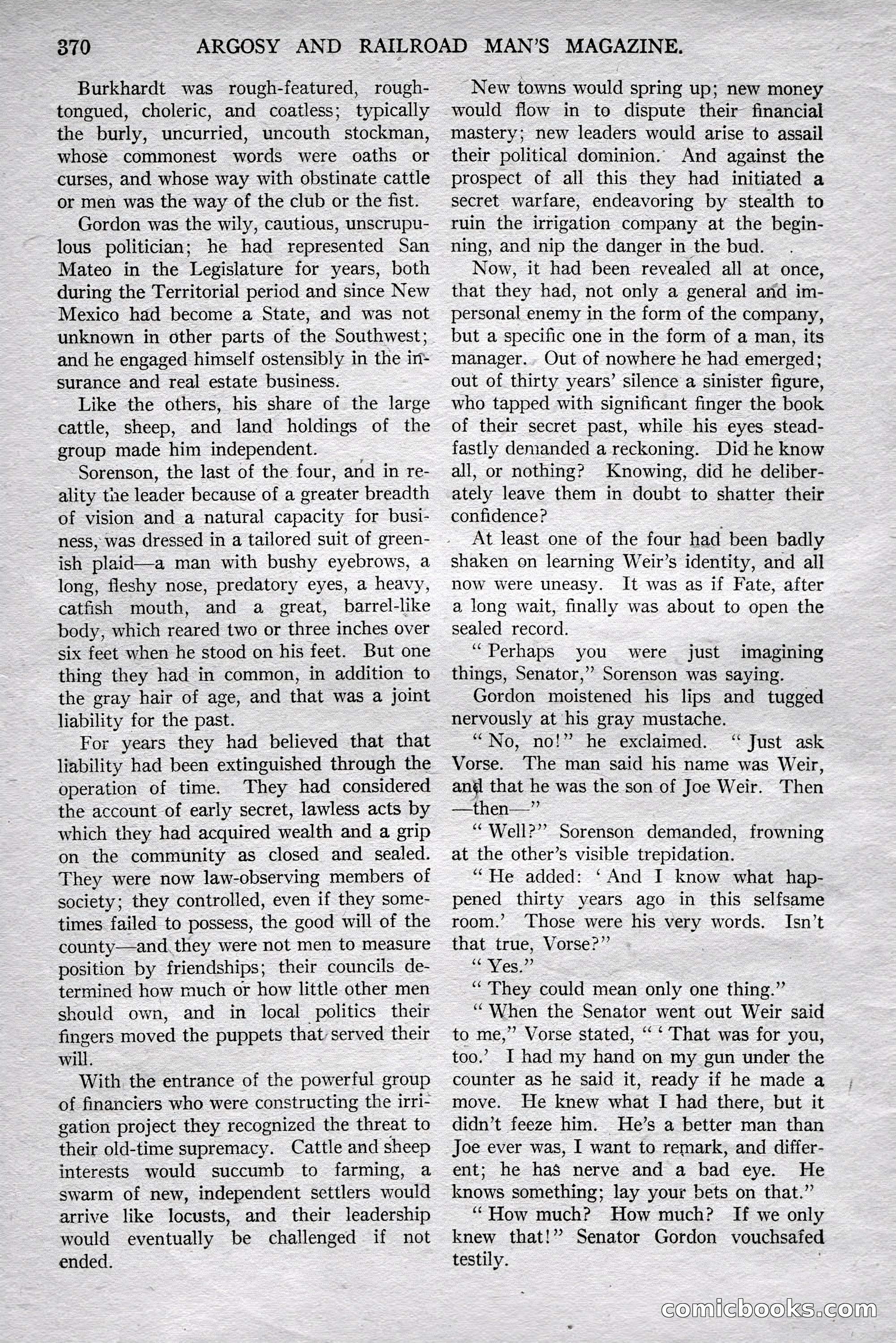
A restored page from Pulp Fiction, 1919. Page through the whole issue in the reader above.
📄 Transcribed text from this page (OCR, searchable)
Machine-transcribed from the original scan — historical spelling and the odd misread are preserved.
370 Burkhardt was rough-featured, rough- tongued, choleric, and coatless; typically the burly, uncurried, uncouth stockman, whose commonest words were oaths or curses, and whose way with obstinate cattle or men was the way of the club or the fist. Gordon was the wily, cautious, unscrupu- lous politician; he had represented San Mateo in the Legislature for years, both during the Territorial period and since New Mexico had become a State, and was not unknown in other parts of the Southwest; and he engaged himself ostensibly in the in- surance and real estate business. Like the others, his share of the large cattle, sheep, and land holdings of the group made him independent. Sorenson, the last of the four, and in re- ality the leader because of a greater breadth of vision and a natural capacity for busi- ness, was dressed in a tailored suit of green- ish plaid—a man with bushy eyebrows, a long, fleshy nose, predatory eyes, a heavy, catfish mouth, and a great, barrel-like body, which reared two or three inches over six feet when he stood on his feet. But one thing they had in common, in addition to the gray hair of age, and that was a joint liability for the past. For years they had believed that that liability had been extinguished through the operation of time. They had considered the account of early secret, lawless acts by which they had acquired wealth and a grip on the community as closed and sealed. They were now law-observing members of society; they controlled, even if they some- times failed to possess, the good will of the county—and. they were not men to measure position by friendships; their councils de- termined how much or how little other men should own, and in local politics their fingers moved the puppets thatserved their will. With the entrance of the powerful group of financiers who were constructing the irri- gation project they recognized the threat to their old-time supremacy. Cattle and sheep interests would succumb to farming, a swarm of new, independent settlers would arrive like locusts, and their leadership would eventually be challenged if not ended. ARGOSY AND RAILROAD MAN’S MAGAZINE. New towns would spring up; new money would flow in to dispute their financial mastery; new leaders would arise to assail their political dominion. And against the prospect of all this they had initiated a secret warfare, endeavoring by stealth to ruin the irrigation company at the begin- ning, and nip the danger in the bud. Now, it had been revealed all at once, that they had, not only a general and im- personal enemy in the form of the company, but a specific one in the form of a man, its manager... Out of nowhere he had emerged; out of thirty years’ silence a sinister figure, who tapped with significant finger the book of their secret past, while his eyes stead- fastly demanded a reckoning. Did he know all, or nothing? Knowing, did he deliber- ately leave them in doubt to shatter their confidence? At least one of the four had been badly shaken on learning Weir’s identity, and all now were uneasy. It was as if Fate, after a long wait, finally was about to open the sealed record. “Perhaps you were just imagining things, Senator,” Sorenson was saying. Gordon moistened his lips and tugged nervously at his gray mustache. “No, no!” he exclaimed. ‘“ Just ask Vorse. The man said his name was Weir, an that he was the son of Joe Weir. Then —then—” “Well?” Sorenson demanded, frowning at the other’s visible trepidation. “He added: ‘And I know what hap- pened thirty years ago in this selfsame room.’ Those were his very words. Isn’t that true, Vorse?” «cc Yes.” “They could mean only one thing.” “When the Senator went out Weir said to me,” Vorse stated, “ ‘ That was for you, too.’ I had my hand on my gun under the counter as he said it, ready if he made a move. He knew what I had there, but it didn’t feeze him. He’s a better man than Joe ever was, I want to remark, and differ- ent; he has nerve and a bad eye. He knows something; lay your bets on that.” “How much? How much? If we only knew that!” Senator Gordon vouchsafed testily. comiclooolkks.conn