
Pulp Fiction, 1919 · page 19 of 196
Argosy and Railroad Man's Magazine — page 19: what you’re looking at
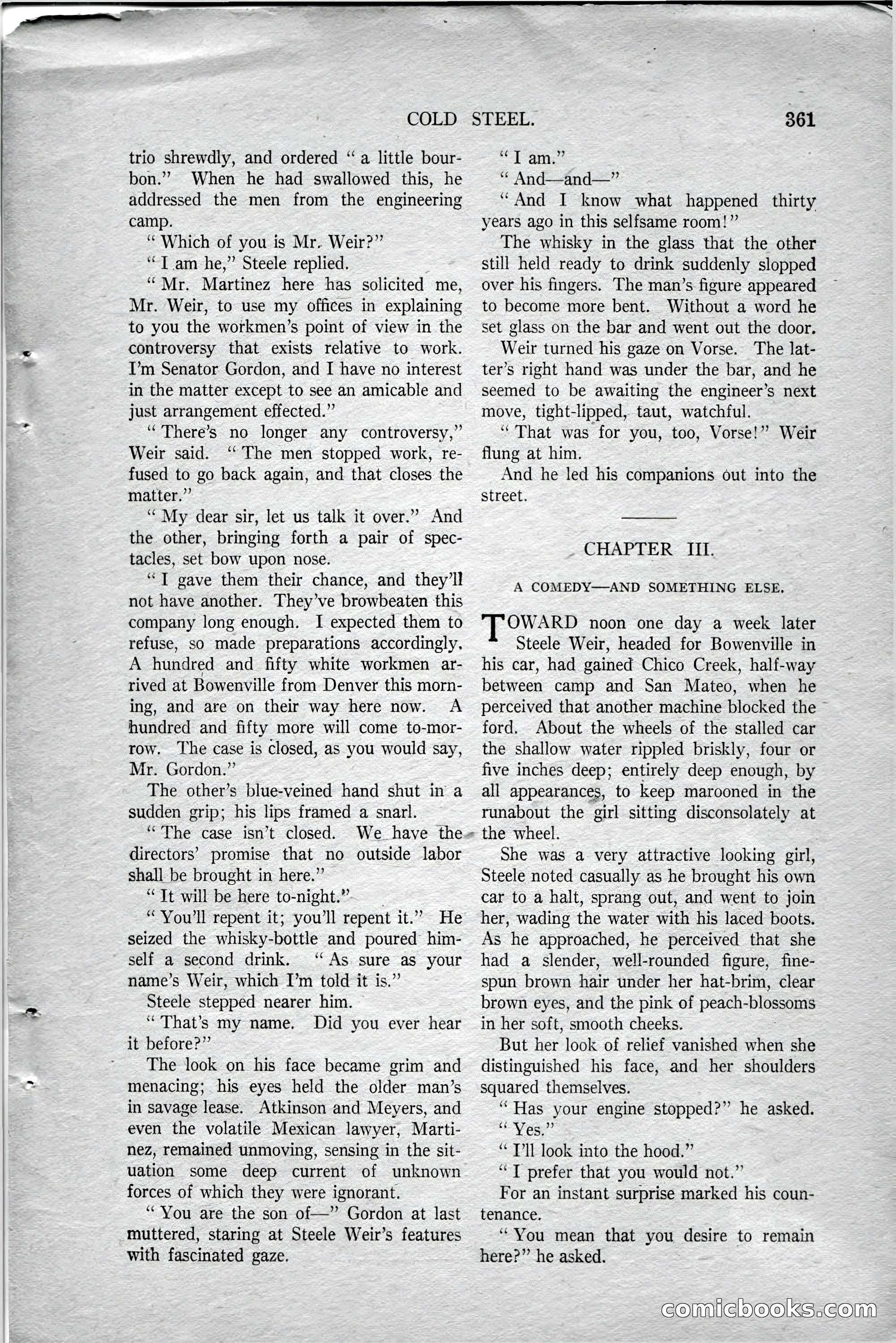
A restored page from Pulp Fiction, 1919. Page through the whole issue in the reader above.
📄 Transcribed text from this page (OCR, searchable)
Machine-transcribed from the original scan — historical spelling and the odd misread are preserved.
9 COLD STEEL. 361 trio shrewdly, and ordered “a little bour- bon.” When he had swallowed this, he addressed the men from the engineering camp. “Which of you is Mr. Weir?” ‘*“T am he,” Steele replied. “Mr. Martinez here has solicited me, Mr. Weir, to use my offices in explaining to you the workmen’s point of view in the controversy that exists relative to work. I’m Senator Gordon, and I have no interest in the matter except to see an amicable and just arrangement effected.” “There’s no longer any controversy,” Weir said. ‘The men stopped work, re- fused to go back again, and that closes the matter.” ““ My dear sir, let us talk it over.” And the other, bringing forth a pair of spec- tacles, set bow upon nose. “TI gave them their chance, and they’ll not have another. They’ve browbeaten this company long enough. I expected them to refuse, so made preparations accordingly, A hundred and fifty white workmen ar- rived at Bowenville from Denver this morn- ing, and are on their way here now. A hundred and fifty more will come to-mor- row. The case is closed, as you would say, Mr. Gordon.” The other’s blue-veined hand shut in a sudden grip; his lips framed a snarl. “The case isn’t closed. We have the directors’ promise that no outside labor shall be brought in here.” “Tt will be here to-night.” “You'll repent it; you’ll repent it.” He seized the whisky-bottle and poured him- self a second drink. ‘As sure as your name’s Weir, which I’m told it is.” Steele stepped nearer him. “That’s my name. Did you ever hear it before?” The look on his face became grim and menacing; his eyes held the older man’s in savage lease. Atkinson and Meyers, and even the volatile Mexican lawyer, Marti- nez, remained unmoving, sensing in the sit- uation some deep current of unknown forces of which they were ignorant. “You are the son of—” Gordon at last muttered, staring at Steele Weir’s features with fascinated gaze. <9 I am.” “ And—and—” “And I know what happened thirty years ago in this selfsame room!” The whisky in the glass that the other still held ready to drink suddenly slopped over his fingers. The man’s figure appeared to become more bent. Without a word he set glass on the bar and went out the door. Weir turned his gaze on Vorse. The lat- ter’s right hand was under the bar, and he seemed to be awaiting the engineer’s next move, tight-lipped, taut, watchful. ‘That was for you, too, Vorse!” Weir flung at him. And he led his companions out into the street. CHAPTER III. A COMEDY—AND SOMETHING ELSE, T OWARD noon one day a week later Steele Weir, headed for Bowenville in his car, had gained Chico Creek, half-way between camp and San Mateo, when he perceived that another machine blocked the ford. About the wheels of the stalled car the shallow water rippled briskly, four or five inches deep; entirely deep enough, by all appearances, to keep marooned in the runabout the girl sitting disconsolately at the wheel. She was a very attractive looking girl, Steele noted casually as he brought his own car to a halt, sprang out, and went to join her, wading the water with his laced boots. As he approached, he perceived that she had a slender, well-rounded figure, fine- spun brown hair under her hat-brim, clear brown eyes, and the pink of peach-blossoms in her soft, smooth cheeks. But her look of relief vanished when she distinguished his face, and her shoulders squared themselves. “Has your engine stopped?” he asked. a3 Ves.” “Tl look into the hood.” “T prefer that you would not.” For an instant surprise marked his coun- tenance. “You mean that you desire to remain here?” he asked. ComnmiclooolkksS.conn