
Pulp Fiction, 1919 · page 181 of 196
Argosy and Railroad Man's Magazine — page 181: what you’re looking at
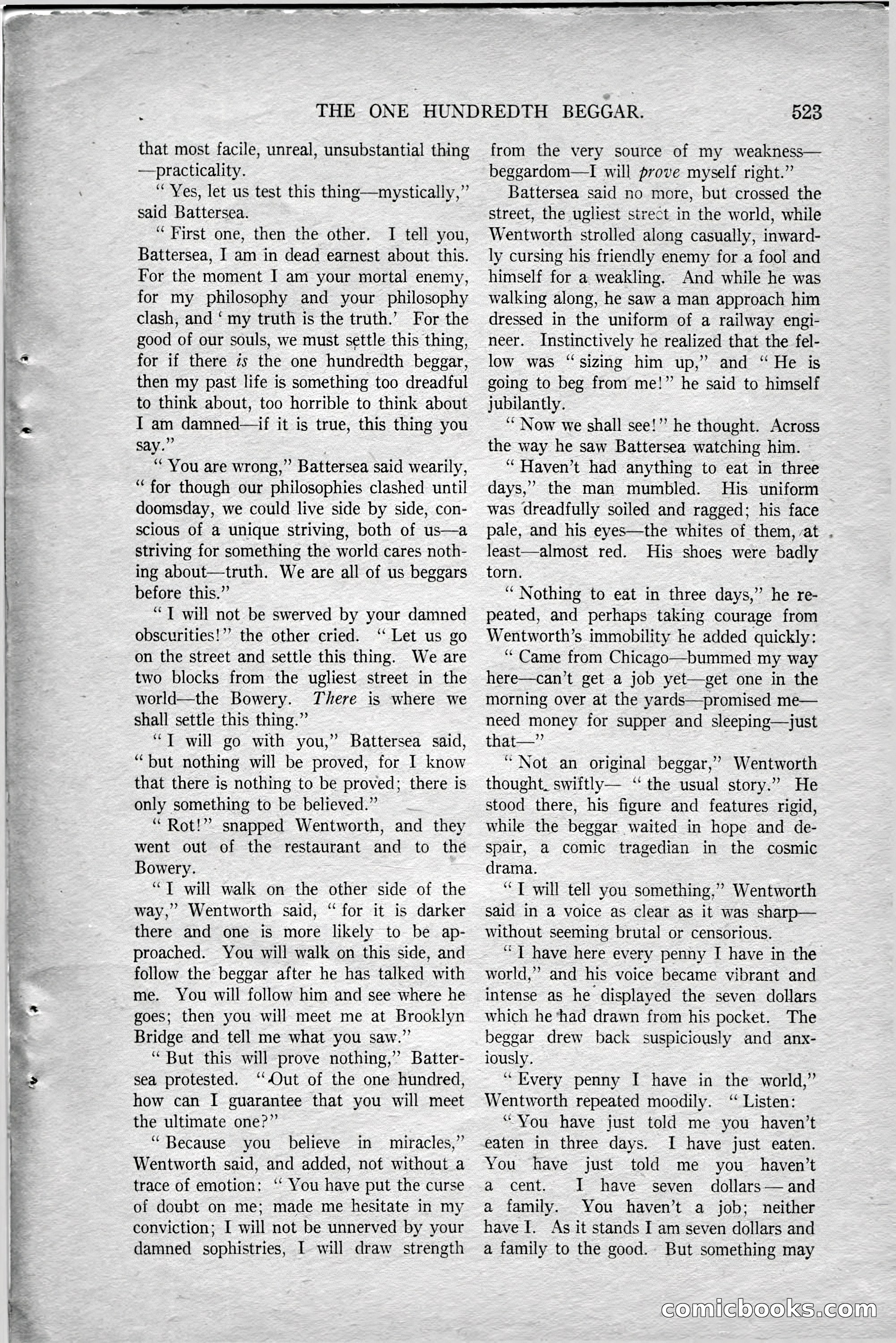
A restored page from Pulp Fiction, 1919. Page through the whole issue in the reader above.
📄 Transcribed text from this page (OCR, searchable)
Machine-transcribed from the original scan — historical spelling and the odd misread are preserved.
THE ONE HUNDREDTH BEGGAR. 523 that most facile, unreal, unsubstantial thing —practicality. “Yes, let us test this thing—mystically,” said Battersea. “First one, then the other. I tell you, Battersea, I am in dead earnest about this. For the moment I am your mortal enemy, for my philosophy and your philosophy clash, and ‘ my truth is the truth.’ For the good of our souls, we must settle this thing, for if there is the one hundredth beggar, then my past life is something too dreadful to think about, too horrible to think about I am damned—if it is true, this thing you say.” “ You are wrong,” Battersea said wearily, “for though our philosophies clashed until doomsday, we could live side by side, con- scious of a unique striving, both of us—a striving for something the world cares noth- ing about—truth. We are all of us beggars before this.” “T will not be swerved by your damned obscurities!” the other cried. ‘Let us go on the street and settle this thing. We are two blocks from the ugliest street in the world—the Bowery. There is where we shall settle this thing.” “JT will go with you,” Battersea said, “but nothing will be proved, for I know that there is nothing to be proved; there is only something to be believed.” “Rot!” snapped Wentworth, and they went out of the restaurant and to the Bowery. “YT will walk on the other side of the way,” Wentworth said, “for it is darker there and one is more likely to be ap- proached. You will walk on this side, and follow the beggar after he has talked with me. You will follow him and see where he goes; then you will meet me at Brooklyn Bridge and tell me what you saw.” “But this will prove nothing,” Batter- sea protested. ‘Out of the one hundred, how can I guarantee that you will meet the ultimate one?” “Because you believe in miracles,” Wentworth said, and added, not without a trace of emotion: ‘‘ You have put the curse of doubt on me; made me hesitate in my conviction; I will not be unnerved by your damned _ sophistries, I will draw strength from the very source of my weakness— beggardom—I will prove myself right.” Battersea said no more, but crossed the street, the ugliest strect in the world, while Wentworth strolled along casually, inward- ly cursing his friendly enemy for a fool and himself for a weakling. And while he was walking along, he saw a man approach him dressed in the uniform of a railway engi- neer. Instinctively he realized that the fel- low was “sizing him up,” and “ He is going to beg from me!” he said to himself jubilantly. “Now we shall see!” he thought. Across the way he saw Battersea watching him. “Haven’t had anything to eat in three days,” the man mumbled. His uniform was dreadfully soiled and ragged; his face pale, and his eyes—the whites of them, at , least—almost red. His shoes were badly torn. “Nothing to eat in three days,” he re- peated, and perhaps taking courage from Wentworth’s immobility he added quickly: “Came from Chicago—bummed my way here—can’t get a job yet—get one in the morning over at the yards—promised me— need money for supper and sleeping—just that—”’ “ Not an original beggar,” Wentworth thought. swiftly— ‘‘ the usual story.” He stood there, his figure and features rigid, while the beggar waited in hope and de- spair, a comic tragedian in the cosmic drama. “T will tell you something,’ Wentworth said in a voice as clear as it was sharp— without seeming brutal or censorious. “I have here every penny I have in the world,” and his voice became vibrant and intense as he displayed the seven dollars which he had drawn from his pocket. The beggar drew back suspiciously and anx- iously. “Every penny I have in the world,” Wentworth repeated moodily. “ Listen: “You have just told me you haven’t eaten in three days. I have just eaten. You have just told me you haven’t a cent. I have seven dollars— and a family. You haven’t a job; neither have I. As it stands I am seven dollars and a family to the good. But something may comniclooolkks.conn