
Pulp Fiction, 1919 · page 167 of 196
Argosy and Railroad Man's Magazine — page 167: what you’re looking at
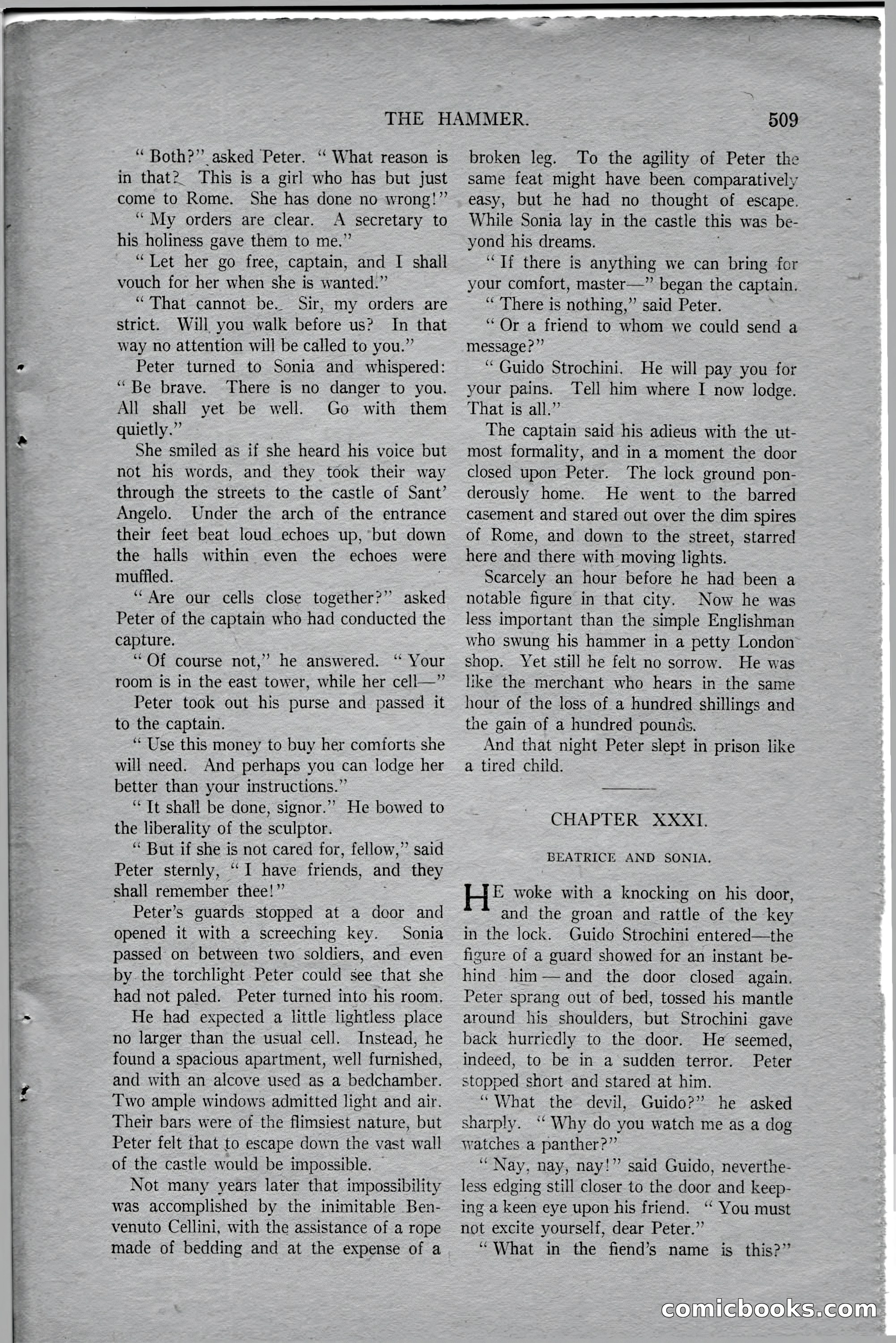
A restored page from Pulp Fiction, 1919. Page through the whole issue in the reader above.
📄 Transcribed text from this page (OCR, searchable)
Machine-transcribed from the original scan — historical spelling and the odd misread are preserved.
THE HAMMER. “ Both?” asked Peter. ‘“‘ What reason is in that?, This is a girl who has but just come to Rome. She has done no wrong!” ‘My orders are clear. A secretary to his holiness gave them to me.” “Let her go free, captain, and I shall vouch for her when she is wanted.” “That cannot be. Sir, my orders are strict. Will you walk before us? In that way no attention will be called to you.” Peter turned to Sonia and whispered: “Be brave. There is no danger to you. All shall yet be well. Go with them quietly.” She smiled as if she heard his voice but not his words, and they took their way through the streets to the castle of Sant’ Angelo. Under the arch of the entrance their feet beat loud echoes up, but down the halls within even the echoes were muffled. “Are our cells close together?” asked Peter of the captain who had conducted the capture. “Of course not,”’ he answered. ‘“ Your room is in the east tower, while her cell—” Peter took out his purse and passed it to the captain. “Use this money to buy her comforts she will need. And perhaps you can lodge her better than your instructions.” “Tt shall be done, signor.” the liberality of the sculptor. “ But if she is not cared for, fellow,” said Peter sternly, “I have friends, and they shall remember thee!” Peter’s guards stopped at a door and opened it with a screeching key. Sonia passed on between two soldiers, and even by. the torchlight Peter could see that she had not paled. Peter turned into his room. He had expected a little lightless place no larger than the usual cell. Instead, he found a spacious apartment, well furnished, and with an alcove used as a bedchamber. Two ample windows admitted light and air. Their bars were of the flimsiest nature, but Peter felt that to escape down the vast wall of the castle would be impossible. Not many years later that impossibility was accomplished by the inimitable Ben- venuto Cellini, with the assistance of a rope made of bedding and at the expense of a He bowed to 509 broken leg. To the agility of Peter the same feat might have been comparatively easy, but he had no thought of escape. While Sonia lay in the castle this was be- yond his dreams. “Tf there is anything we can bring for your comfort, master—” began the captain. “ There is nothing,” said Peter. “Or a friend to whom we could send a message?” “ Guido Strochini. He will pay you for your pains. Tell him where I now lodge. That is all.” The captain said his adieus with the ut- most formality, and in a moment the door closed upon Peter. The lock ground pon- derously home. He went to the barred casement and stared out over the dim spires of Rome, and down to the street, starred here and there with moving lights. Scarcely an hour before he had been a notable figure in that city. Now he was less important than the simple Englishman who swung his hammer in a petty London shop. Yet still he felt no sorrow. He was like the merchant who hears in the same hour of the loss of a hundred shillings and the gain of a hundred pounds. And that night Peter slept in prison like a tired child. CHAPTER XXXI. BEATRICE AND SONIA. HE woke with a knocking on his door, and the groan and rattle of the key in the lock. Guido Strochini entered—the figure of a guard showed for an instant be- hind him—and the door closed again. Peter sprang out of bed, tossed his mantle around his shoulders, but Strochini gave back hurriedly to the door. He seemed, indeed, to be in a sudden terror. Peter stopped short and stared at him. “What the devil, Guido?” he asked sharply. ‘‘ Why do you watch me as a dog watches a panther?” ‘Nay, nay, nay!” said Guido, neverthe- less edging still closer to the door and keep- ing a keen eye upon his friend. ‘“ You must not excite yourself, dear Peter.”’ “What in the fiend’s name is this?” comicbooks.com