
Pulp Fiction, 1919 · page 164 of 196
Argosy and Railroad Man's Magazine — page 164: what you’re looking at
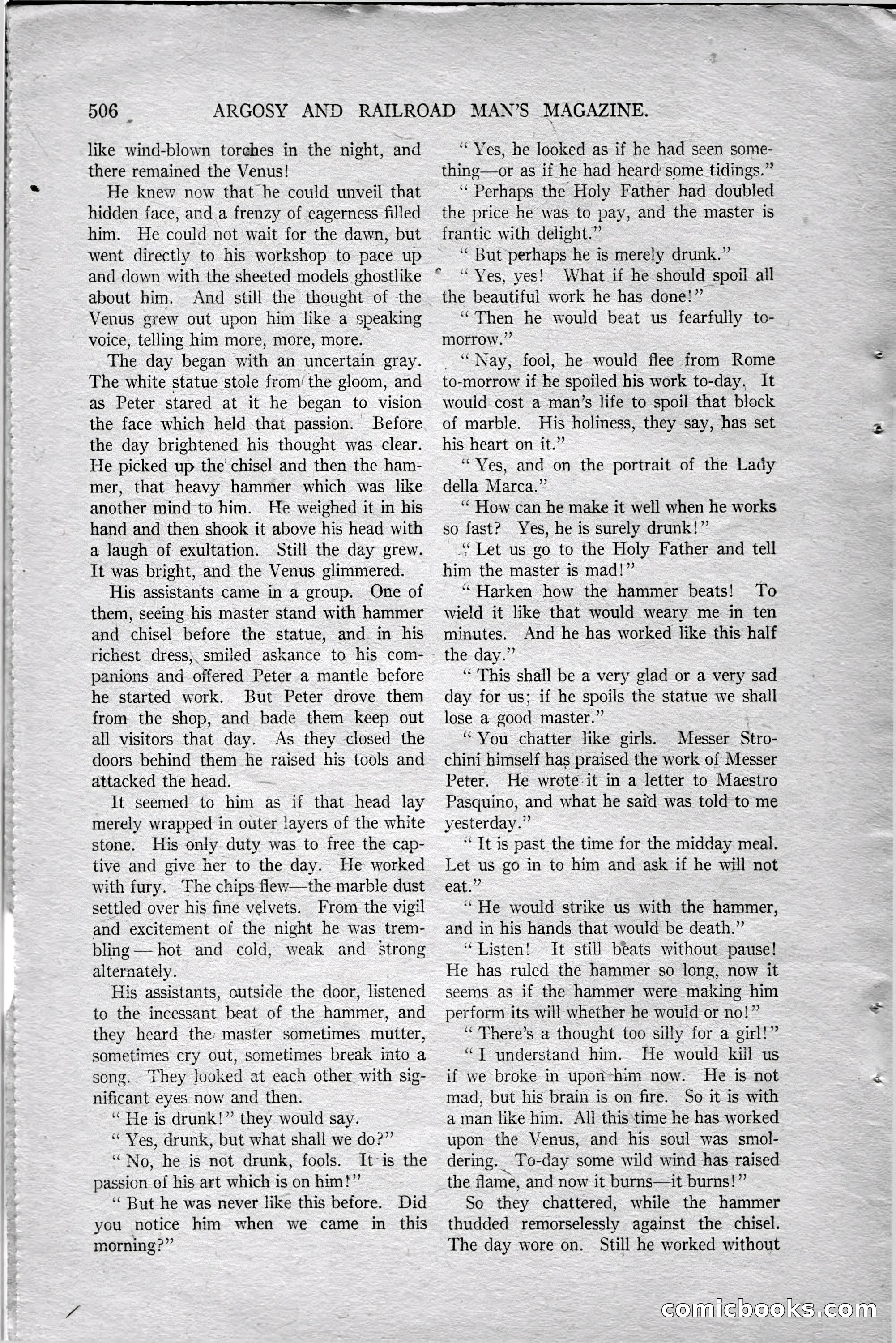
A restored page from Pulp Fiction, 1919. Page through the whole issue in the reader above.
📄 Transcribed text from this page (OCR, searchable)
Machine-transcribed from the original scan — historical spelling and the odd misread are preserved.
506 | ARGOSY AND RAILROAD MAN’S MAGAZINE. like wind-blown torehes in the night, and there remained the Venus! He knew now that he could unveil that hidden face, and a frenzy of eagerness filled him. He could not wait for the dawn, but went directly to his workshop to pace up and down with the sheeted models ghostlike about him. And still the thought of the Venus grew out upon him like a speaking voice, telling him more, more, more. The day began with an uncertain gray. The white statue stole from’ the gloom, and as Peter stared at it he began to vision the face which held that passion. Before the day brightened his thought was clear. He picked up the chisel and then the ham- mer, that heavy hammer which was like another mind to him. He weighed it in his hand and then shook it above his head with a laugh of exultation. Still the day grew. It was bright, and the Venus glimmered. His assistants came in a group. One of them, seeing his master stand with hammer and chisel before the statue, and in his richest dress) smiled askance to his com- panions and offered Peter a mantle before he started work. But Peter drove them from the shop, and bade them keep out all visitors that day. As they closed the doors behind them he raised his tools and attacked the head. It seemed to him as if that head lay merely wrapped in outer layers of the white stone. His only duty was to free the cap- tive and give her to the day. He worked with fury. The chips flew—the marble dust settled over his fine velvets. From the vigil and excitement of the night he was trem- bling — hot and cold, weak and strong alternately. His assistants, outside the door, listened to the incessant beat of the hammer, and they heard the master sometimes mutter, sometimes cry out, sometimes break into a song. They looked at each other with sig- nificant eyes now and then. ‘He is drunk!” they would say. “ Yes, drunk, but what shall we do?” “No, he is not drunk, fools. It-is the passion of his art which is on him!” “ But he was never like this before. Did you notice him when we came in this morning?” “Ves, he looked as if he had seen some- thing—or as if he had heard’ some tidings.” “Perhaps the Holy Father had doubled the price he was to pay, and the master is frantic with delight.” ‘“ But perhaps he is merely drunk.” ° “Ves, yes! What if he should spoil all the beautiful work he has done!” “Then he would beat us fearfully to- morrow.” _ “Nay, fool, he would flee from Rome to-morrow if he spoiled his work to-day. It would cost a man’s life to spoil that block of marble. His holiness, they say, has set his heart on it.” “Yes, and on the portrait of the Lady della Marca.” “How can he make it well when he works so fast? Yes, he is surely drunk!” “Let us go to the Holy Father and tell him the master is mad!” “Harken how the hammer beats! To wield it like that would weary me in ten minutes. And he has worked like this half the day.” “This shall be a very glad or a very sad day for us; if he spoils the statue we shall lose a good master.” ‘“You chatter like girls. Messer Stro- chini himself has praised the work of Messer Peter. He wrote it in a letter to Maestro Pasquino, and what he said was told to me yesterday.” “Tt is past the time for the midday meal. Let us go in to him and ask if he will not eat.” ‘He would strike us with the hammer, and in his hands that would be death.” “Listen! It still beats without pause! He has ruled the hammer so long, now it seems as if the hammer were making him perform its will whether he wouid or no!” “There’s a thought too silly for a girl!” “JT understand him. He would kill us if we broke in upon-him now. He is not mad, but his brain is on fire. So it is with aman like him. All this time he has worked upon the Venus, and his soul was smol- dering. To-day some wild wind has raised the flame, and now it burns—it burns!” So they chattered, while the hammer thudded remorselessly against the chisel. The day wore on. Still he worked without ConmicooolkS.comnn