
Pulp Fiction, 1919 · page 150 of 196
Argosy and Railroad Man's Magazine — page 150: what you’re looking at
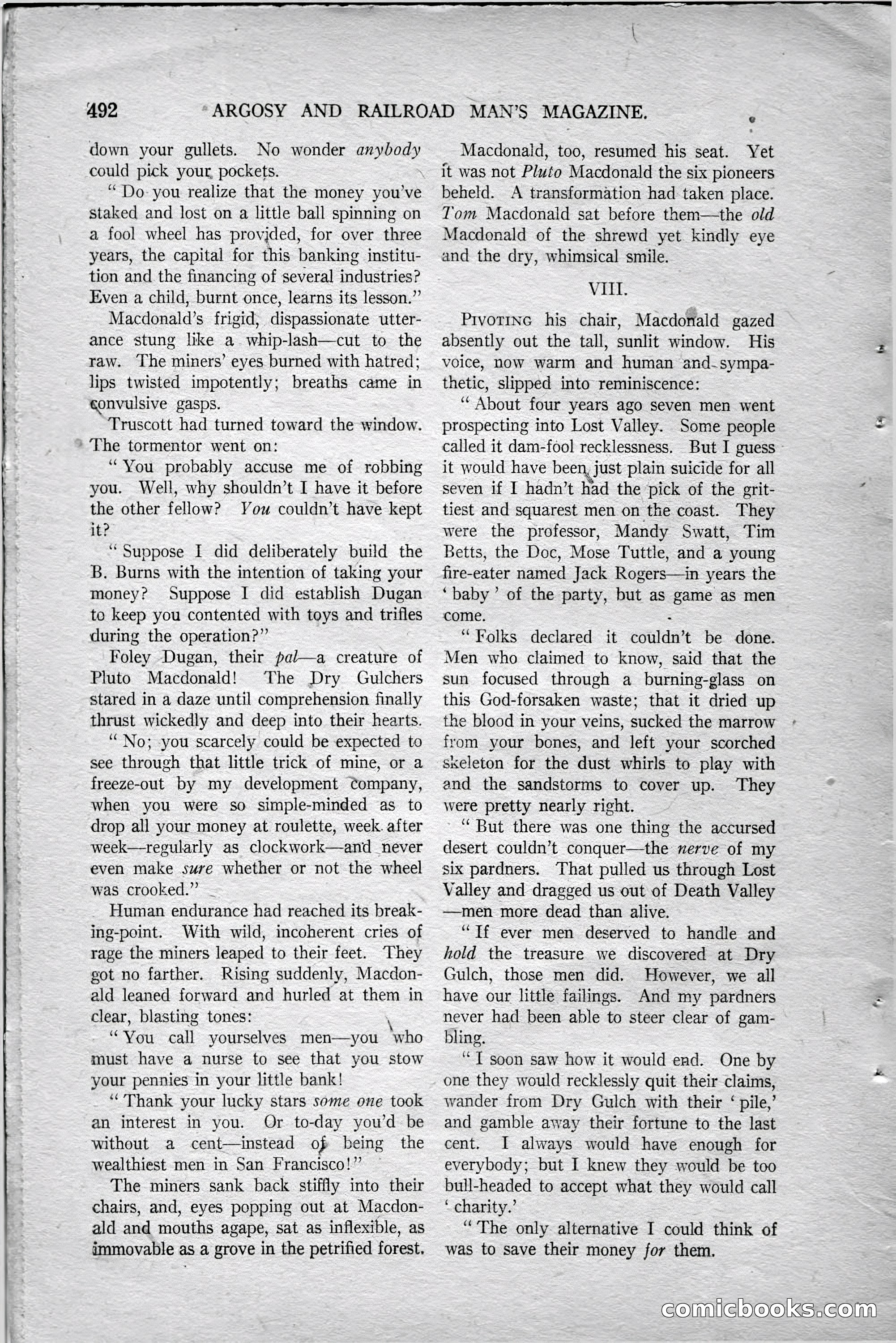
A restored page from Pulp Fiction, 1919. Page through the whole issue in the reader above.
📄 Transcribed text from this page (OCR, searchable)
Machine-transcribed from the original scan — historical spelling and the odd misread are preserved.
A492 ARGOSY AND RAILROAD MAN’S MAGAZINE. down your gullets. No wonder aes could pick your, pockets. “Do- you realize that the money you’ve staked and lost on a little ball spinning on a fool wheel has provided, for over three years, the capital for this banking institu- tion and the financing of several industries? Even a child, burnt once, learns its lesson.” Macdonald’s frigid, dispassionate utter- ance stung like a whip-lash—cut to the raw. The miners’ eyes burned with hatred; lips twisted impotently; breaths came in convulsive gasps. Truscott had turned toward the window. ' The tormentor went on: “You probably accuse me of robbing you. Well, why shouldn’t I have it before the other fellow? You couldn’t have kept it? “Suppose I did deliberately build the B. Burns with the intention of taking your money? Suppose I did establish Dugan to keep you contented with toys and trifles during the operation?” Foley Dugan, their pal—a creature of Pluto Macdonald! The Dry Gulchers stared in a daze until comprehension finally thrust wickedly and deep into their hearts. ‘““No; -you scarcely could be expected to see through that little trick of mine, or a freeze-out by my development Company, when you were so simple-minded as to drop all your money at roulette, week. after week—tregularly as clockwork—and never even make sure whether or not the wheel was crooked.” - Human endurance had reached its break- ing-point. With wild, incoherent cries of rage the miners leaped to their feet. They got no farther. Rising suddenly, Macdon- ald leaned forward and hurled at them in clear, blasting tones: \ “You call yourselves men—you who must have a nurse to see that you stow your pennies in your little bank! “Thank your lucky stars some one took an interest in you. Or to-day you'd be without a cent—instead of being the wealthiest men in San Francisco!” The miners sank back stiffly into their chairs, and, eyes popping out at Macdon- ald and mouths agape, sat as inflexible, as immovable as a grove in the petrified forest. e Macdonald, too, resumed his seat. Yet it was not Pluto Macdonald the six pioneers beheld. A transformation had taken place. Tom Macdonald sat before them—the old Macdonald of the shrewd yet kindly eye and the dry, whimsical smile. VII. Prvotinc his chair, Macdonald gazed absently out the tall, sunlit window. His voice, now warm and human and.sympa- thetic, slipped into reminiscence: “About four years ago seven men went prospecting into Lost Valley. Some people called it dam-fool recklessness. But I guess it would have been, \ just plain suicide for all seven if I hadn’t had the pick of the grit- tiest and squarest men on the coast. They were the professor, Mandy Swatt, Tim Betts, the Doc, Mose Tuttle, and a young fire-eater named Jack Rogers—in years the ‘baby’ of the party, but as game as men come. “Folks declared it eaiildy’ t be done. Men who claimed to know, said that the sun focused through a burning-glass on this God-forsaken waste; that it dried up the blood in your veins, sucked the marrow from your bones, and left your scorched sxeleton for the dust whirls to play with and the sandstorms to cover up. They were pretty nearly right. “But there was one thing the accursed desert couldn’t conquer—the nerve of my six pardners. That pulled us through Lost Valley and dragged us out of Death Valley —men more dead than alive. “Tf ever men deserved to handle and hold the treasure we discovered at Dry Gulch, those men did. However, we all have our little failings. And my pardners never had been able to steer clear of gam- bling. “T soon saw how it would end. One by one they would recklessly quit their claims, wander from Dry Gulch with their ‘pile,’ and gamble away their fortune to the last cent. I always would have enough for everybody; but I knew they would be too bull-headed to accept what they would call ‘ charity.’ “The only alternative I could think of was to save their money for them. comicbooks-com rr