
Pulp Fiction, 1919 · page 132 of 196
Argosy and Railroad Man's Magazine — page 132: what you’re looking at
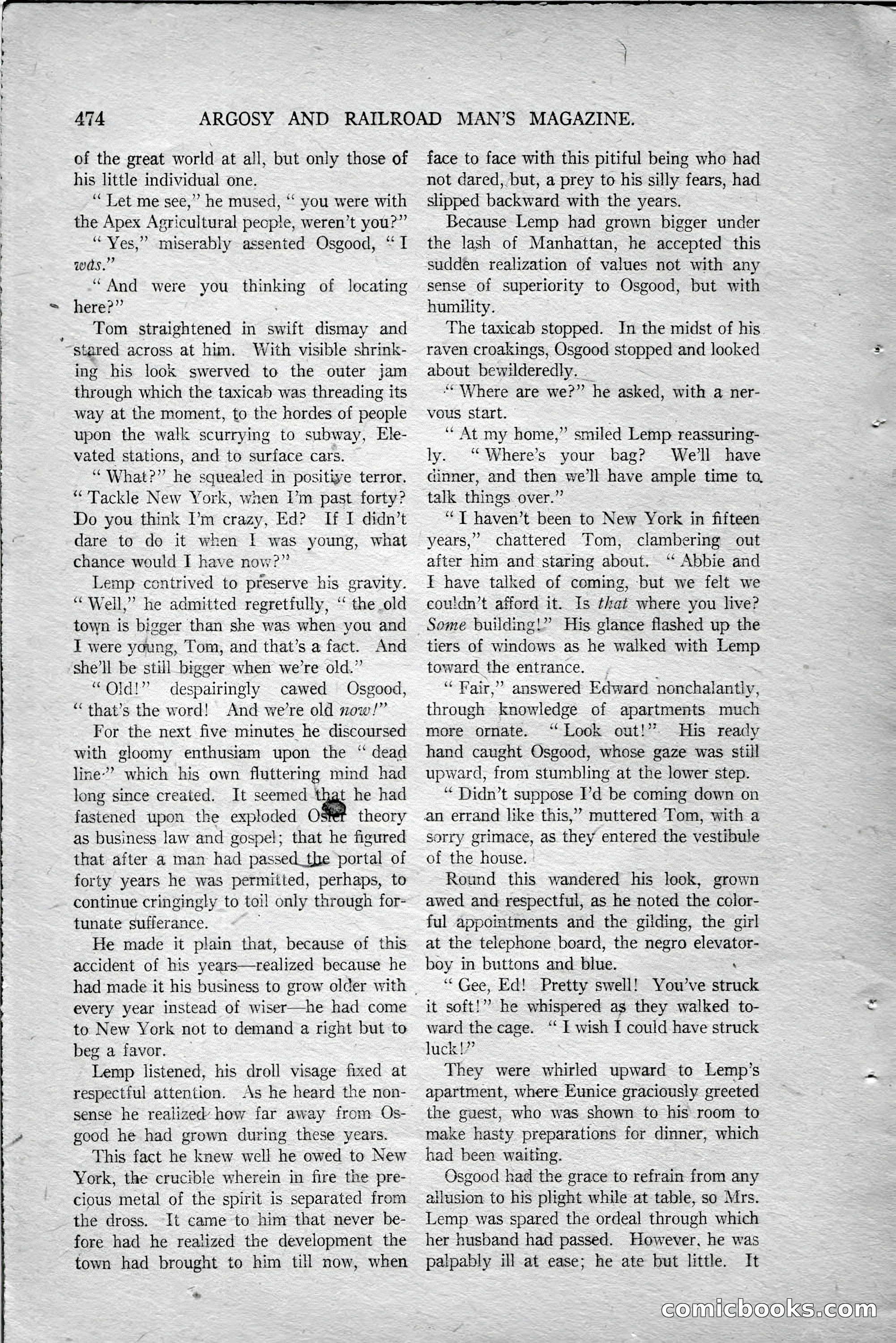
A restored page from Pulp Fiction, 1919. Page through the whole issue in the reader above.
📄 Transcribed text from this page (OCR, searchable)
Machine-transcribed from the original scan — historical spelling and the odd misread are preserved.
ATA ARGOSY AND RAILROAD MAN’S MAGAZINE. of the great world at all, but only those of his little individual one. “Let me see,” he mused, ‘‘ you were with the Apex Agricultural people, weren’t you?” “Yes,” miserably assented Osgood, “I was.” “And were you thinking of locating here?” Tom straightened in swift dismay and stared across at him. With visible shrink- ing his look swerved to the outer jam through which the taxicab was threading its way at the moment, to the hordes of people upon the walk scurrying to subway, Ele- vated stations, and to surface cars. “What?” he squealed in positiye terror. “Tackle New York, when I’m past forty? Do you think I’m crazy, Ed? If I didn’t dare to do it wken | was young, what chance would I have now?” Lemp contrived to preserve his gravity. “Well,” he admitted regretfully, “ the old town is bigger than she was when you and I were young, Tom, and that’s a fact. And she'll be still bigger when we’re old.” “Qld!” despairingly cawed Osgood, “that’s the word! And we’re old xow!/” For the next five minutes he discoursed with gloomy enthusiam upon the “ dead line’ which his own fluttering mind had long since created. It seemed that he had fastened upon the exploded O theory as business law and gospel; that he figured that after a man had passed_the portal of forty years he was permitted, perhaps, to continue cringingly to toil only through for- tunate sufferance. : He made it plain that, because of this accident of his years—trealized because he had made it his business to grow older with | every year instead of wiser—he had come to New York not to demand a right but to beg a favor. Lemp listened, his droll visage fixed at respectful attention. As he heard the non- sense he realized how far away from Os- good he had grown during these years. This fact he knew well he owed to New York, the crucible wherein in fire the pre- cious metal of the spirit is separated from the dross. It came to him that never be- fore had he realized the development the town had brought to him till now, when * face to face with this pitiful being who had not dared, but, a prey to his silly fears, had slipped backward with the years. Because Lemp had grown bigger under the lash of Manhattan, he accepted this sudden realization of values not with any sense of superiority to Osgood, but with humility. The taxicab stopped. In the midst of his raven croakings, Osgood stopped and looked about bewilderedly. ““ Where are we?” he asked, with a ner- vous start. ‘““ At my home,” smiled Lemp. reassuring- ly. “ Where’s your bag? We'll have dinner, and then we'll have ample time to, talk things over.” “T haven’t been to New York in fifteen years,” chattered Tom, clambering out after him and staring about. “ Abbie and T have talked of coming, but we felt we couldn’t afford it. Is that where you live? Some building!” His glance flashed up the tiers of windows as he walked with Lemp toward the entrance. i “ Fair,” answered Edward nonchalantly, through knowledge of apartments much more orate. “Look out!” His ready hand caught Osgood, whose gaze was still upward, from stumbling at the lower step. “Didn’t suppose I’d be coming down on an errand like this,” muttered Tom, with a sorry grimace, as they entered the vestibule of the house. | Round this wandered his look, grown awed and respectful, as he noted the color- ful appointments and the gilding, the girl at the telephone board, the negro elevator- boy in buttons and blue. ‘ “Gee, Ed! Pretty swell! You’ve struck it soft!” he whispered as they walked to- ward the cage. ‘‘ I wish I could have struck luck!?? They were whirled upward to Lemp’s apartment, where Eunice graciously greeted the guest, who was shown to his room to make hasty preparations for dinner, which had been waiting. Osgood had the grace to refrain from any allusion to his plight while at table, so Mrs. Lemp was spared the ordeal through which her husband had passed. However. he was palpably ill at ease; he ate but little. It {% comicbooks.com