
Pulp Fiction, 1919 · page 11 of 196
Argosy and Railroad Man's Magazine — page 11: what you’re looking at
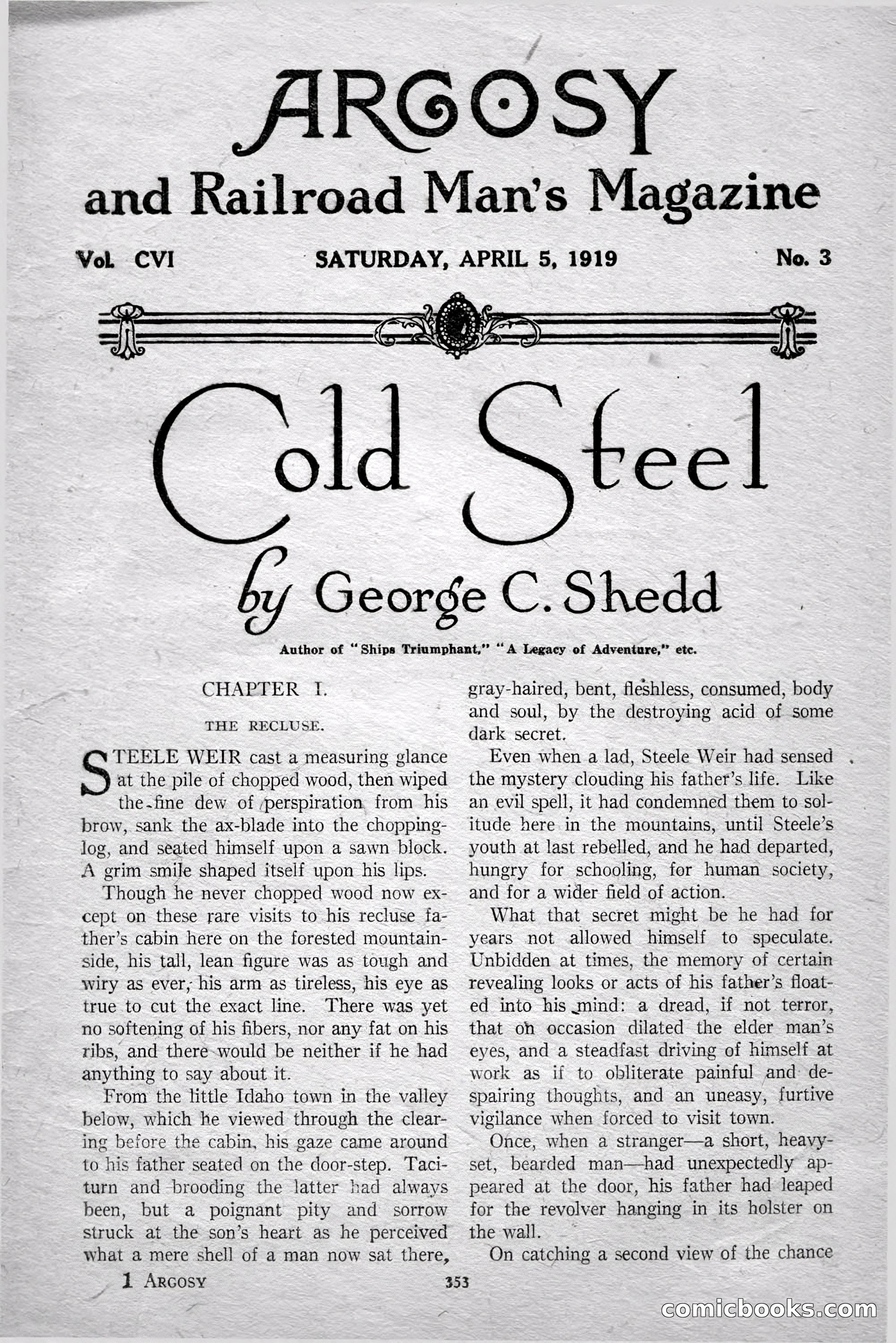
A restored page from Pulp Fiction, 1919. Page through the whole issue in the reader above.
📄 Transcribed text from this page (OCR, searchable)
Machine-transcribed from the original scan — historical spelling and the odd misread are preserved.
RGOSY and Railroad Man's Magazine Vol CVI ‘ SATURDAY, APRIL 5, 1919 No. 3 i ee by George C. Shedd Author of “Ships Triumphant,” “A Legacy of Adveniure,”’ etc. CHAPTER TI. THE RECLUSE. TEELE WEIR cast a measuring glance S at the pile of chopped wood, then wiped the.fime dew of perspiration. from his brow, sank the ax-blade into the chopping- log, and seated himself upon a sawn block. A grim smile shaped itself upon his lips. Though he never chopped wood now ex- cept on these rare visits to his recluse fa- ther’s cabin here on the forested mountain- side, his tall, lean figure was as tough and wiry as ever, his arm as tireless, his eye as true to cut the exact line. There was yet no softening of his fibers, nor any fat on his ribs, and there-would be neither if he had anything to say about it. From the little Idaho town in the valley below, which he viewed through the clear- ing before the cabin, his gaze came around to his father seated on the door-step. Taci- turn and -brooding the latter had always been, but a poignant pity and sorrow struck at the son’s heart as he perceived what a mere shell of a man now sat there, 1 Arcosy 353 gray-haired, bent, fleshless, consumed, body and soul, by the destroying acid of some dark secret. Even when a lad, Steele Weir had sensed . the mystery clouding his father’s life. Like an evil spell, it had condemned them to sol- itude here in the mountains, until Steele’s youth at last rebelled, and he had departed, hungry for schooling, fer human society, and for a wider field of action. What that secret might be he had for years not allowed himself to speculate. Unbidden at times, the memory of certain revealing looks or acts of his father’s float- ed into his mind: a dread, if not terror, that on occasion dilated the elder man’s eyes, and a steadfast driving of himself at work as if to obliterate painful and: de- spairing thoughts, and an uneasy, furtive vigilance when forced to visit town. Once, when a stranger—a short, heavy- set, bearded man—had unexpectedly ap- peared at the door, his father had leaped for the revolver hanging in its holster on the wall. On catching a second view of the chance ComnmiclooolkS.comnn