
Pulp Fiction, 1919 · page 107 of 196
Argosy and Railroad Man's Magazine — page 107: what you’re looking at
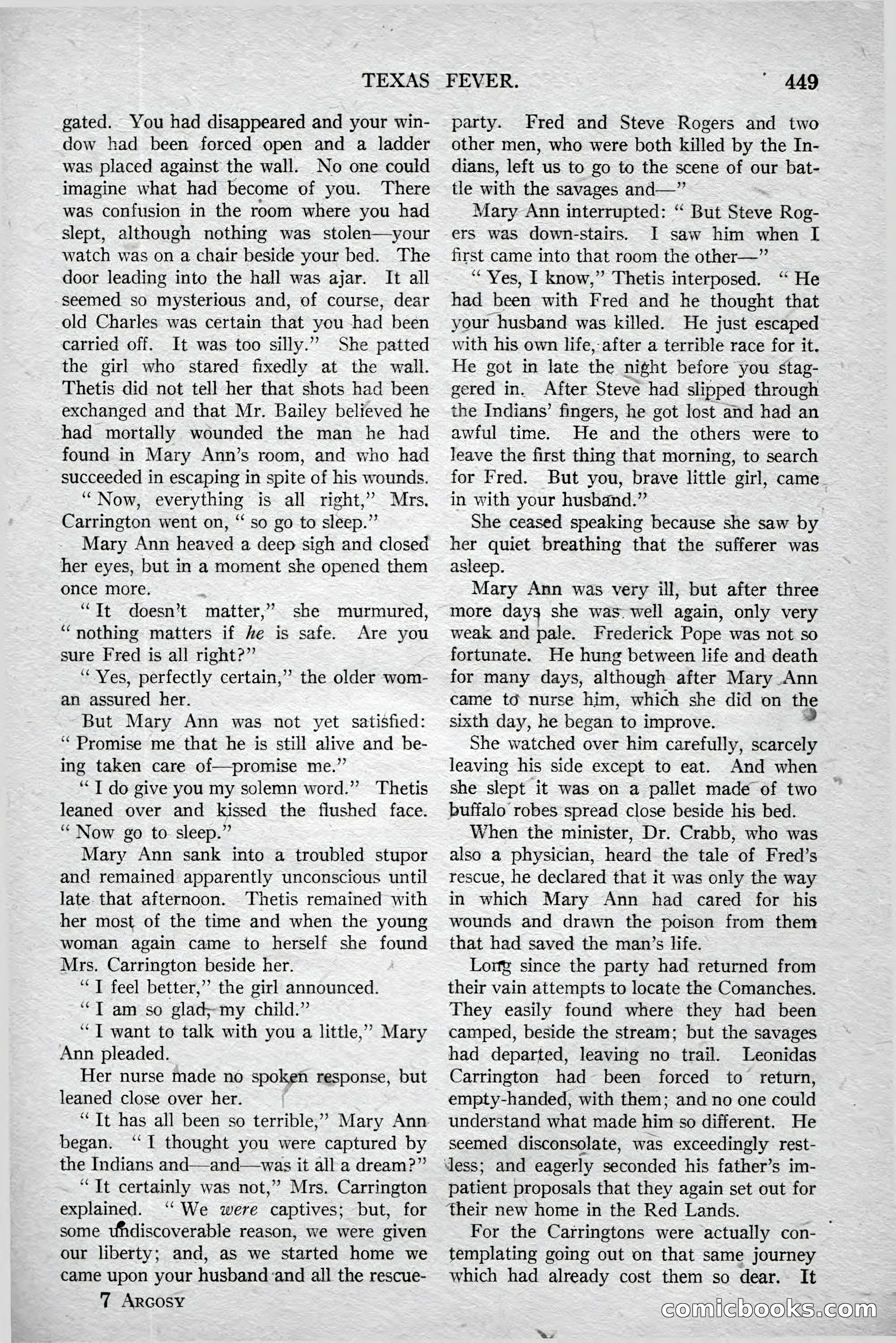
A restored page from Pulp Fiction, 1919. Page through the whole issue in the reader above.
📄 Transcribed text from this page (OCR, searchable)
Machine-transcribed from the original scan — historical spelling and the odd misread are preserved.
TEXAS gated. You had disappeared and your win- dow had been forced open and a ladder was placed against the wall. No one could imagine what had become of you. There was confusion in the room where you had slept, although nothing was stolen—your watch was on a chair beside your bed. The door leading into the hall was ajar. It all seemed so mysterious and, of course, dear old Charles was certain that you had been carried off. It was too silly.” She patted the girl who stared fixedly at the wall. Thetis did not tell her that shots had been exchanged and that Mr. Bailey believed he had mortally wounded the man he had found in Mary Ann’s room, and who had succeeded in escaping in spite of his wounds. ‘Now, everything is all right,” Mrs. Carrington went on, “ so go to sleep.” Mary Ann heaved a deep sigh and closed her eyes, but in a moment she opened them once more, “Tt doesn’t ‘matter,” she murmured, “nothing matters if he is safe. Are you sure Fred is all right?” “Yes, perfectly certain,’ the older wom- an assured her. But Mary Ann was not yet satisfied: “Promise me that he is still alive and be- ing taken care of—promise me.” *““T do give you my solemn word.” Thetis leaned over and kissed the flushed face. “Now go to sleep.” Mary Ann sank into a troubled stupor and remained apparently unconscious until late. that afternoon. Thetis remained with her most of the time and when the young woman again came to herself she found Mrs. Carrington beside her. “T feel better,” the girl announced. ““T am so glad;my child.” ““T want to talk with you a little,” Mary Ann pleaded. Her nurse made no spoken response, but leaned close over her. “Tt has all been so terrible,’ Mary Ann began. “I thought you were captured by the Indians and—and—was it all a dream?” “Tt certainly was not,’ Mrs. Carrington explained. ‘‘ We were captives; but, for some uffdiscoverable reason, we were given our liberty; and, as we started home we came upon your husband and all the rescue- 7 Arcosy FEVER. 449 party. Fred and Steve Rogers and two other men, who were both killed by the In- dians, left us to go to the scene of our bat- tle with the savages and—” Mary Ann interrupted: “ But Steve Rog- ers was down-stairs. I saw him when I first came into that room the other—” “Yes, I know,” Thetis interposed. ‘“ He had been with Fred and he thought that your husband was killed. He just escaped with his own life, after a terrible race for it. He got in late the night before you stag- gered in. After Steve had slipped through the Indians’ fingers, he got lost and had an awful time. He and the others were to leave the first thing that morning, to search for Fred. But you, brave little girl, came in with your husband.” She ceased speaking because she saw by her quiet breathing that the sufferer was asleep. Mary Ann was very ill, but after three more days she was well again, only very weak and pale. Frederick Pope was not so fortunate. He hung between life and death for many days, although after Mary Ann came tod nurse him, which she did on ne sixth day, he began to improve. She watched over him carefully, scarcely leaving his side except to eat. And when she slept it was on a pallet made of two buffalo robes spread close beside his bed. When the minister, Dr. Crabb, who was also a physician, heard the tale of Fred’s rescue, he declared that it was only the way in which Mary Ann had cared for his wounds and drawn the poison from them that had saved the man’s life. Lome since the party had returned from their vain attempts to locate the Comanches. They easily found where they had been camped, beside the stream; but the savages had departed, leaving no trail. Leonidas Carrington had been forced to return, empty-handed, with them; and no one could understand what made him so different. He seemed disconsolate, was exceedingly rest- ‘less; and eagerly seconded his father’s im- patient proposals that they again set out for their new home in the Red Lands. . For the Carringtons were actually con- templating going out on that same journey which had already cost them so dear. It comniclooolks.conn