
Pulp Fiction, 1919 · page 104 of 196
Argosy and Railroad Man's Magazine — page 104: what you’re looking at
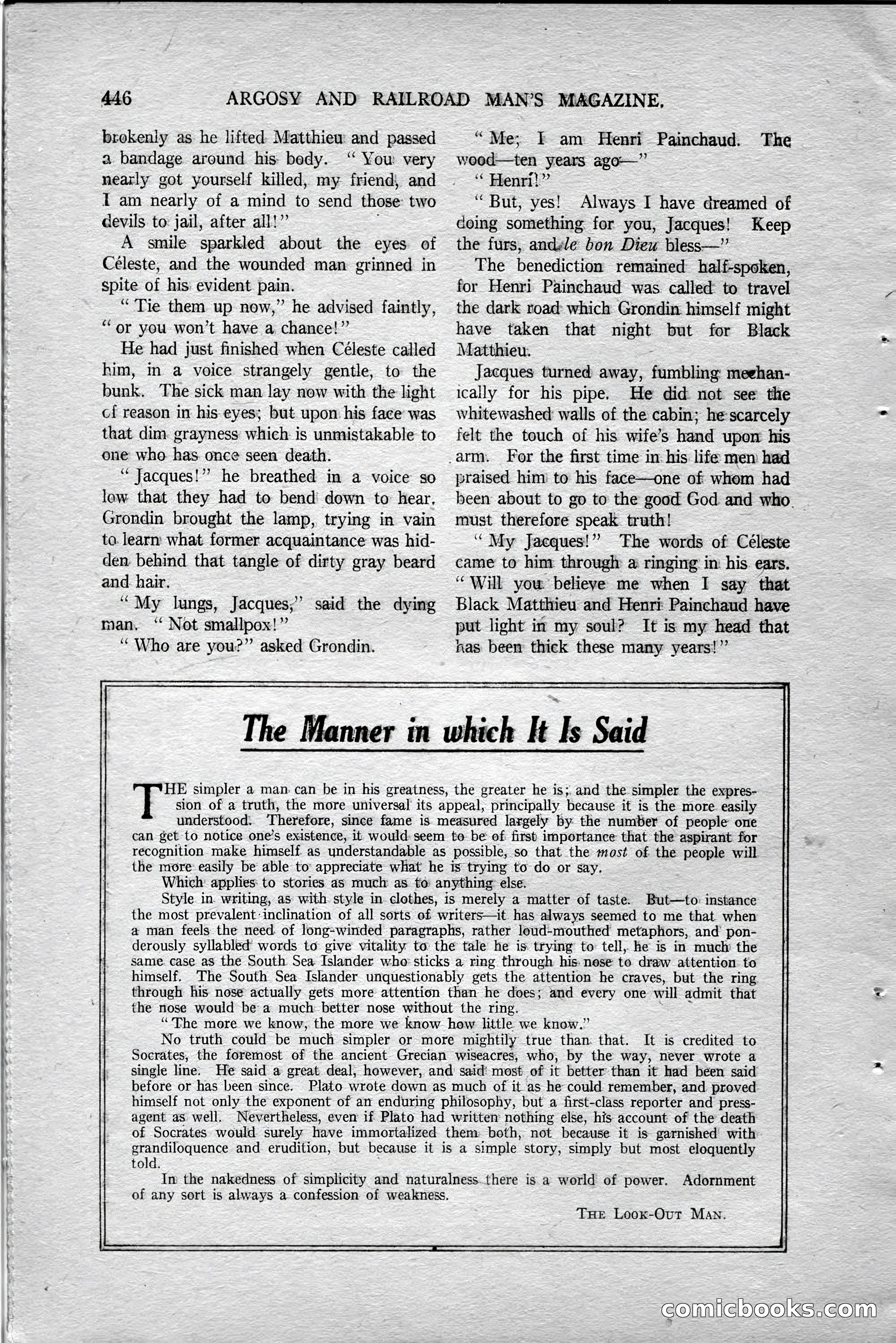
A restored page from Pulp Fiction, 1919. Page through the whole issue in the reader above.
📄 Transcribed text from this page (OCR, searchable)
Machine-transcribed from the original scan — historical spelling and the odd misread are preserved.
446 ARGOSY AND RAILROAD MAN’S MAGAZINE, brokeniy as he lifted Matthieu: and passed a bandage around his bedy. “ You very nearly got yourself killed, my friend; and Tam ncatly of a mind to send those: two devils to: jail, after all!” A smile sparkled about the eyes of Céleste, and the wounded man grinned in spite of his: evident. pain. “Tie them up now,” he advised faintly, “or you won’t have a chance!” He had just finished when Céleste called him, in a voice strangely gentle, to the bunk. The sick man lay now with the light ci reason in his eyes; but upon his face was that dim. grayness which is unmistakable to one who has once seen death. ““ Jacques!”” he breathed in a voice so lew that they had to bend’ down to: hear. Grondin brought the lamp, trying in vain to. learn what former acquaintance was hid- den behind that tangle of dirty gray beard and. hair. “My lungs, Jacques;” said the dying man, ‘‘ Not smallpox!” ‘‘ Who are you?” asked Grondin. “Me; I am Henri Painchaud. The wood—ten years ago—” “ Henri!” “But, yes! Always I have dreamed of doing something for you, Jacques! Keep the furs, andle bon Dieu bless—” The benediction remained half-spoken, for Henri Painchaud was. called to travel the dark road: which Grondin himself might have taken that eee but for Black Matthieu. Jacques turned away, iennisting meehan- ically for his pipe. He did not see the whitewashed walls of the cabin; he scarcely felt the touch of his wife’s hand upor his .arm. For the first time in: his life men had praised himi to his face—one of whom had been about to go to the good God and who _— must therefore speak truth! ‘“ My Jacques!” Fhe words of Céleste came to him through a ringing in: his. ears. “Will you believe me when I say that Black Matthieu: and Henri: Painchaud have put light im my soul? It is my head that has been thick these many years!” The Blanner in which lt Is Said sion of a truth, the more universal its appeal, principally because it is the more easily Se simpler a man can be in his greatness, the greater he is; and the simpler the expres- understood. Therefore, since fame is. measured largely by: the number of people one can get to notice one’s existence, it. would: seem tobe of first importance that the aspirant for recognition make himself as understandable as possible, so that the most of the people will the more: easily be able to appreciate what he is trying to-do or say, Which: applies: to stories as much as. to: anything else. Style in. writing, as with. style in clothes, is merely a matter of taste. But—to: instance the most prevalent-inclination of all sorts of writers—it has always seemed to me that when a man feels the need of long-winded paragraphs, rather loud-nrouthed metaphors, and’ pon- derously syllabled' words to give vitality to the tale he is trying’ to tell, he is in much the same. case ag the South Sea Islander whe: sticks a ring through his: nese to draw attention to himself. The South Sea Islander unquestionably gets the attention he craves, but the ring through his nose actually gets more attention than he does; and every one will admit that the nose would be a much: better nose without the ring. “The more we know, the more we know-how little we know.” No truth could be much simpler or more mightily true than: that. It is credited to Socrates, the foremost of the ancient Grecian wiseacres, who, by the way, never wrote a single line. He said a great deal, however, and’ said: most of it better than it had been said before or has been since. Plato wrote down as much of it as he could. remember, and proved himself not only the exponent of an enduring philosophy, but a first-class reporter and press- agent as well. Nevertheless, even if Plato had written nothing else, his account of the death of Socrates would surely have immortalized them both, not because it is- garnished’ with grandiloquence and. erudition, but because it is a simple story, simply but most eloquently told. Im the nakedness of simplicity and naturalness.there is a world of power. Adornment of any sort is always a confession of weakness, a THe Loox-Out Man. Comicloolk<s.COnn