
Pulp Fiction, 1920 · page 95 of 160
The Argosy, March 27, 1920 — page 95: what you’re looking at
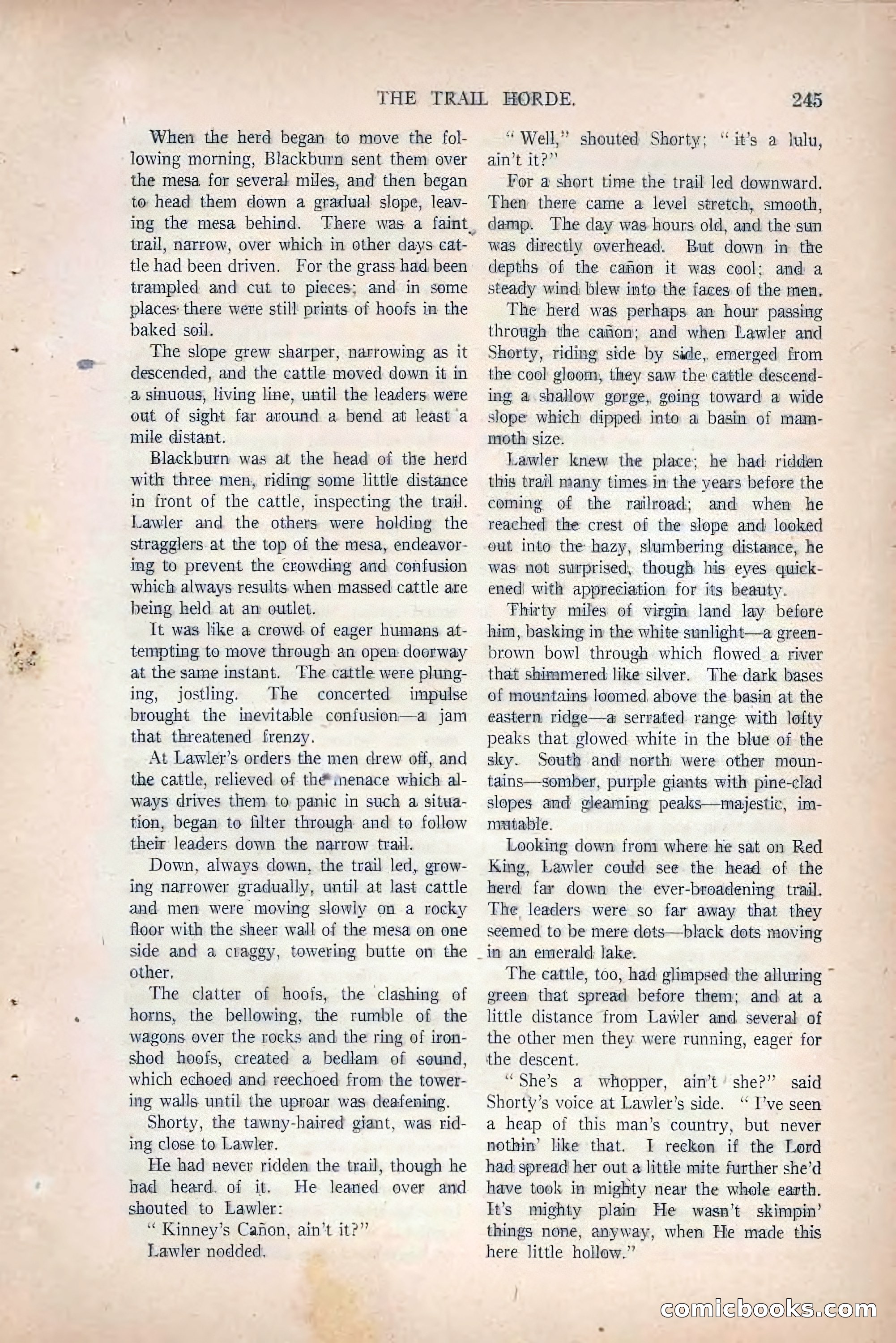
A restored page from Pulp Fiction, 1920. Page through the whole issue in the reader above.
📄 Transcribed text from this page (OCR, searchable)
Machine-transcribed from the original scan — historical spelling and the odd misread are preserved.
Pry war® By + THE TRAIL HORDE, 245 When the herd began to move the fol- lowing morning, Blackburn sent them over the mesa for several miles, and then began to head them down a gradual slope, leav- ing the mesa behind. There was a faint, trail, narrow, over which in other days cat- tle had been driven. For the grass had, been trampled and cut to pieces; and in some places: there were still prints of hoofs in the baked soil. The slope grew sharper, narrowing as it descended, and the cattle moved down it in a sinuous, living line, until the leaders were out of sight far around a bend at least a mile distant: Blackburn was at the head of the herd with three men, riding some little distance in front of the cattle, inspecting the trail. Lawler and the others were holding the stragglers at the top of the mesa, endeavor- ing to prevent the crowding and confusion which always results when massed cattle are being held at am outlet. It was like a crowd: of eager humans at- tempting to move through an open doorway at the same instant. The cattle were plung- ing, jostling. The concerted impulse brought the inevitable confusion—a jam that threatened frenzy. At Lawler’s orders the men drew off, and the cattle, relieved of thé inenace which al- ways drives them to panic in such a situa- tion, began to filter through and to follow their leaders down the narrow trail. Down, always down, the trail led, grow- ing narrower gradually, until at last cattle and men were moving slowly on a rocky floor with the sheer wall of the mesa on one side and a craggy, towering butte on the other, The clatter of hoois, the clashing of horns, the bellowing, the rumble of the wagons over the rocks and the ring of iron- shod hoofs, created a bedlam of sound, which echoed and reechoed from the tower- ing walls until the uproar was deafening. Shorty, the tawny-haired giant, was rid- ing close to Lawler. He had never ridden the trail, though he had heard. of it. He leaned over and shouted to Lawler: ‘““ Kinney’s Canon, ain’t it?” Lawler nodded, “Well,” shouted Shorty; “it’s a lulu, ain’t it?” For a short time the trail led downward. Then there came a level stretch, smooth, damp. The day was hours old, and the sun was directly overhead. But down in the depths of the cation it was cool; and a steady wind blew into the faces of the men. The herd was perhaps an hour passing through the cation; and when Lawler and Shorty, riding side by side, emerged from the cool gloom, they saw the cattle descend- ing a shallow gorge, going toward a wide slope which dipped into a basin of mam- moth size. Lawler knew the place; he had ridden this trail many times in the vears before the coming of the railroad; and when he reached the crest of the slope and looked out into the hazy, slumbering distance, he was not surprised, though his eyes quick- ened! with appreciation for its beauty. Thirty miles of virgin land lay before him, basking in the white sunlight—a green- brown bowl through which flowed a river that shimmered like silver. The dark bases of mountains loomed above the basin at the eastern ridge—a serrated range with lofty peaks that glowed white in the blue of the sley. South and north were other moun- tains—somber, purple giants with pine-clad slopes and gleaming peaks—majestic, im- mattable. Looking down from where he sat on Red King, Lawler could see the head of the herd far down the ever-broadening trail. The leaders were so far away that they seemed to be mere dots—black dots moving _in an emerald: lake. The cattle, too, had glimpsed the alluring ~ green that spread before them; and at a little distance from Lawler amd several of the other men they were running, eager for the descent, ““She’s a whopper, ain’t’ she?” said Shorty’s voice at Lawlet’s side. “ I’ve seen a heap of this man’s country, but never nothin’ like that. I reckon if the Lord had: spread her out a little mite further she’d have took in mighty near the whole earth. It’s mighty plain He wasn’t skimpin’ things none, anyway, when He made this here little hollow.” comniclooolkksS.cotn