
Pulp Fiction, 1920 · page 92 of 160
The Argosy, March 27, 1920 — page 92: what you’re looking at
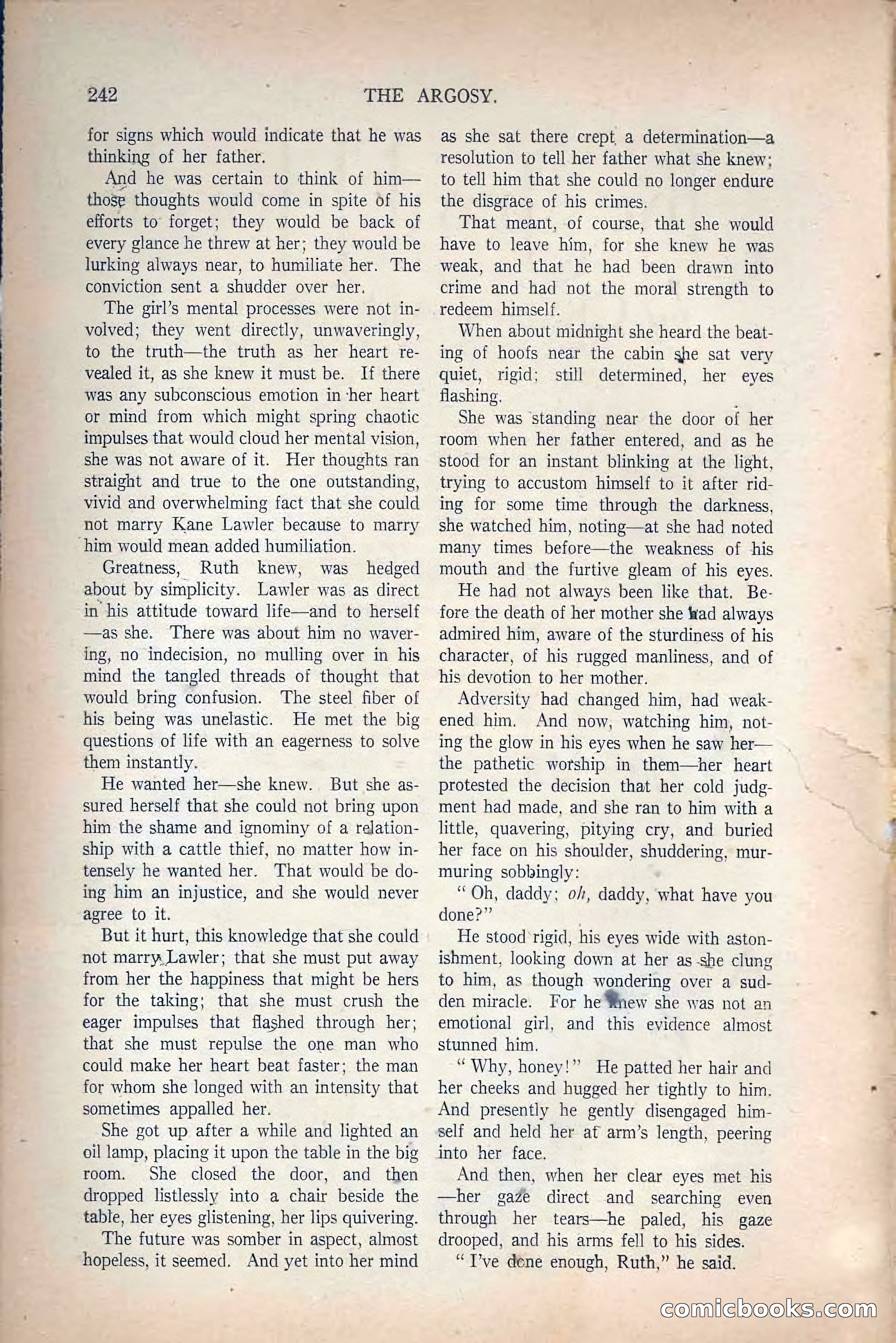
A restored page from Pulp Fiction, 1920. Page through the whole issue in the reader above.
📄 Transcribed text from this page (OCR, searchable)
Machine-transcribed from the original scan — historical spelling and the odd misread are preserved.
242 THE ARGOSY. for signs which would indicate that he was thinking of her father. And he was certain to think of him— those thoughts would come in spite of his efforts to forget; they would be back of every glance he threw at her; they would be lurking always near, to humiliate her. The conviction sent a shudder over her. The girl’s mental processes were not in- volved; they went directly, unwaveringly, to the truth—the truth as her heart re- vealed it, as she knew it must be. If there was any subconscious emotion in ‘her heart or mind from which might spring chaotic impulses that would cloud her mental vision, she was not aware of it. Her thoughts ran straight and true to the one outstanding, vivid and overwhelming fact that she could not marry Kane Lawler because to marry ‘him would mean added humiliation. Greatness, Ruth knew, was hedged about by simplicity. Lawler was as direct in his attitude toward life—and to herself —as she. There was about him no waver- ing, no indecision, no mulling over in his mind the tangled threads of thought that would bring confusion. The steel fiber of his being was unelastic. He met the big questions of life with an eagerness to solve them instantly. He wanted her—she knew. But she as- sured herself that she could not bring upon him the shame and ignominy of a relation- ship with a cattle thief, no matter how in- tensely he wanted her. That would be do- ing him an injustice, and she would never agree to it. But it hurt, this knowledge that she could not marry Lawler; that she must put away from her the happiness that might be hers for the taking; that she must crush the eager impulses that flashed through her; that she must repulse the one man who could make her heart beat faster; the man for whom she longed with an intensity that sometimes appalled her. She got up after a while and lighted an oil lamp, placing it upon the table in the big room. She closed the door, and then dropped listlessly into a chair beside the table, her eyes glistening, her lips quivering. The future was somber in aspect, almost hopeless, it seemed. And yet into her mind as she sat there crept a determination—a resolution to tell her father what she knew; to tell him that she could no longer endure the disgrace of his crimes. That meant, of course, that she would have to leave him, for she knew he was weak, and that he had been drawn into crime and had not the moral strength to redeem himself. When about midnight she heard the beat- ing of hoofs near the cabin she sat very quiet, rigid; still determined, her eyes flashing. : She was standing near the door of her room when her father entered, and as he stood for an instant blinking at the light, trying to accustom himself to it after rid- ing for some time through the darkness, she watched him, noting—at she had noted many times before—the weakness of his mouth and the furtive gleam of his eyes. He had not always been like that, Be- fore the death of her mother she wad always admired him, aware of the sturdiness of his character, of his rugged manliness, and of his devotion to her mother. Adversity had changed him, had weak- ened him. And now, watching him, not- ing the glow in his eyes when he saw her— the pathetic worship in them—her heart protested the decision that her cold judg- ment had made, and she ran to him with a little, quavering, pitying cry, and buried her face on his shoulder, shuddering, mur- muring sobbingly: “Oh, daddy; o/, daddy, what have you done?” He stood'rigid, his eyes wide with aston- ishment, looking down at her as she clung to him, as though wondering over a sud- den miracle. For he Wnew she was not an emotional girl, and this evidence almost stunned him. “Why, honey!” He patted her hair and her cheeks and hugged her tightly to him. And presently he gently disengaged him- self and held her at arm’s length, peering into her face, And then, when her clear eyes met his —her gaze direct and searching even through her tears—he paled, his gaze drooped, and his arms fell to his sides. “ve dene enough, Ruth,” he said. comnliclooolks. com