
Pulp Fiction, 1920 · page 80 of 160
The Argosy, March 27, 1920 — page 80: what you’re looking at
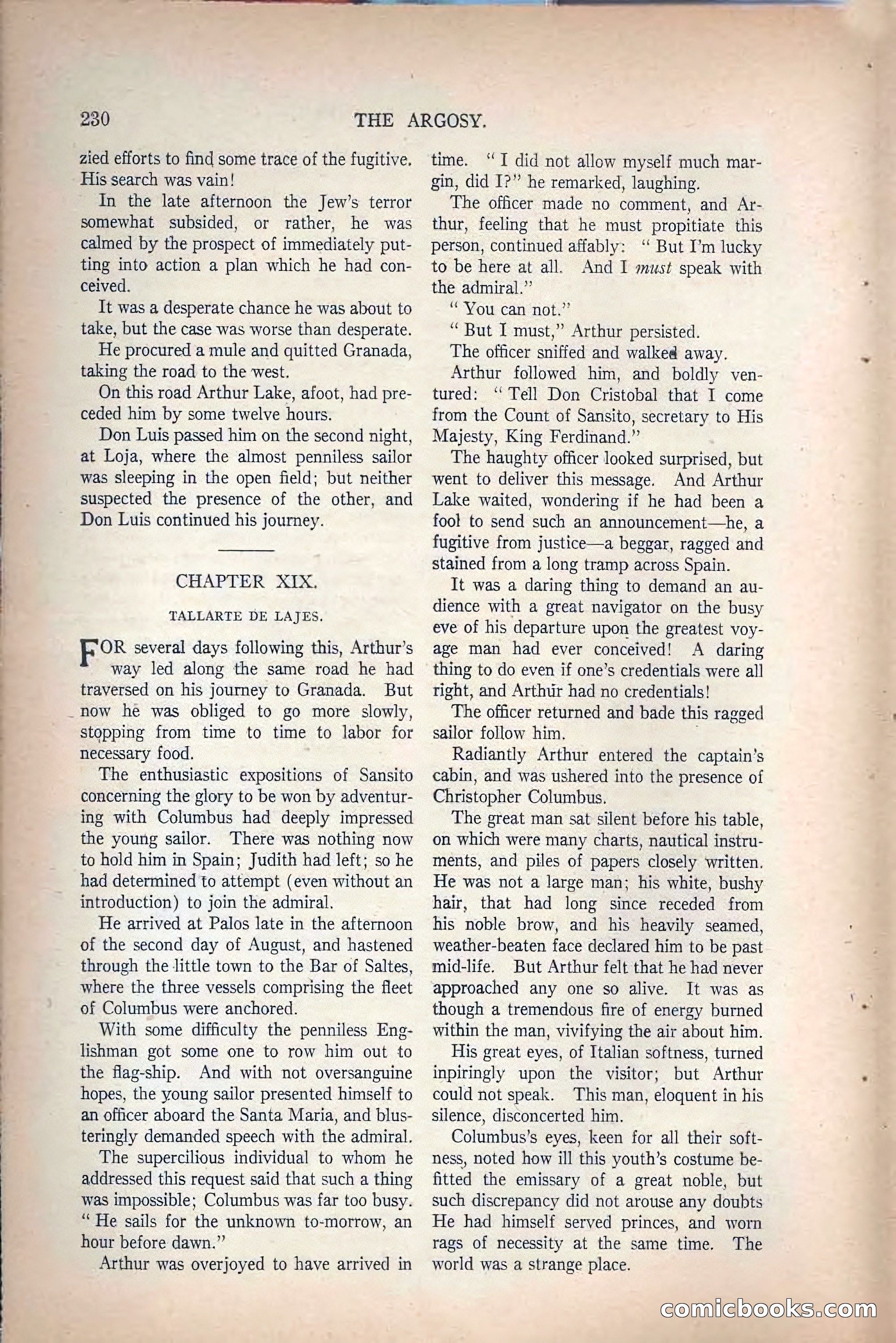
A restored page from Pulp Fiction, 1920. Page through the whole issue in the reader above.
📄 Transcribed text from this page (OCR, searchable)
Machine-transcribed from the original scan — historical spelling and the odd misread are preserved.
230 THE ARGOSY. zied efforts to find some trace of the fugitive. His search was vain! In the late afternoon the Jew’s terror somewhat subsided, or rather, he was calmed by the prospect of immediately put- ting into action a plan which he had con- ceived. It was a desperate chance he was about to take, but the case was worse than desperate. He procured a mule and quitted Granada, taking the road to the west. On this road Arthur Lake, afoot, had pre- ceded him by some twelve hours. Don Luis passed him on the second night, at Loja, where the almost penniless sailor was sleeping in the open field; but neither suspected the presence of the other, and Don Luis continued his journey. CHAPTER XIX. TALLARTE DE LAJES. FOR several days following this, Arthur’s way led along the same road he had traversed on his journey to Granada. But _now he was obliged to go more slowly, stopping from time to time to labor for necessary food. The enthusiastic expositions of Sansito concerning the glory to be won by adventur- ing with Columbus had deeply impressed the young sailor. There was nothing now to hold him in Spain; Judith had left; so he had determined to attempt (even without an introduction) to join the admiral. He arrived at Palos late in the afternoon of the second day of August, and hastened through the little town to the Bar of Saltes, where the three vessels comprising the fleet of Columbus were anchored. With some difficulty the penniless Eng- lishman got some one to row him out to the flag-ship. And with not oversanguine hopes, the young sailor presented himself to an officer aboard the Santa Maria, and blus- teringly demanded speech with the admiral. The supercilious individual to whom he addressed this request said that such a thing was impossible; Columbus was far too busy. “ He sails for the unknown to-morrow, an hour before dawn.” Arthur was overjoyed to have arrived in time. ‘“T did not allow myself much mar- gin, did I?” he remarked, laughing. The officer made no comment, and Ar- thur, feeling that he must propitiate this person, continued affably: ‘‘ But I’m lucky to be here at all. And I must speak with the admiral.” “You can not.” “But I must,” Arthur persisted. The officer sniffed and walked away. Arthur followed him, and boldly ven- tured: “ Tell Don Cristobal that I come from the Count of Sansito, secretary to His Majesty, King Ferdinand.” The haughty officer looked surprised, but went to deliver this message. And Arthur Lake waited, wondering if he had been a fool to send such an announcement—he, a fugitive from justice—a beggar, ragged and stained from a long tramp across Spain. It was a daring thing to demand an au- dience with a great navigator on the busy eve of his departure upon the greatest voy- age man had ever conceived! A daring thing to do even if one’s credentials were all right, and Arthur had no credentials! The officer returned and bade this ragged sailor follow him, : Radiantly Arthur entered the captain's cabin, and was ushered into the presence of Christopher Columbus. The great man sat silent before his table, on which were many charts, nautical instru- ments, and piles of papers closely written. He was not a large man; his white, bushy hair, that had long since receded from his noble brow, and his heavily seamed, weather-beaten face declared him to be past mid-life. But Arthur felt that he had never approached any one so alive. It was as though a tremendous fire of energy burned within the man, vivifying the air about him. His great eyes, of Italian softness, turned inpiringly upon the visitor; but Arthur could not speak. This man, eloquent in his silence, disconcerted him. Columbus's eyes, keen for all their soft- ness, noted how ill this youth’s costume be- fitted the emissary of a preat noble, but such discrepancy did not arouse any doubts He had himself served princes, and worn rags of necessity at the same time. The world was a strange place. ConmiclooolkS.cCOln)