
Pulp Fiction, 1920 · page 54 of 160
The Argosy, March 27, 1920 — page 54: what you’re looking at
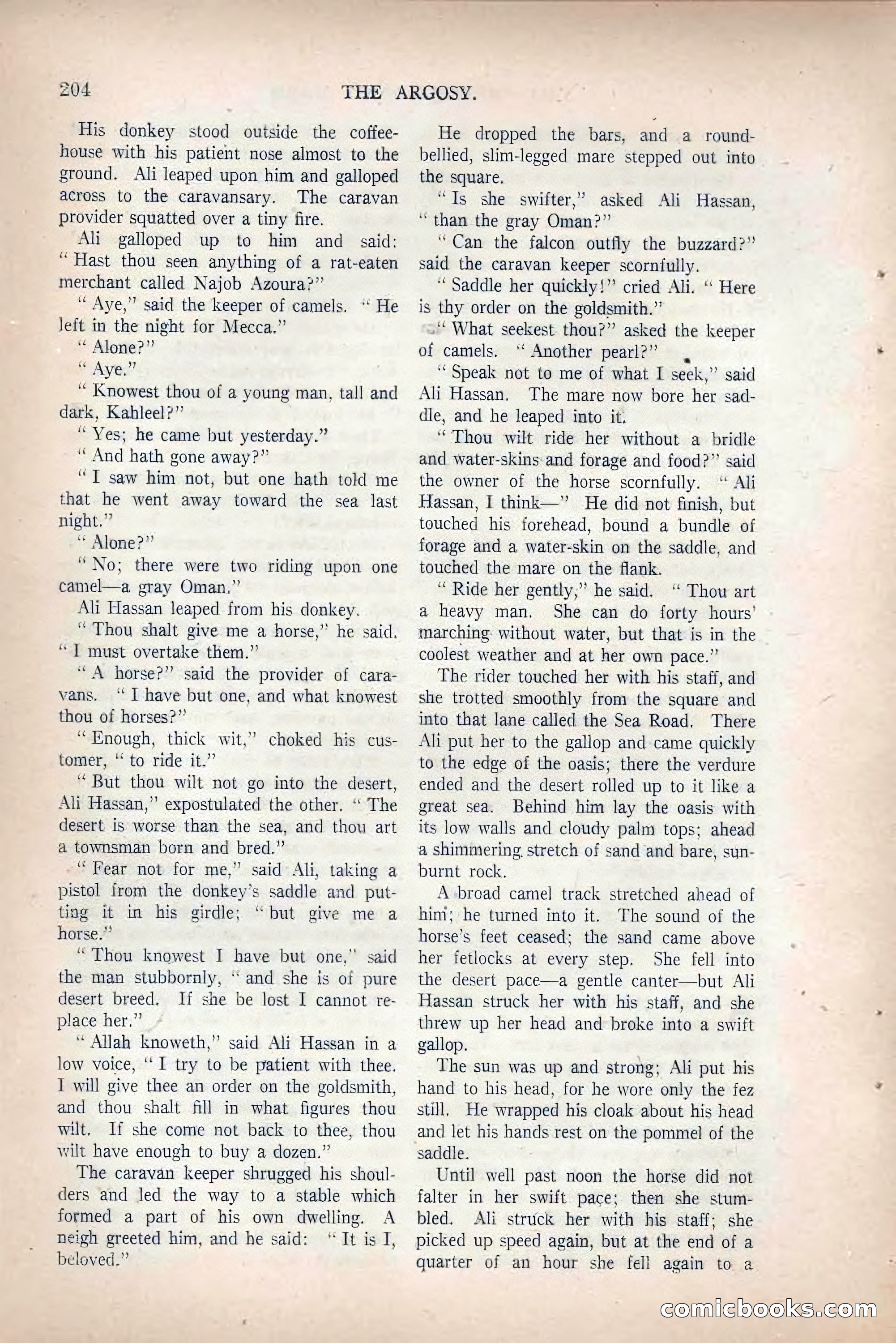
A restored page from Pulp Fiction, 1920. Page through the whole issue in the reader above.
📄 Transcribed text from this page (OCR, searchable)
Machine-transcribed from the original scan — historical spelling and the odd misread are preserved.
204 His donkey stood outside the coffee- house with his patient nose almost to the ground. Ali leaped upon him and galloped across to the caravansary. The caravan provider squatted over a tiny fire. Ali galloped up to him and said: “Hast thou seen anything of a rat-eaten merchant called Najob Azoura?” “ Aye,” said the keeper of camels. “‘ He left in the night for Mecca.” “ Alone?” ac Aye.” “ Knowest thou of a young man, tall and dark, Kahleel?”’ * Yes; he came but yesterday.” “And hath gone away?” “T saw him not, but one hath told me that he went away toward the sea last night,” “Alone?” “No; there were two riding upon one camel—a gray Oman,” Ali Hassan leaped from his donkey. “ Thou shalt give me a horse,’’ he said. * | must overtake them.” “A horse?’ said the provider of cara- vans. “I have but one, and what knowest thou of horses?” “Enough, thick wit,’ choked his cus- tomer, “ to ride it.” “But thou wilt not go into the desert, Ali Hassan,” expostulated the other. ‘‘ The desert is worse than the sea, and thow art a townsman born and bred.” “ Fear not for me,” said Ali, taking a pistol from the donkey’s saddle and put- ting it in his girdle; “but give me a horse.”” “Thou knowest I have but one,” said the man stubbornly, “ and she is of pure desert breed. If she be lost I cannot re- place her.” “ Allah knoweth,” said Ali Hasgan in a low voice, ‘I try to be patient with thee. I will give thee an order on the goldsmith, and thou shalt fill in what figures thou wilt. If she come not back to thee, thou wilt have enough to buy a dozen.” The caravan keeper shrugged his shoul- ders and led the way to a stable which formed a part of his own dwelling. A neigh greeted him, and he said: “It is I, beloved.” THE ARGOSY. He dropped the bars, and a round- bellied, slim-legged mare stepped out into the square. “Ts she swifter,’ asked Ali Hassan, “than the gray Oman?” ‘Can the falcon outfly the buzzard?” said the caravan keeper scornfully. “ Saddle her quickly!” cried Ali. “ Here is thy order on the goldsmith.” ““ What seekest thou?” asked the keeper of camels, ‘ Another pearl?” ‘Speak not to me of what I seek,” said Ali Hassan, The mare now bore her sad- dle, and he leaped into it. “Thou wilt ride her without a bridle and water-skins-and forage and food?” said the owner of the horse scornfully. “ Ali Hassan, I think—” He did not finish, but touched his forehead, bound a bundle of forage and a water-skin on the saddle, and touched the mare on the flank. “ Ride her gently;” he said. “ Thow art a heavy man. She can do forty hours’ marching without water, but that is in the coolest weather and at her own pace.” The rider touched her with his staff, and she trotted smoothly from the square and into that lane called the Sea Road, There Ali put her to the gallop and came quickly to the edge of the oasis; there the verdure ended and the desert rolled up to it like a great sea. Behind him lay the oasis with its low walls and cloudy palm tops; ahead a shimmering. stretch of sand and bare, sun- burnt rock. A broad camel track stretched ahead of him; he turned into it. The sound of the horse’s feet ceased; the sand came above her fetlocks at every step. She fell into the desert pace—a gentle canter—but Ali Hassan struck her with his staff, and she threw up her head and broke into a swift gallop. The sun was up and strong; Ali put his hand to his head, for he wore only the fez still, He wrapped his cloak about his head and let his hands rest on the pommel of the saddle. Until well past noon the horse did not falter in her swift pace; then she stum- bled. Ali struck her with his staff; she picked up speed again, but at the end of a quarter of an hour she fell again to a comniclooolkksS.comn