
Pulp Fiction, 1920 · page 48 of 160
The Argosy, March 27, 1920 — page 48: what you’re looking at
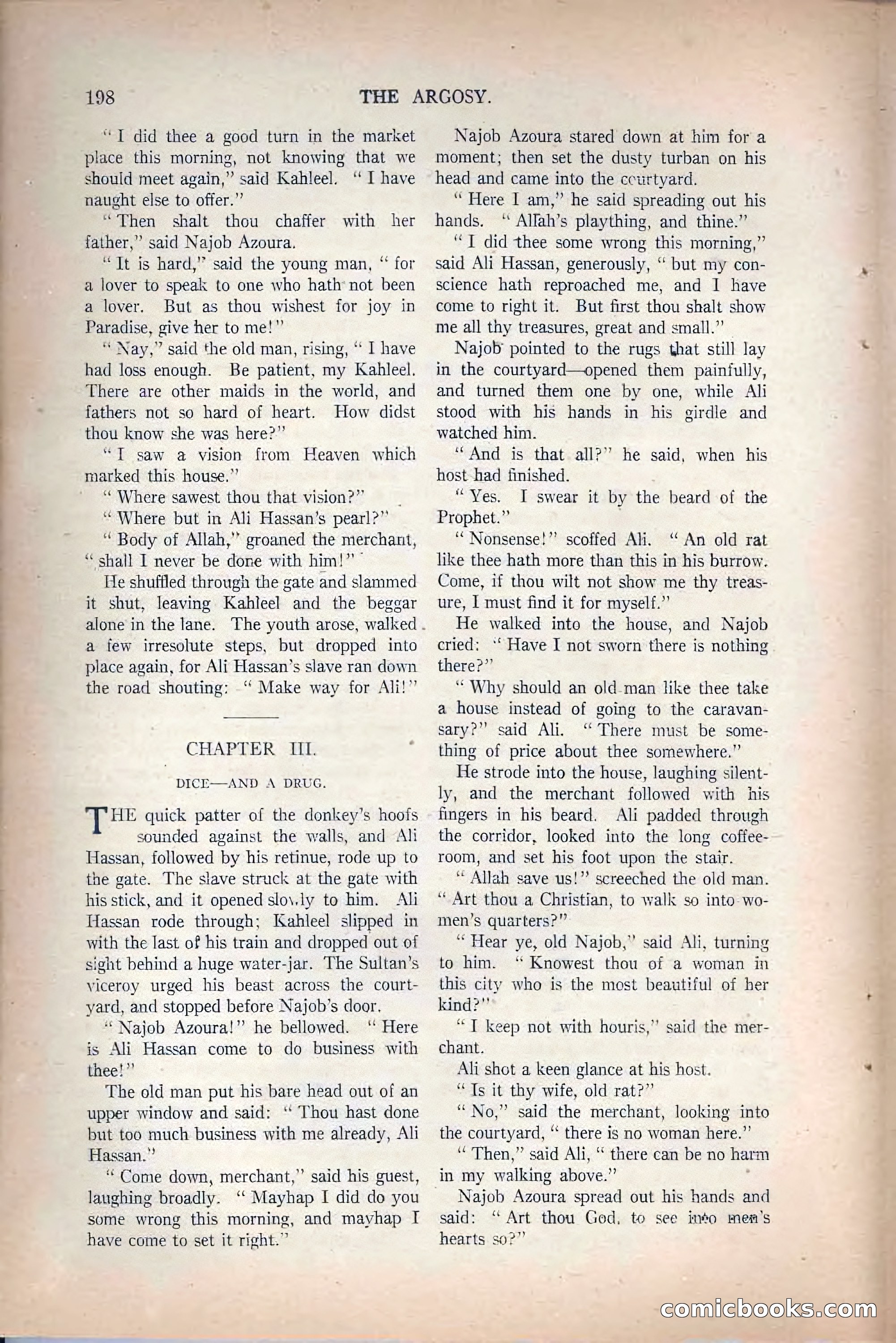
A restored page from Pulp Fiction, 1920. Page through the whole issue in the reader above.
📄 Transcribed text from this page (OCR, searchable)
Machine-transcribed from the original scan — historical spelling and the odd misread are preserved.
198 THE ARGOSY. “T did thee a good turn in the market place this morning, net knowing that we should meet again,” said Kahleel. “ I have naught else to offer.” “Then shalt thou chaffer with her father,” said Najob Azoura. “Tt is hard,” said the young man, “ for a lover to speak to one who hath not been a lover. But as thou wishest for joy in Paradise, give her to me!” “ Nay,” said the old man, rising, ‘“ I have had loss enough. Be patient, my Kahleel. There are other maids in the world, and fathers not so hard of heart. How didst thou know she was here?” “T saw a vision from Heaven which marked this house.” “Where sawest thou that vision?” ; “Where but in Ali Hassan’s pearl?” “ Body of Allah,” groaned the merchant, “shall I never be done with him!” ” He shuffled through the gate and slammed it shut, leaving Kahleel and the beggar alone in the lane. The youth arose, walked . a few irresolute steps, but dropped into place again, for Ali Hassan’s slave ran down the road shouting: ‘“ Make way for Ali!” CHAPTER UL. DICE—AND A DRUG. THE quick patter of the donkey’s hoofs sounded against the walls, and Ali Hassan, followed by his retinue, rode up to the gate. The slave struck at the gate with his stick, and it opened slo\,ly to him. Ali Hassan rode through; Kahleel slipped in with the last of his train and dropped out of sight behind a huge water-jar. The Sultan’s viceroy urged his beast across the court- yard, and stopped before Najob’s door, ““Najob Azoura!” he bellowed. ‘ Here is Ali Hassan come to do business with thee!” The old man put his bare head out of an upper window and said: ‘‘ Thou hast done but too much business with me already, Ali Hassan.” “Come down, merchant,” said his guest, laughing broadly. ‘‘ Mayhap I did do you some wrong this morning, and mayhap I have come to set it right.” Najob Azoura stared down at him for a moment; then set the dusty turban on his head and came into the ccurtyard. “ Here I am,” he said spreading out his hands. “ Allah’s plaything, and thine.” “T did thee some wrong this morning,” said Ali Hassan, generously, “ but my con- science hath reproached me, and I have come to right it. But first thou shalt show me all thy treasures, great and small.” Najob pointed to the rugs that still lay in the courtyard—opened them painfully, and turned them one by one, while Ali stood with his hands in his girdle and watched him. ““And is that all?” he said, when his host -had finished. “Yes. I swear it by the beard of the Prophet.” “Nonsense!” scoffed Ali. “ An old rat like thee hath more than this in his burrow. Come, if thou wilt not show me thy treas- ure, I must find it for myself.” He walked into the house, and Najob cried: ‘‘ Have I not sworn there is nothing there?” “Why should an old-man like thee take a house instead of going to the caravan- sary?” said Ali. “ There must be some- thing of price about thee somewhere.” He strode into the house, laughing silent- ly, and the merchant followed with his fingers in his beard. Ali padded through the corridor, looked into the long coffee- room, and set his foot upon the stair. * Allah save us!” screeched the old man. “Art thou a Christian, to walk so into-wo- men’s quarters?” “Hear ye, old Najob,” said Ali, turning to him. “ Knowest thou of a woman in this city who is the most beautiful of her “T keep not with houris,” said the mer- chant. Ali shot a keen glance at his host. “Ts it thy wife, old rate” “No,” said the merchant, looking into the courtyard, ‘“ there is no woman here.” “Then,” said Ali, “ there can be no harm in my walking above.” Najob Azoura spread out his hands and said: “ Art thou God, to see into mea’s hearts so?” cComichooks7com