
Pulp Fiction, 1920 · page 43 of 160
The Argosy, March 27, 1920 — page 43: what you’re looking at
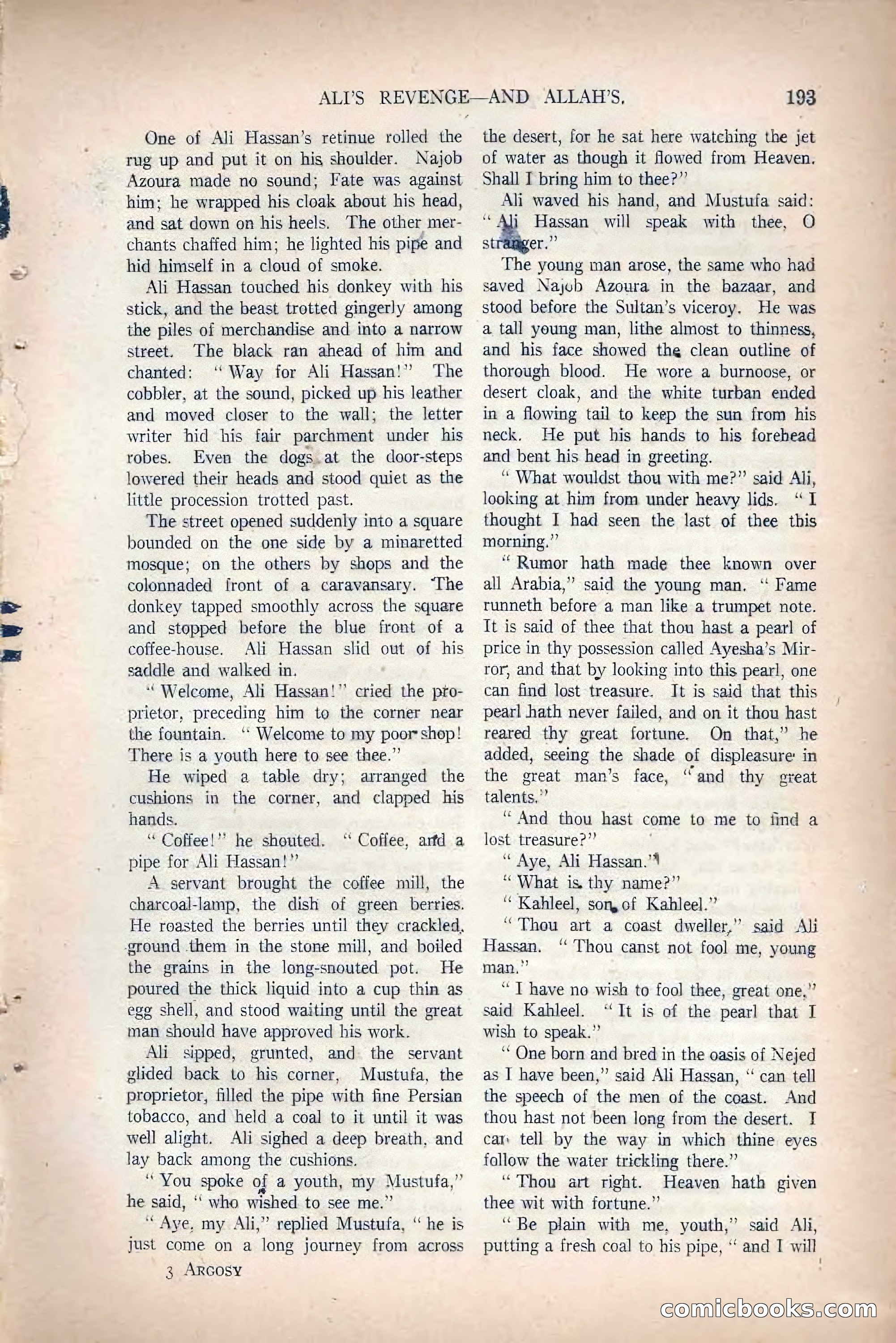
A restored page from Pulp Fiction, 1920. Page through the whole issue in the reader above.
📄 Transcribed text from this page (OCR, searchable)
Machine-transcribed from the original scan — historical spelling and the odd misread are preserved.
wey ae ALV’S REVENGE—AND ALLAB’S, 193 One of Ali Hassan’s retinue rolled the rug up and put it on his shoulder. Najob Azoura made no sound; Fate was against him; he wrapped his cloak about his head, and sat down on his heels. The other mer- chants chaffed him; he lighted his pipe and hid himself in a cloud of smoke. Ali Hassan touched his donkey with his stick, and the beast trotted gingerly among the piles of merchandise and into a narrow street. The black ran ahead of him and chanted: ‘Way for Ali Hassan!” The cobbler, at the sound, picked up his leather and moved closer to the wall; the letter writer hid his fair parchment under his robes. Even the dogs.at the door-steps lowered their heads and stood quiet as the little procession trotted past. The street opened suddenly into a square bounded on the one side by a minaretted mosque; on the others by shops and the colonnaded front of a caravansary. “The donkey tapped smoothly across the square and stopped before the blue front of a coffee-house. Ali Hassan slid out of his saddle and walked in. “Welcome, Ali Hassan!” cried the pto- prietor, preceding him to the corner near the fountain. ‘ Welcome to my poor shop! ‘There is a youth here to see thee.” He wiped a table dry; arranged the cushions in the corner, and clapped his hands. “ Coffee!’ he shouted. ‘ Coffee, arfd a pipe for Ali Hassan!” A servant brought the coffee mill, the charcoal-lamp, the dish of green berries. He roasted the berries until thev crackled, ground them in the stone mill, and boiled the grains in the long-snouted pot. He poured the thick liquid into a cup thin as egg shell, and stood waiting until the great man should have approved his work. Ali sipped, grunted, and the servant glided back to his corner, Mustufa, the proprietor, filled the pipe with fine Persian tobacco, and held a coal to it until it was well alight. Ali sighed a deep breath, and lay back among the cushions. “You spoke of a youth, my Mustufa,” he said, ‘‘ who wished to see me.” ‘Aye, my Ali,” replied Mustufa, “ he is just come on a long journey from across 3 ARGosY the desert, for he sat here watching the jet of water as though it owed from Heaven. Shall I bring him to thee?” Ali waved his hand, and Mustufa said: ‘Ali Hassan will speak with thee, O ste: The young man arose, the same who had saved Najob Azoura in the bazaar, and stood before the Sultan’s viceroy, He was a tall young man, lithe almost to thinness, and his face showed the clean outline of thorough blood. He wore a burnoose, or desert cloak, and the white turban ended in a flowing tail to keep the sun from his neck. He put his hands to his forehead and bent his head in greeting. “ What wouldst thou with me?” said Ali, looking at him from under heavy lids. “I thought I had seen the last of thee ibis morning.” “Rumor hath made thee known over all Arabia,” said the young man, ‘‘ Fame runneth before a man like a trumpet note. Tt is said of thee that thou hast a pearl of price in thy possession called Ayesha’s Mir- ror, and that by looking into this pearl, one can find lost treasure. It is said that this pearl hath never failed, and on it thou hast reared thy great fortune. On that,” he added, seeing the shade of displeasure: in the great man’s face, “and thy great talents.” “And thou hast come to me to find a lost treasure?” ‘“ Ave, Ali Hassan."4 “What is thy name?” ‘* Kahleel, son, of Kahleel.” “Thou art a coast dweller,” said Aji Hassan. “ Thou canst not fool me, young man,” “ T have no wish to fool thee, great one,”’ said Kahleel. “It is of the pearl that I wish to speak.” ‘ One born and bred in the oasis of Nejed as I have been,” said Ali Hassan, ‘ can tell the speech of the men of the coast. And thou hast not been long from the desert. 1 can tell by the way in which thine eyes fallow the water trickling there.” “Thou art right. Heaven hath given thee wit with fortune.” “Be plain with me, youth,” said Ah, putting a fresh coal to his pipe, ‘“‘ and I will comnliclooolks. com