
Pulp Fiction, 1920 · page 38 of 160
The Argosy, March 27, 1920 — page 38: what you’re looking at
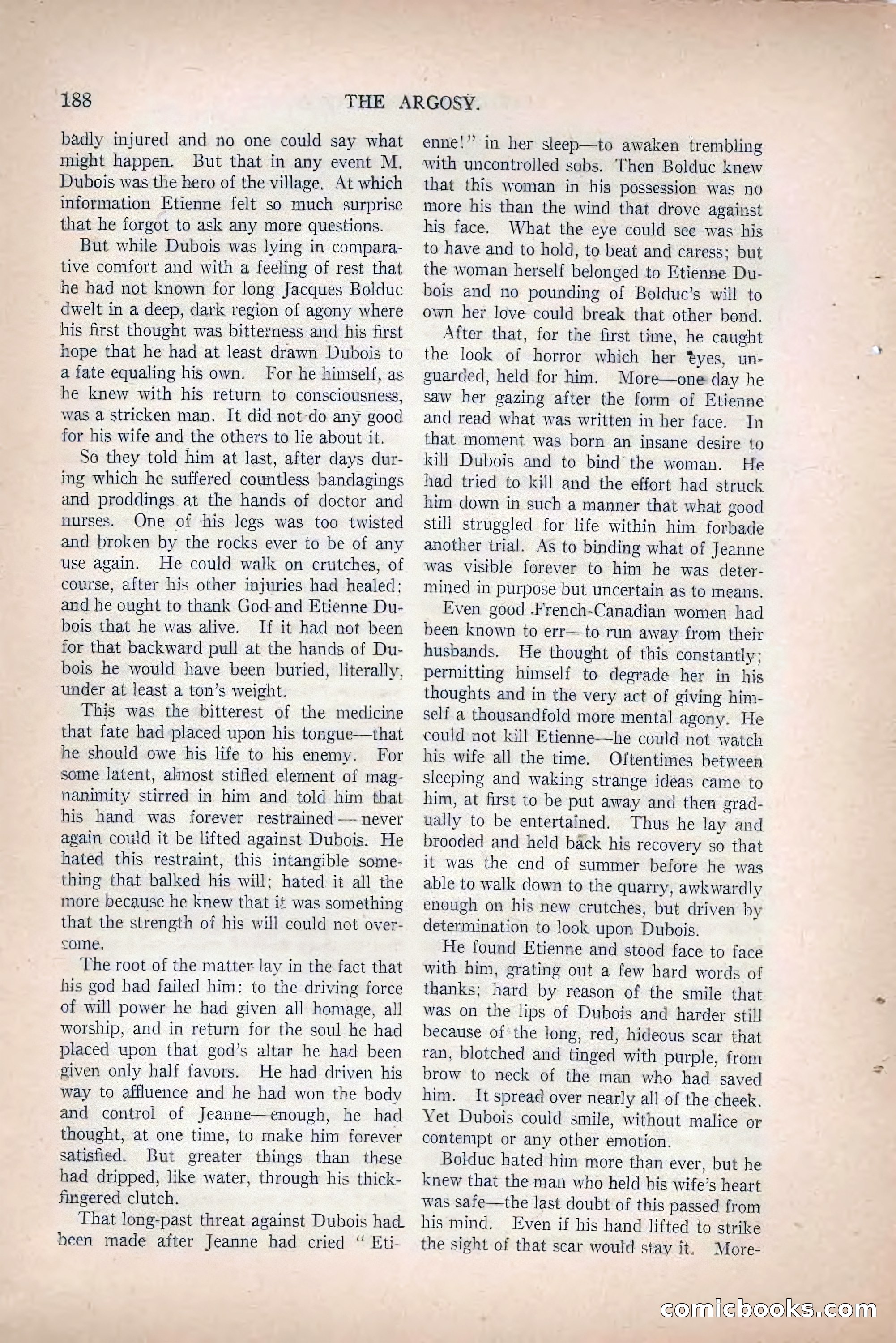
A restored page from Pulp Fiction, 1920. Page through the whole issue in the reader above.
📄 Transcribed text from this page (OCR, searchable)
Machine-transcribed from the original scan — historical spelling and the odd misread are preserved.
188 badly injured and no one could say what might happen. But that in any event M. Dubois was the hero of the village. At which information Etienne felt so much surprise that he forgot to ask any more questions. But while Dubois was lying in compara- tive comfort and with a feeling of rest that he had not known for long Jacques Bolduc dwelt in a deep, dark region of agony where his first thought was bitterness and his first hope that he had at least drawn Dubois to a fate equaling his own. For he himself, as he knew with his return to consciousness, was a stricken man. It did not-do any good for his wife and the others to lie about it. So they told him at last, after days dur- ing which he suffered countless bandagings and proddings at the hands of doctor and nurses. One of his legs was too twisted and broken by the rocks ever to be of any use again. He could walk on crutches, of course, after his other injuries had healed: and he ought to thank God and Etienne Du- bois that he was alive. If it had not been for that backward pull at the hands of Du- bois he would have been buried, literally, under at least a ton’s weight. This was the bitterest of the medicine that fate had placed upon his tongue—that he should owe his life to his enemy. For some latent, almost stifled element of mag- nanimity stirred in him and told him that his hand was forever restrained — never again could it be lifted against Dubois. He hated this restraint, this intangible some- thing that balked his will; hated it all the more because he knew that it was something that the strength of his will could not over- come. The root of the matter lay in the fact that his god had failed him: to the driving force of will power he had given all homage, all worship, and in return for the soul he had placed upon that god’s altar he had been given only half favors. He had driven his way to affluence and he had won the body and control of Jeanne—enough, he had thought, at one time, to make him forever satisfied. But greater things than these had dripped, like water, through his thick- fingered clutch. That long-past threat against Dubois hac been made after Jeanne had cried “ Eti- THE ARGOSY. enne!” in her sleep—to awaken trembling with uncontrolled sobs. Then Bolduc knew that this woman in his possession was no more his than the wind that drove against his face. What the eye could see was his to have and to hold, to beat and caress: but the woman herself belonged to Etienne Du- bois and no pounding of Bolduc’s will to own her love could break that other bond. After that, for the first time, he caught the look of horror which her tyes, un- guarded, held for him. More—one day he saw her gazing after the form of Etienne and read what was written in her face. In that moment was born an insane desire to kill Dubois and to bind the woman. He had tried to kill and the effort had struck him down in such a manner that what good still struggled for life within him forbade another trial. As to binding what of Jeanne was visible forever to him he was deter- mined in purpose but uncertain as to means. Even good French-Canadian women had been known to err—to run away from their husbands. He thought of this constantly . permitting himself to degrade her in his thoughts and in the very act of giving him- self a thousandfold more mental agony. He could not kill Etienne—he could not watch his wife all the time. Oftentimes between sleeping and waking strange ideas came to him, at first to be put away and then grad- ually to be entertained. Thus he lay and brooded and held back his recovery so that it was the end of summer before he was able to walk down to the quarry, awkwardly enough on his new crutches, but driven by determination to look upon Dubois. He found Etienne and stood face to face with him, grating out a few hard words of thanks; hard by reason of the smile that was on the lips of Dubois and harder still because of the long, red, hideous scar that ran, blotched and tinged with purple, from brow to neck of the man who had saved him. It spread over nearly all of the cheek. Yet Dubois could smile, without malice or contemipt or any other emotion. Bolduc hated him more than ever, but he knew that the man who held his wife’s heart was safe—the last doubt of this passed from his mind. Even if his hand lifted to strike the sight of that scar would stay it. More comicbooksscom