
Pulp Fiction, 1920 · page 18 of 160
The Argosy, March 27, 1920 — page 18: what you’re looking at
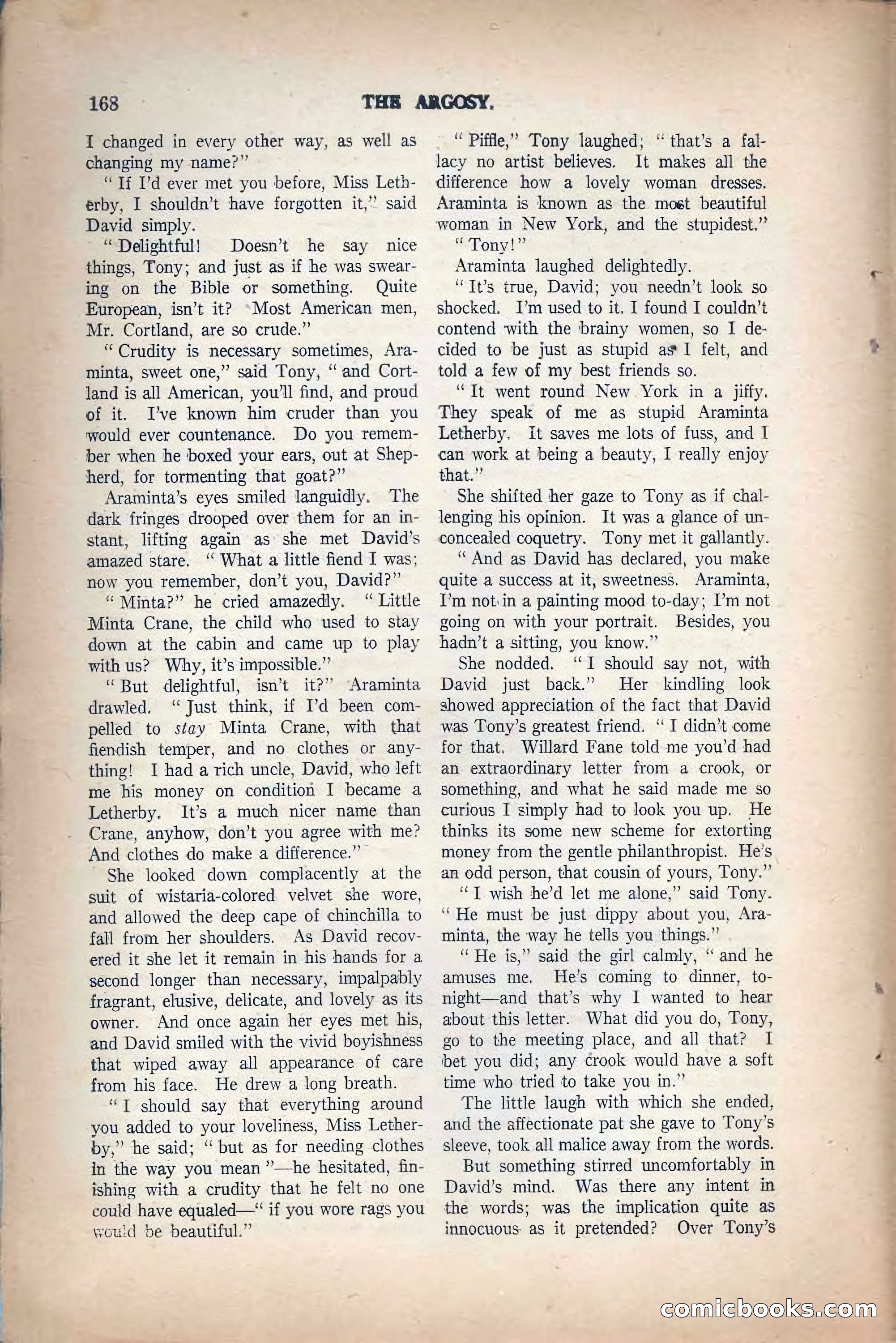
A restored page from Pulp Fiction, 1920. Page through the whole issue in the reader above.
📄 Transcribed text from this page (OCR, searchable)
Machine-transcribed from the original scan — historical spelling and the odd misread are preserved.
168 THE ARGOSY. I changed in every other way, as well as changing my name?”’ “Tf I’d ever met you before, Miss Leth- érby, I shouldn’t have forgotten it,” said David simply. “Delightful! Doesn’t he say nice things, Tony; and just as if he was swear- ing on the Bible or something. Quite European, isn’t it? “Most American men, Mr. Cortland, are so crude.” “ Crudity is necessary sometimes, Ara- minta, sweet one,” said Tony, “and Cort- land is all American, you'll find, and proud of it. I’ve known him cruder than you would ever countenance. Do you remem- ber when he boxed your ears, out at Shep- herd, for tormenting that goat?” Araminta’s eyes smiled languidly. The dark fringes drooped over them for an in- stant, lifting again as she met David’s amazed stare. ‘ What a little fiend I was; now you remember, don’t you, David?” “ Minta?” he cried amazedly. “Little Minta Crane, the child who used to stay down at the cabin and came up to play with us? Why, it’s impossible.” “But delightful, isn’t it?’ Araminta drawled. ‘Just think, if I'd been com- pelled to stay Minta Crane, with that fiendish temper, and no clothes or any- thing! I had a rich uncle, David, who left me his money on condition I became a Letherby, It’s a much nicer name than Crane, anyhow, don’t you agree with me? And clothes do make a difference.” She looked down complacently at the suit of wistaria-colored velvet she wore, and allowed the deep cape of chinchilla to fall from her shoulders. As David recov- ered it she let it remain in his hands for a second longer than necessary, impalpably fragrant, elusive, delicate, and lovely as its owner. And once again her eyes met his, and David smiled with the vivid boyishness that wiped away all appearance of care from his face. He drew a long breath. “1 should say that everything around you added to your loveliness, Miss Lether- by,” he said; “but as for needing clothes in the way you mean ’—he hesitated, fin- ishing with a crudity that he felt no one could have equaled— if you wore rags you would be beautiful.” “ Piffle,” Tony laughed; “ that’s a fal- lacy no artist believes. It makes all the difference how a lovely woman dresses. Araminta is known as the moet beautiful woman in New York, and the stupidest.” Araminta laughed delightedly. ‘It’s true, David; you needn’t look so shocked. I’m used to it, I found I couldn’t contend with the brainy women, so I de- cided to be just as stupid as I felt, and told a few of my best friends so. “Tt went round New York in a jiffy, They speak of me as stupid Araminta Letherby, It saves me lots of fuss, and 1 can work at being a beauty, I really enjoy that.” She shifted her gaze to Tony as if chal- lenging his opinion. It was a glance of un- concealed coquetry. Tony met it gallantly. “And as David has declared, you make quite a success at it, sweetness. Araminta, I’m not:in a painting mood to-day; ’'m not going on with your portrait. Besides, you hadn’t a sitting, you know.” She nodded. ‘I should say not, with David just back.” Her kindling look showed appreciation of the fact that David was Tony’s greatest friend. ‘‘I didn’t come for that. Willard Fane told me you’d had an extraordinary letter from a crook, or something, and what he said made me so curious I simply had to look you up. He thinks its some new scheme for extorting money from the gentle philanthropist. He's an odd person, that cousin of yours, Tony.” ‘‘T wish he’d let me alone,” said Tony. ‘He must be just dippy about you, Ara- minta, the way he tells you things.” “ He is,” said the girl calmly, “ and he amuses me, He’s coming to dinner, to- night—and that’s why I wanted to hear about this letter. What did you do, Tony, go to the meeting place, and all that? I ibet you did; any crook would have a soft time who tried to take you in.” The little laugh with which she ended, and the affectionate pat she gave to Tony’s sleeve, took all malice away from the words. But something stirred uncomfortably in David’s mind. Was there any intent in the words; was the implication quite as innoctious as it pretended? Over Tony’s comicbooksscom