
Pulp Fiction, 1920 · page 117 of 160
The Argosy, March 27, 1920 — page 117: what you’re looking at
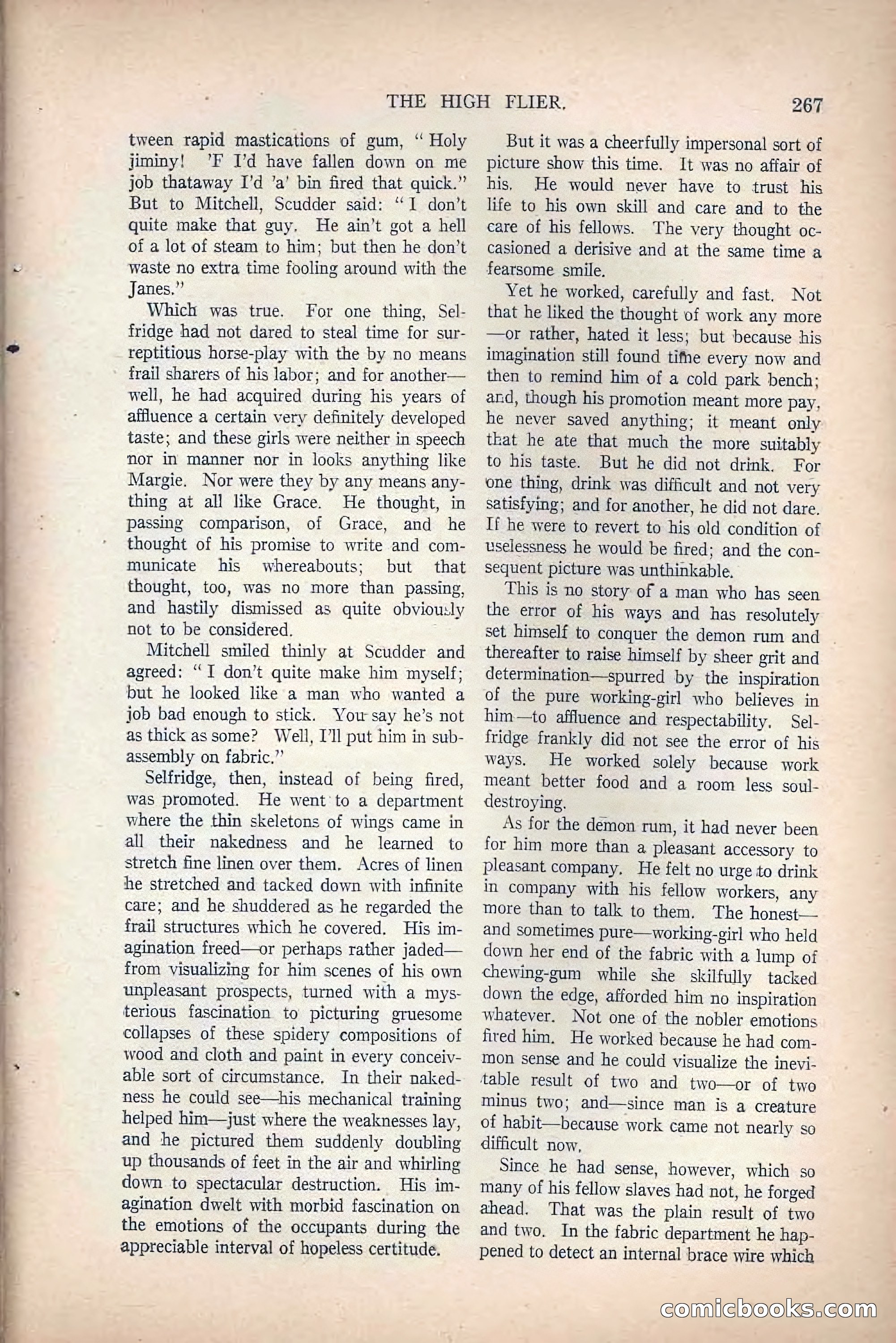
A restored page from Pulp Fiction, 1920. Page through the whole issue in the reader above.
📄 Transcribed text from this page (OCR, searchable)
Machine-transcribed from the original scan — historical spelling and the odd misread are preserved.
THE HIGH FLIER, 267 tween rapid mastications of gum, ‘“ Holy jiminy! ’F I’d have fallen down on me job thataway I’d ’a’ bin fired that quick.” But to Mitchell, Scudder said: ‘1 don’t quite make that guy. He ain’t got a hell of a lot of steam to him; but then he don’t waste no extra time fooling around with the Janes.” Which was true. For one thing, Sel- fridge had not dared to steal time for sur- reptitious horse-play with the by no means frail sharets of his labor; and for another— well, he had acquired during his years of affluence a certain very definitely developed taste; and these girls were neither in speech mor in manner nor in looks anything like Margie. Nor were they by any means any- thing at all like Grace. He thought, in passing comparison, of Grace, and he thought of his promise to write and com- municate his whereabouts; but that thought, too, was no more than passing, and hastily dismissed as quite obviously not to be considered, Mitchell smiled thinly at Scudder and agreed: “TI don’t quite make him myself; but he looked like a man who wanted a job bad enough to stick. You say he’s not as thick as some? Well, Ill put him in sub- assembly on fabric,’’ Selfridge, then, instead of being fired, was promoted. He went’ to a department where the thin skeletons of wings came in all their nakedness and he learned to stretch fine linen over them. Acres of linen he stretched and tacked down with infinite care; and he shuddered as he regarded the frail structures which he covered. His im- agination freed—or perhaps rather jaded— from visualizing for him scenes of his own unpleasant prospects, turned with a mys- terious fascination to picturing gruesome collapses of these spidery compositions of wood and cloth and paint in every conceiv- able sort of circumstance, In their naked- ness he could see—his mechanical training helped him—just where the weaknesses lay, and he pictured them suddenly doubling up thousands of feet in the air and whirling down to spectacular destruction. His im- agination dwelt with morbid fascination on the emotions of the occupants during the appreciable interval of hopeless certitude. But it was a cheerfully impersonal sort of picture show this time. It was no affair of his, He would never have to trust his life to his own skill and care and to the care of his fellows. The very thought oc- casioned a derisive and at the same time a fearsome smile. Yet he worked, carefully and fast, Not that he liked the thought of work any more —or rather, hated it less: but because his imagination still found tifne every now and then to remind him of a cold park bench; and, though his promotion meant more pay, he never saved anything; it meant only that he ate that much the more suitably to his taste. But he did not drink, For one thing, drink was difficult and not very satisfying; and for another, he did not dare. If he were to revert to his old condition of uselessness he would be fired; and the con- sequent picture was unthinkable, This is no story of a man who has seen the error of his ways and has resolutely set himself to conquer the demon rum and thereafter to raise himself by sheer grit and determination—spurred by the inspiration of the pure working-girl who believes in him—to affluence and respectability, Sel- fridge frankly did not see the error of his ways. He worked solely because work meant better food and a room less soul- destroying, As for the demon rum, it had never been for him more than a pleasant accessory to pleasant company, He felt no urge to drink in company with his fellow workers, any more than to talk to them. The honest— and sometimes pure—working-girl who held down her end of the fabric with a lump of chewing-gum while she skilfully tacked down the edge, afforded him no inspiration whatever. Not one of the nobler emotions fired him. He worked because he had com- mon sense and he could visualize the inevi- table result of two and two—or of two minus two; and—since man is a creature of habit—because work came not nearly so difficult now, Since he had sense, however, which so many of his fellow slaves had not, he forged ahead. That was the plain result of two and two. In the fabric department he hap- pened to detect an internal brace wire which ConmiclooolkS.cCOlin