
Pulp Fiction, 1928 · page 79 of 99
Amazing Stories — page 79: what you’re looking at
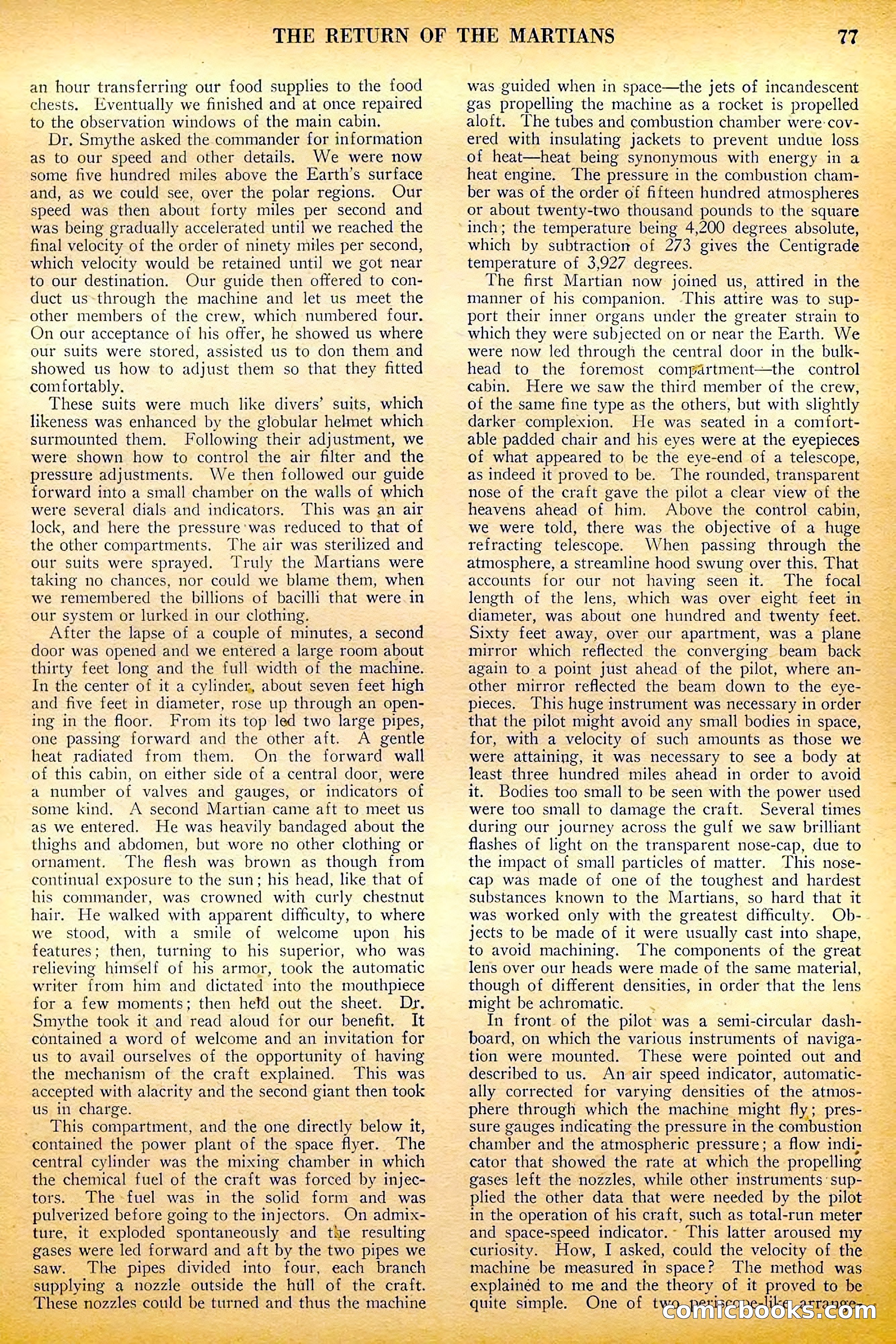
A restored page from Pulp Fiction, 1928. Page through the whole issue in the reader above.
📄 Transcribed text from this page (OCR, searchable)
Machine-transcribed from the original scan — historical spelling and the odd misread are preserved.
== tors. an hour transferring our food supplies to the food chests. Iventually we finished and at once repaired to the observation windows of the main cabin. Dr, Smythe asked the commander for information as to our speed and other details. We were now some five hundred miles above the Earth’s surface and, as we could see, over the polar regions. Our speed was then about forty miles per second and was being gradually accelerated until we reached the final velocity of the order of ninety miles per second, which velocity would be retained until we got near to our destination. Our guide then offered to con- duct us-through the machine and let us meet the other members of the crew, which numbered four. On our acceptance of his offer, he showed us where our suits were stored, assisted us to don them and showed us how to adjust them so that they fitted comfortably. These suits were much like divers’ suits, which likeness was enhanced by the globular helmet which surmounted them. Following their adjustment, we were shown how to control the air filter and the pressure adjustments. We then followed our guide forward into a small chamber on the walls of which were several dials and indicators. This was an air lock, and here the pressure’ was reduced to that of the other compartments. The air was sterilized and our suits were sprayed. Truly the Martians were taking no chances, nor could we blame them, when we remembered the billions of bacilli that were in our system or lurked in our clothing. After the lapse of a couple of minutes, a second door was opened and we entered a large room about thirty feet long and the full width of the machine. In the center of it a cylinder, about seven feet high and five feet in diameter, rose up through an open- ing in the floor. From its top led two large pipes, one passing forward and the other aft. A gentle heat radiated from them. On the forward wall of this cabin, on either side of a central door, were a number of valves and gauges, or indicators of some kind, A second Martian came aft to meet us as we entered. He was heavily bandaged about the thighs and abdomen, but wore no other clothing or ornament. The flesh was brown as though from continual exposure to the sun; his head, like that of his commander, was crowned with curly chestnut hair. He walked with apparent difficulty, to where we stood, with a smile of welcome upon his features; then, turning to his superior, who was relieving himself of his armor, took the automatic writer from him and dictated into the mouthpiece for a few moments; then held out the sheet. Dr. Smythe took it and read aloud for our benefit. It contained a word of welcome and an invitation for us to avail ourselves of the opportunity of having the mechanism of the craft explained. This was accepted with alacrity and the second giant then took us in charge. This compartment, and the one directly below it, contained the power plant of the space flyer. The central cylinder was the mixing chamber in which the chemical fuel of the craft was forced by injec- The -fuel was in the solid form_and was ‘ pulverized before going to the injectors. On admix- ture, it exploded spontaneously and the resulting gases were led forward and aft by the two pipes we . The pipes divided into four, each branch YI lyin a nozzle outside the hull of the craft. uld be tur pet aud: thus the machine aes to me and the theory. of was guided when in space—the jets of incandescent gas propelling the machine as a rocket is propelled aloft. The tubes and combustion chamber were: cov- ered with insulating jackets to prevent undue loss of heat—heat being synonymous with energy in a heat engine. The pressure in the combustion cham- ber was of the order of fifteen hundred atmospheres or about twenty-two thousand pounds to the square temperature of 3,927 degrees. The first Martian now joined us, attired in the manner of his companion. ‘This attire was to sup- port their inner organs under the greater strain to which they were subjected on or near the Earth. We were now led through the central door in the bulk- head to the foremost compartment—the control cabin. Here we saw the third member of the crew, of the same fine type as the others, but with slightly darker complexion. He was seated in a comfort- able padded chair and his eyes were at the eyepieces of what appeared to be the eye-end of a telescope, as indeed it proved to be. The rounded, transparent nose of the craft gave the pilot a clear view of the — heavens ahead of him. Above the control cabin, we were told, there was the objective of a huge refracting telescope. When passing through the atmosphere, a streamline hood swung over this. That accounts for our not having seen it. The focal length of the lens, which was over eight feet in diameter, was about one hundred and twenty feet. Sixty feet away, over our apartment, was a plane mirror which reflected the converging beam back — again to a point just ahead of the pilot, where an- other mirror reflected the beam down to the eye- pieces, that the pilot might avoid any small bodies in space, for, with a velocity of such amounts as those we were attaining, it was necessary to see a body at least three hundred miles ahead in order to avoid it. Bodies too small to be seen with the power used were too small to damage the craft. Several times during our journey across the gulf we saw brilliant This huge instrument was necessary in order wi ™~, ‘inch; the temperature being 4,200 degrees absolute, — which by subtraction of 273 gives the Centigrade — 4 i a" Clee wh * 5 (oh SUM 2 ea ih tp yi fuga? flashes of light on the transparent nose-cap, due to — the impact of small particles of matter. This nose- cap was made of one of the toughest and hardest substances known to the Martians, so hard that it was worked only with the greatest difficulty. jects to be made of it were usually cast into shape, to avoid machining. The components of the great lens over our heads were made of the same material, though of different densities, in onder that the lens might be achromatic. | In front. of the pilot. was a semi-circular dastt board, on which the various instruments of naviga- tion were mounted. These were pointed out and described to us. An-air speed indicator, automatic- ally corrected for varying densities of the atmos- phere through which the machine might i pres- abustion — chamber and the atmospheric pressure; a flow indi- 3 cator that showed the rate at which the propelling — sure gauges indicating the pressure in the con gases left the nozzles, while other instruments sup- plied the other data that were needed by the pilot in the operation of his craft, such as total-run mete and space-speed indicator.- This latter aroused m curiosity. How, I asked, could the velocity of tt machine be measured in space? The metho Ob- -