
Pulp Fiction, 1928 · page 76 of 99
Amazing Stories — page 76: what you’re looking at
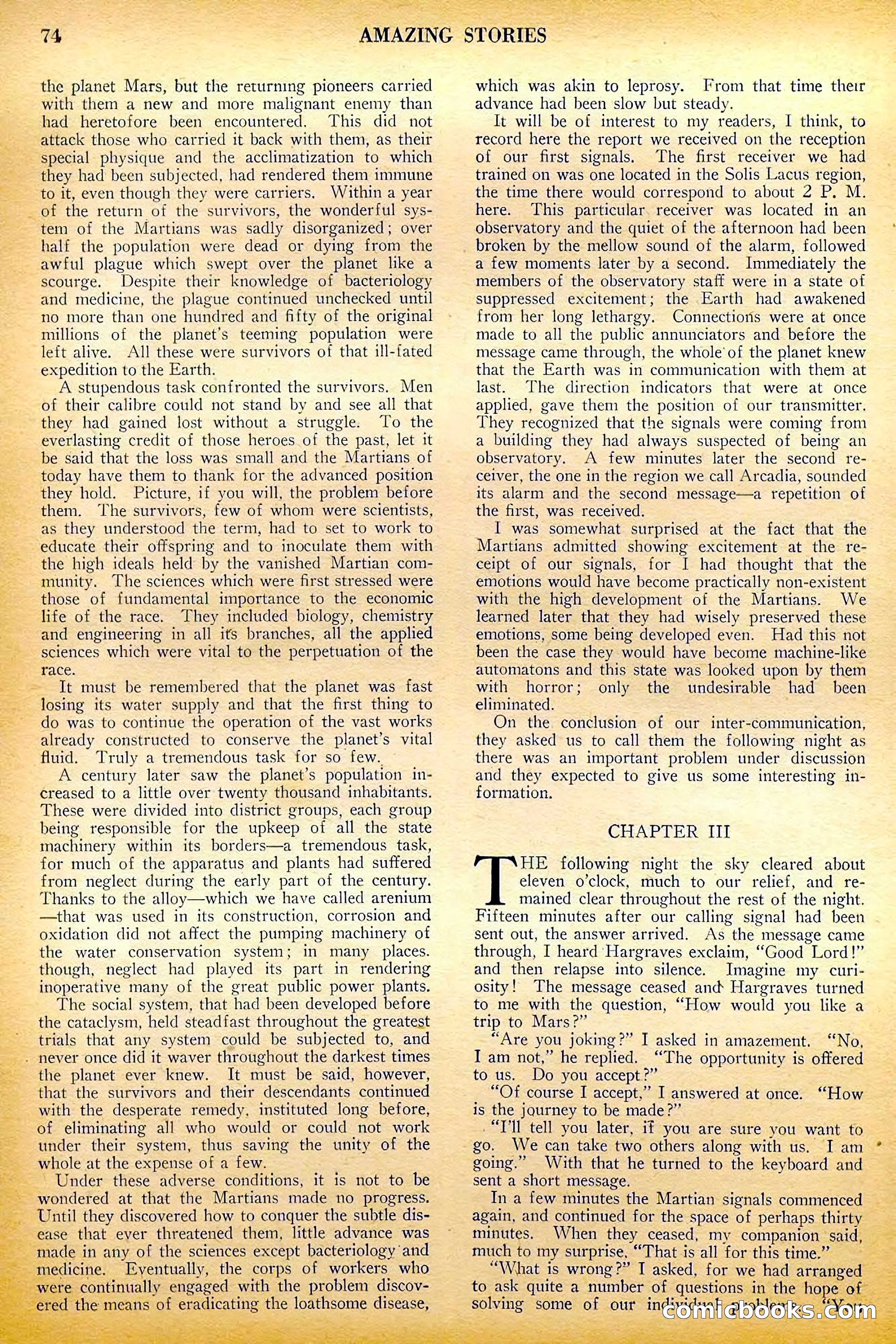
A restored page from Pulp Fiction, 1928. Page through the whole issue in the reader above.
📄 Transcribed text from this page (OCR, searchable)
Machine-transcribed from the original scan — historical spelling and the odd misread are preserved.
en ew the planet Mars, but the returning pioneers carried with them a new and more malignant enemy than had heretofore been encountered. This did not a attack those who carried it back with them, as their special physique and the acclimatization to which they had been subjected, had rendered them immune to it, even though they were carriers. Within a year - _ of the return of the survivors, the wonderful sys- } tem of the Martians was sadly disorganized; over half the population were dead or dying from the awful plague which swept over the planet like a scourge. Despite their knowledge of bacteriology and medicine, the plague continued unchecked until no more than one hundred and fifty of the original millions of the planet’s teeming population were left alive. All these were survivors of that ill-fated expedition to the Earth. A stupendous task confronted the survivors. Men of their calibre could not stand by and see all that they had gained lost without a struggle. To the everlasting credit of those heroes of the past, let it 2 be said that the loss was small and the Martians of today have them to thank for the advanced position they hold. Picture, if you will, the problem before them. The survivors, few of whom were scientists, as they understood the term, had to set to work to educate their offspring and to inoculate them with yi the high ideals held by the vanished Martian com- munity. The sciences which were first stressed were those of fundamental importance to the economic life of the race. They included biology, chemistry and engineering in all its branches, all the applied sciences which were vital to the perpetuation of the race. ~ It must be remembered that the planet was fast losing its water supply and that the first thing to do was to continue the operation of the vast works already constructed to conserve the planet’s vital fluid. Truly a tremendous task for so few. A century later saw the planet’s population in- creased to a little over twenty thousand inhabitants. These were divided into district groups, each group being responsible for the upkeep of all the state machinery within its borders—a tremendous task, for much of the apparatus and plants had suffered from neglect during the early part of the century. Thanks to the alloy—which we have called ar enium —that was used in its construction, corrosion and oxidation did not affect the pumping machinery of the water conservation system; in many places. though, neglect had played its part in rendering inoperative many of the great public power plants. The social system, that had been developed before the cataclysm, held steadfast throughout the greatest trials that any system could be subjected to, and _. never once did it waver throughout the darkest times the planet ever knew. It must be said, however, that the survivors and their descendants continued with the desperate remedy, instituted long before, of eliminating all who would or could not work under their system, thus saving the unity of the whole at the expense of a few. - Under these adverse conditions, it is not to be wondered at that the Martians made no progress. - Until they discovered how to conquer the subtle dis- ease that ever threatened them, little advance was made in any of the sciences except bacteriology and un edicine. Eyentually, the corps of workers who : 1ally engaged with the problem discov- £- loathsome disease, — he P| oad ue cau NO Ay - ee lt ae roe a . Sails cet es Cae Se eer Z a ae “AMAZING STORIES which was akin to leprosy. From that time their advance had been slow but steady. It will be of interest to my readers, I think, to record here the report we received on the reception of our first signals. The first receiver we had trained on was one located in the Solis Lacus region, the time there would correspond to about 2 P. M. here. This particular receiver was located in an observatory and the quiet of the afternoon had been _ broken by the mellow sound of the alarm, followed a few moments later by a second. Immediately the members of the observatory staff were in a state of suppressed excitement; the Earth had awakened from her long lethargy. Connectioris were at once made to all the public annunciators and before the message came through, the whole’ of the planet knew that the Earth was in communication with them at last. The direction indicators that were at once applied, gave them the position of our transmitter. They recognized that the signals were coming from a building they had always suspected of being an observatory. A few minutes later the second re- ceiver, the one in the region we call Arcadia, sounded its alarm and the second message—a repetition of the first, was received. I was somewhat surprised at the fact that the Martians admitted showing excitement at the re- ceipt of our signals, for I had thought that the emotions would have become practically non-existent with the high development of the Martians. We learned later that they had wisely preserved these emotions, some being developed even. Had this not been the case they would have become machine-like automatons and this state was looked upon by them with horror; only the undesirable had been eliminated. On the conclusion of our inter-communication, they asked us to call them the following night as there was an important problem under “discussion and they expected to give us some interesting in- formation. CHAPTER III HE following night the sky cleared about eleven o’clock, much to our relief, and re- mained clear throughout the rest of the night. Fifteen minutes after our calling signal had been sent out, the answer arrived. As the message came through, I heard Hargraves exclaim, “Good Lord!” and then relapse into silence. Imagine my curi- osity! The message ceased anc Hargraves turned to me with the question, “How would you like a trip to Mars?” “Are you joking?” I asked in amazement. “No, I am not,” he replied. “The opportunity is offered to us. Do you accept?” “Of course I accept,” I answered at once. “How is the jqurney to be made?” “T'll tell you later, if you are sure you want to go. We can take two others along with us. I am going.” With that he turned to the keyboard and sent a short message. _ In a few minutes the Martian signals commenced 4 again, and continued for the space of perhaps thirty — minutes. When they ceased, my companion said, to ask quite a ‘number of question ae some NDE our weomi much to my surprise, “That is all for this time.” ‘What is wrong?” I asked, for we pete arranged —