
Pulp Fiction, 1928 · page 74 of 99
Amazing Stories — page 74: what you’re looking at
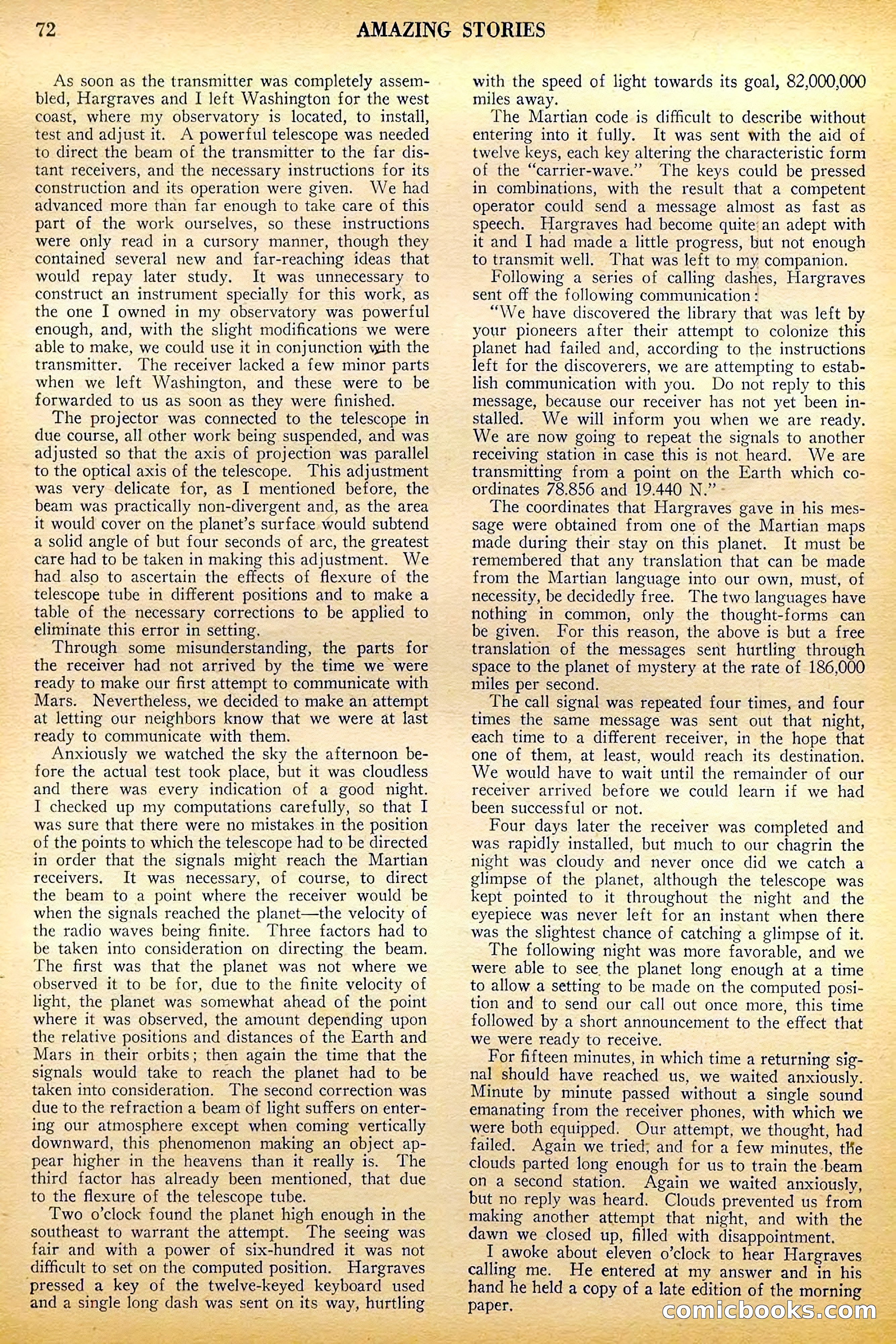
A restored page from Pulp Fiction, 1928. Page through the whole issue in the reader above.
📄 Transcribed text from this page (OCR, searchable)
Machine-transcribed from the original scan — historical spelling and the odd misread are preserved.
72 AMAZING STORIES As soon as the transmitter was completely assem- bled, Hargraves and I left Washington for the west coast, where my observatory is located, to install, test and adjust it. A powerful telescope was needed to direct the beam of the transmitter to the far dis- tant receivers, and the necessary instructions for its construction and its operation were given. We had advanced more than far enough to take care of this part of the work ourselves, so these instructions were only read in a cursory manner, though they contained several new and far-reaching ideas that would repay later study. It was unnecessary to construct an instrument specially for this work, as the one I owned in my observatory was powerful enough, and, with the slight modifications we were able to make, we could use it in conjunction with the transmitter. The receiver lacked a few minor parts when we left Washington, and these were to be forwarded to us as soon as they were finished. The projector was connected to the telescope in due course, all other work being suspended, and was adjusted so that the axis of projection was parallel to the optical axis of the telescope. This adjustment was very delicate for, as I mentioned before, the beam was practically non-divergent and, as the area it would cover on the planet’s surface would subtend a solid angle of but four seconds of arc, the greatest care had to be taken in making this adjustment. We had also to ascertain the effects of flexure of the telescope tube in different positions and to make a table of the necessary corrections to be applied to eliminate this error in setting, Through some misunderstanding, the parts for the receiver had not arrived by the time we were ready to make our first attempt to communicate with Mars. Nevertheless, we decided to make an attempt at letting our neighbors know that we were at last ready to communicate with them. Anxiously we watched the sky the afternoon be- fore the actual test took place, but it was cloudless and there was every indication of a good night. I checked up my computations carefully, so that I was sure that there were no mistakes in the position of the points to which the telescope had to be directed in order that the signals might reach the Martian receivers. It was necessary, of course, to direct the beam to a point where the receiver would be when the signals reached the planet—the velocity of the radio waves being finite. Three factors had to be taken into consideration on directing the beam. The first was that the planet was not where we observed it to be for, due to the finite velocity of light, the planet was somewhat ahead of the point where it was observed, the amount depending upon the relative positions and distances of the Earth and Mars in their orbits; then again the time that the signals would take to reach the planet had to be taken into consideration. The second correction was due to the refraction a beam of light suffers on enter- ing our atmosphere except when coming vertically downward, this phenomenon making an object ap- pear higher in the heavens than it really is. The third factor has already been mentioned, that due to the flexure of the telescope tube. Two o’clock found the planet high enough in the southeast to warrant the attempt. The seeing was fair and with a power of six-hundred it was not difficult to set on the computed position. Hargraves ‘pressed a key of the twelve-keyed keyboard used and a single long dash was sent on its way, hurtling : ete RE ners ra eg - sn ng ne ae pet : nr De ah, ga -~) nd "il Ve PO Ae A Pe ee, Ve . = : A a2 we 7 with the speed of light towards its goal, 82,000,000 miles away. The Martian code is difficult to describe without entering into it fully. It was sent with the aid of twelve keys, each key altering the characteristic form of the “carrier-wave.” The keys could be pressed in combinations, with the result that a competent operator could send a message almost as fast as speech. Hargraves had become quite‘an adept with it and I had made a little progress, but not enough to transmit well. That was left to my companion. Following a series of calling dashes, Hargraves sent off the following communication : “We have discovered the library that was left by your pioneers after their attempt to colonize this planet had failed and, according to the instructions left for the discoverers, we are attempting to estab- lish communication with you. Do not reply to this message, because our receiver has not yet been in- stalled. We will inform you when we are ready. We are now going to repeat the signals to another receiving station in case this is not. heard. We are transmitting from a point on the Earth which co- ordinates 78.856 and 19.440 N.” - The coordinates that Hargraves gave in his mes- sage were obtained from one of the Martian maps made during their stay on this planet. It must be remembered that any translation that can be made from the Martian language into our own, must, of necessity, be decidedly free. The two languages have nothing in common, only the thought-forms can be given. For this reason, the above is but a free translation of the messages sent hurtling through space to the planet of mystery at the rate of 186,000 miles per second. The call signal was repeated four times, and four times the same message was sent out that night, each time to a different receiver, in the hope that one of them, at least, would reach its destination. We would have to wait until the remainder of our receiver arrived before we could learn if we had been successful or not. Four days later the receiver was completed and was rapidly installed, but much to our chagrin the night was cloudy and never once did we catch a glimpse of the planet, although the telescope was kept pointed to it throughout the night and the eyepiece was never left for an instant when there was the slightest chance of catching a glimpse of it. The following night was more favorable, and we were able to see. the planet long enough at a time to allow a setting to be made on the computed posi- tion and to send our call out once more, this time followed by a short announcement to the effect that we were ready to receive. For fifteen minutes, in which time a returning sig- nal should have reached us, we waited anxiously. Minute by minute passed without a single sound emanating from the receiver phones, with which we were both equipped. Our attempt, we thought, had failed. Again we tried; and for a few minutes, tHe clouds parted long enough for us to train the beam on a second station. Again we waited anxiously, but no reply was heard. Clouds prevented us from making another attempt that night, and with the dawn we closed up, filled with disappointment. I awoke about eleven o’clock to hear Hargraves ras calling me. He entered at my answer and in his hand he held a copy of a late edition of the mornin = comicbook: