
Pulp Fiction, 1928 · page 7 of 99
Amazing Stories — page 7: what you’re looking at
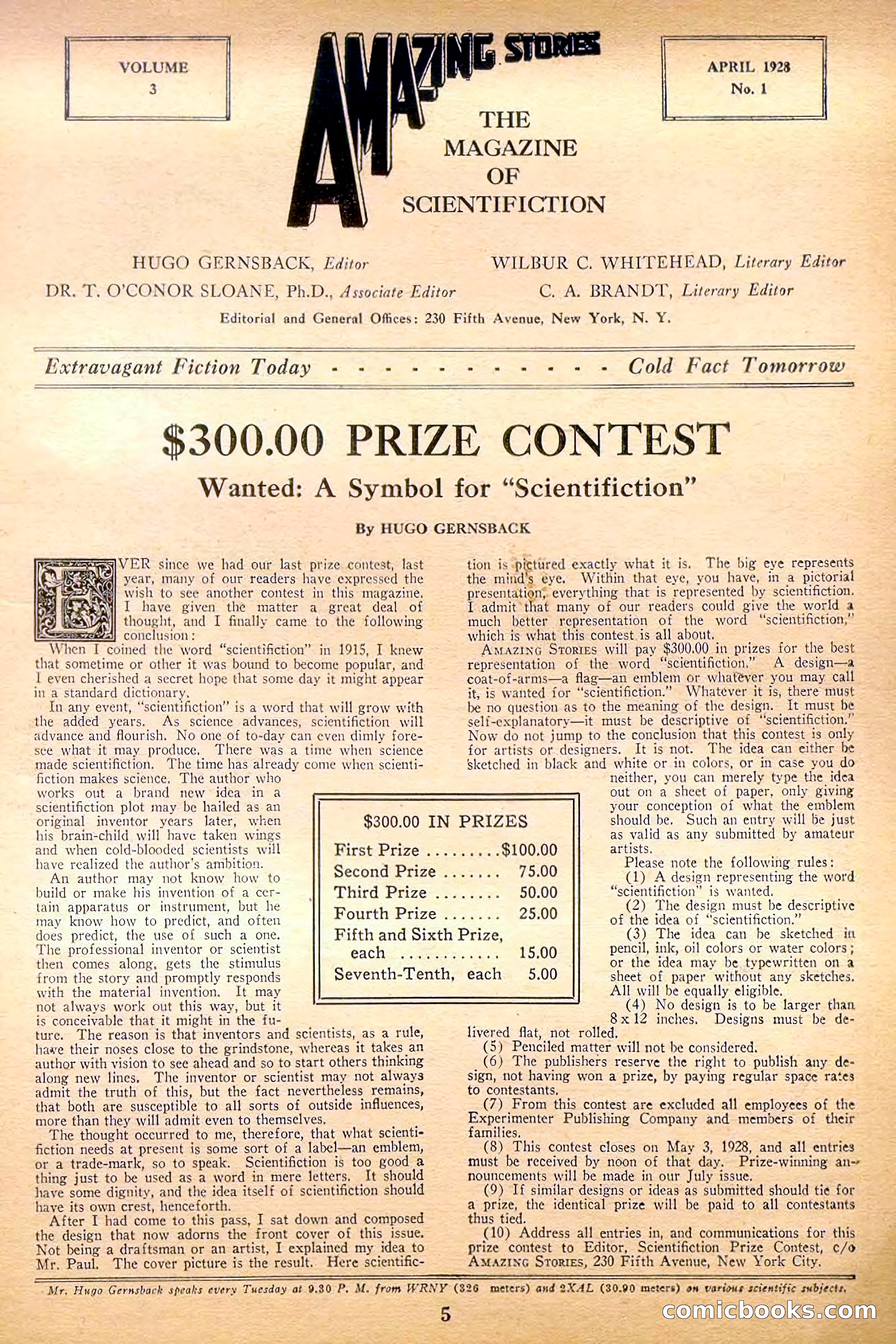
A restored page from Pulp Fiction, 1928. Page through the whole issue in the reader above.
📄 Transcribed text from this page (OCR, searchable)
Machine-transcribed from the original scan — historical spelling and the odd misread are preserved.
~oee * BD HUGO GERNSBACK, Editor = je ss etn age ~~! nga a baal ee —— THE MAGAZINE DR. T. O';CONOR SLOANE, Ph.D., Associate Editor Editorial and General Offices: 230 Fifth Avenue, New York, N. Y. OF SCIENTIFICTION WILBUR C. WHITEHEAD, Literary Editor C. A. BRANDT, Literary Editor Extravagant Fiction Today - - - - - + = = Cold Fact Tomorrow $300.00 PRIZE CONTEST Wanted: A Symbol for “Scientifiction” By HUGO GERNSBACK nt ee VER since we had our last prize contest, last year, many of our readers have expressed the wish to see another contest in this magazine, I have given the matter a great deal of thought, and I finally came to the following pesterees| colclusion: When I coined the word “scientifiction” in 1915, I knew that sometime or other it was bound to become popular, and l even cherished a secret hope that some day it might appear in a standard dictionary, In any event, “scientifiction” is a word that will grow with the added years. As science advances, scientifiction will advance and flourish. No one of to-day can even dimly fore- see what it may produce, There was a time when science made scientifiction. The time has already come when scienti- fiction makes science, The author who works out a brand new idea in a scientifiction plot may be hailed as an original inventor years later, when his brain-child will have taken wings and when cold-blooded scientists will have realized the author's ambition. An author may not know how to build or make his invention of a cer- tain apparatus or instrument, but he may know how to predict, and often does predict, the use of such a one. The professional inventor or scientist then comes along, gets the stimulus from the story and promptly responds with the material invention. It may not always work out this way, but it is conceivable that it might in the fu- ture. The reason is that inventors and scientists, as a rule, hawe their noses close to the grindstone, whereas it takes an author with vision to see ahead and so to start others thinking along new lines, The inventor or scientist may not always admit the truth of this, but the fact nevertheless remains, that both are susceptible to all sorts of outside influences, more than they will admit even to themselves. sos The thought occurred to me, therefore, that what scienti- fiction needs at present is some sort of a label—an emblem, or a trade-mark, so to speak. Scientifiction is too good a thing just to be used as a word in mere letters, It should have some dignity, and the idea itself of scientifiction should have its own crest, henceforth. After I had come to this pass, J sat down and composed the design that now adorns the front cover of this issue. Not being a draftsman or an artist, I explained my idea to Mr. Paul. The cover picture is the result. Here scientific- c First Prize Third Prize each Mr. Hugo Gernsback speaks every Tuesday at 9.80 P, M. from WRNY (826 meters) and 2XAL (30.90 meters) om various scientific subject Fourth Prize $300.00 IN PRIZES Second Prize ....,.. Fifth and Sixth Prize, Seventh-Tenth, each tion is -picttred exactly what it is. The big eye represents the mind's éye. Within that eye, you have, in a pictorial presentations everything that is represented by scientifiction. I admit that many of our readers could give the world a much better representation of the word “scientifiction,” which is what this contest is all about. Amazing Storres will pay $300.00 in prizes for the best representation of the word “scientifiction,” A design—a coat-of-arms—a flag—an emblem or whatéver you may call it, is wanted for “‘scientifiction.” Whatever it is, there must be no question as to the meaning of the design. It must be self-explanatory—it must be descriptive of “scientifiction.” Now do not jump to the conclusion that this contest is only for artists or designers. It is not. The idea can either be sketched in black and white or in colors, or in case you do neither, you can merely type the idea out on a sheet of paper, only giving your conception of what the emblem should be. Such an entry will be just as valid as any submitted by amateur artists. Please note the following rules: (1) A design representing the word “scientifiction” is wanted, (2) The design must be descriptive of the idea of “scientifiction.” (3) The idea can be sketched in pencil, ink, oil colors or water colors; or the idea may be typewritten on a sheet of paper without any sketches. All will be equally eligible. (4) No design is to be larger than : 8x12 inches. Designs must be de- livered flat, not rolled, (5) Penciled matter will not be considered. (6) The publishers reserve the right to publish any de- sign, not having won a prize, by paying regular space rates to contestants, (7) From this contest are excluded all employees of the Experimenter Publishing Company and members of their families. (8) This contest closes on May 3, 1928, and all entries — must be received by noon of that day. Prize-winning an- nouncements will be made in our July issue. c (9) If similar designs or ideas as submitted should tie for a prize, the identical prize will be paid to all contestants thus tied. (10) Address all entries in, and communications for this prize contest to Editor, Scientifiction Prize Contest, c/o _ AmazinG Stortes, 230 Fifth Avenue, New York City. 3 . +». -$100,00 75.00 5.00 comicbooks:«