
Pulp Fiction, 1928 · page 62 of 99
Amazing Stories — page 62: what you’re looking at
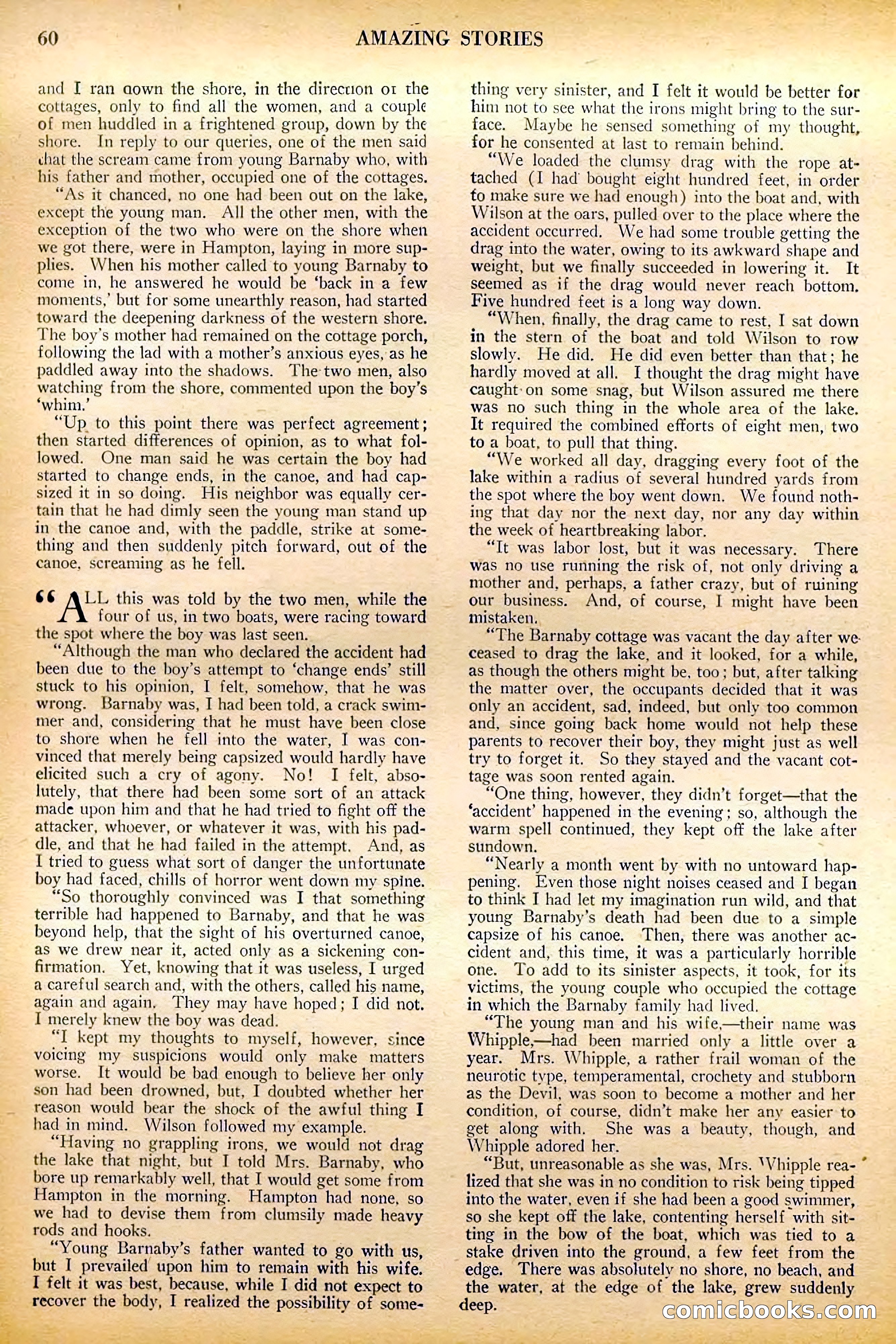
A restored page from Pulp Fiction, 1928. Page through the whole issue in the reader above.
📄 Transcribed text from this page (OCR, searchable)
Machine-transcribed from the original scan — historical spelling and the odd misread are preserved.
60 AMAZING STORIES and [ ran aown the shore, in the direction ot the cottages, only to find all the women, and a couple of men huddled in a frightened group, down by the shore. In reply to our queries, one of the men said chat the scream came from young Barnaby who, with his father and mother, occupied one of the cottages. “As it chanced, no one had been out on the lake, except the young man. All the other men, with the exception of the two who were on the shore when we got there, were in Hampton, laying in more sup- plies. When his mother called to young Barnaby to come in, he answered he would be ‘back in a few moments,’ but for some unearthly reason, had started toward the deepening darkness of the western shore. The boy’s mother had remained on the cottage porch, following the lad with a mother’s anxious eyes, as he paddled away into the shadows. The-two men, also watching from the shore, commented upon the boy’s ‘whim,’ “Up to this point there was perfect agreement; then started differences of opinion, as to what fol- lowed. One man said he was certain the boy had started to change ends, in the canoe, and had cap- sized it in so doing. His neighbor was equally cer- tain that he had dimly seen the young man stand up in the canoe and, with the paddle, strike at some- thing and then suddenly pitch forward, out of the canoe, screaming as he fell. ce ALE this was told by the two men, while the four of us, in two boats, were racing toward the spot where the boy was last seen. “Although the man who declared the accident had been due to the boy’s attempt to ‘change ends’ still stuck to his opinion, I felt, somehow, that he was wrong. Barnaby was, I had been told, a crack swim- mer and, considering that he must have been close to shore when he fell into the water, I was con- vinced that merely being capsized would hardly have elicited such a cry of agony. No! I felt, abso- lutely, that there had been some sort of an attack made upon him and that he had tried to fight off the attacker, whoever, or whatever it was, with his pad- dle, and that he had failed in the attempt. And, as I tried to guess what sort of danger the unfortunate boy had faced, chills of horror went down my spine. “So thoroughly convinced was I that something terrible had happened to Barnaby, and that he was beyond help, that the sight of his overturned canoe, as we drew near it, acted only as a sickening con- firmation. Yet, knowing that it was useless, I urged a careful search and, with the others, called his name, again and again, They may have hoped; I did not. I merely knew the boy was dead. “I kept my thoughts to myself, however, since voicing my suspicions would only make matters worse. It would be bad enough to believe her only son had been drowned, but, I doubted whether her reason would bear the shock of the awful thing I had in mind. Wilson followed my example. “Having no grappling irons, we would not drag the lake that night, but I told Mrs. Barnaby, who bore up remarkably well, that I would get some from Hampton in the morning. Hampton had none, so we had to devise them from clumsily made heavy rods and hooks. “Young Barnaby’s father wanted to go with us, but I prevailed upon him to remain with his wife. I felt it was best, because, while I did not expect to _ recover the body, I realized the possibility of some- *_* 2 += ss a a = | thing very sinister, and I felt it would be better for him not to see what the irons might bring to the sur- face. Maybe he sensed something of my thought, for he consented at last to remain behind. “We loaded the clumsy drag with the rope at- tached (I had’ bought eight hundred feet, in order to make sure we had enough) into the boat and, with Wilson at the oars, pulled over to the place where the accident occurred, We had some trouble getting the drag into the water, owing to its awkward shape and weight, but we finally succeeded in lowering it. It seemed as if the drag would never reach bottom. Five hundred feet is a long way down. “When, finally, the drag came to rest, I sat down in the stern of the boat and told Wilson to row slowly. He did. He did even better than that: he hardly moved at all. I thought the drag might have caught: on some snag, but Wilson assured me there was no such thing in the whole area of the lake, It required the combined efforts of eight men, two to a boat, to pull that thing. “We worked all day, dragging every foot of the lake within a radius of several hundred yards from the spot where the boy went down, We found noth- ing that day nor the next day, nor any day within the week of heartbreaking labor. “Tt was labor lost, but it was necessary. There was no use running the risk of, not only driving a mother and, perhaps, a father crazy, but of ruining our business. And, of course, I might have been mistaken, “The Barnaby cottage was vacant the day after we. ceased to drag the lake, and it looked, for a while, as though the others might be, too; but, after talking the matter over, the occupants decided that it was only an accident, sad, indeed, but only too common and, since going back home would not help these parents to recover their boy, they might just as well try to forget it. So they stayed and the vacant cot- tage was soon rented again. “One thing, however, they didn’t forget—that the ‘accident’ happened in the evening; so, although the warm spell continued, they kept off the lake after sundown. “Nearly a month went by with no untoward hap- pening. Even those night noises ceased and I began to think I had let my imagination run wild, and that young Barnaby’s death had been due to a simple capsize of his canoe. Then, there was another ac- cident and, this time, it was a particularly horrible one. To add to its sinister aspects, it took, for its victims, the young couple who occupied the cottage in which the Barnaby family had lived. “The young man and his wife—their name was Whipple—had been married only a little over a year. Mrs. Whipple, a rather frail woman of the neurotic type, temperamental, crochety and stubborn as the Devil, was soon to become a mother and her condition, of course, didn’t make her any easier to get along with. She was a beauty, though, and Whipple adored her. “But, unreasonable as she was, Mrs. ‘Vhipple rea- ” lized that she was in no condition to risk being tipped into the water, even if she had been a good swimmer, so she kept off the lake, contenting herself with sit- ting in the bow of the boat, which was tied to a stake driven into the ground, a few feet from the edge. There was absolutely no shore, no beach, and the water, at the edge of the lake, grew suddenly deep. Fs — 2 .- - = ee — ~~ - Tg My a — ee - eT te ees SR ae Pe fe re ee a ae a? —s ep PO hana COMMEMOOKS.COM =